Emergency Economic Ministers' Meeting and Export Investment Measures Meeting on the 17th
Regulatory Innovation Plans for Corporate Export and Investment Sites
The areas where drones can fly in Sejong and downtown Daejeon will be expanded, and the installation process of hydrogen charging stations near railway sites will be facilitated. The establishment of a bio-cluster industrial complex will be actively promoted in the Osong area of Chungcheongbuk-do. Companion animals will also be allowed in restaurants.
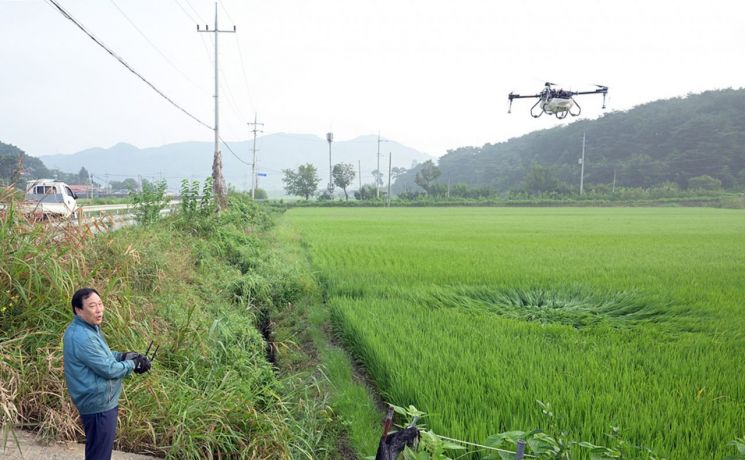
On the 17th, the government held an emergency economic ministers' meeting combined with an export and investment countermeasure meeting and prepared a regulatory innovation plan for corporate export and investment sites based on these contents. Amid signs of economic recovery, the aim is to quickly identify and resolve difficulties faced by companies in export and investment sites so that shadow regulations do not undermine policy effectiveness.
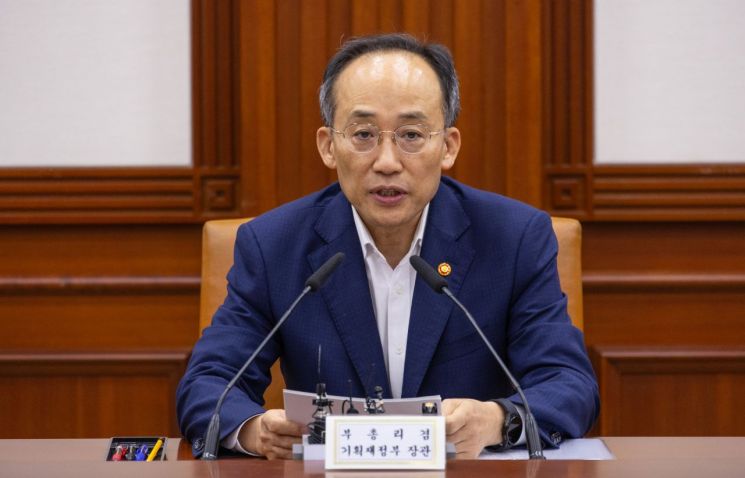 Deputy Prime Minister and Minister of Economy and Finance Choo Kyung-ho is speaking about the recent economic situation at the Emergency Economic Ministers' Meeting and Export Investment Measures Meeting held at the Government Seoul Office in Jongno-gu, Seoul, on the morning of the 17th.
 [Photo by Yonhap News]
"Seven major projects waiting on site... Resolving difficulties expected to generate 7.2 trillion KRW in private investment effects"
In particular, the government identified seven investment projects waiting on site that are blocking corporate activities and decided to ease regulations to ensure smooth implementation of these projects. These projects are waiting on site because, despite corporate investment demand, disagreements between agencies or regulations have prevented execution. The government expects that resolving the difficulties of these seven projects, identified by the Economic Regulatory Innovation TF, will generate over 7.2 trillion KRW in private investment effects.
The government will first expand drone flight zones in Sejong and downtown Daejeon. After the 9/11 terrorist attacks in the U.S., areas around nuclear power plants were designated as drone no-fly zones, but the zones were extensive (a radius of 19 km), restricting the private drone development industry. Accordingly, considering the low output of nuclear power plants, the government plans to adjust the no-fly zone around the Korea Atomic Energy Research Institute in Daejeon to a level comparable to advanced aviation countries (around 5 km). The government expects that lifting this regulation will create an investment effect of 4 billion KRW.
Clear safety standards will also be established for installing hydrogen charging stations near railway sites. Currently, safety evaluation criteria for installing hydrogen charging facilities within 30 meters of railways are unclear, causing difficulties in hydrogen charging projects utilizing railway sites. The government plans to develop separate safety standards applicable to sites near railways to promote investment in hydrogen charging facilities. Once these standards are established, investment in hydrogen charging facilities near railway sites such as Busan is expected to proceed smoothly, generating an effect of 50 billion KRW.
A new bio convergence industrial complex will be established in the Osong area of Chungcheongbuk-do. The government had planned to create the 3rd National Life Science Industrial Complex centered on Osong, Chungbuk, but faced difficulties among related ministries due to farmland included in the site. After discussions, on the 7th, the government finalized the project area of 1.25 million pyeong and district plans through an integrated coordination meeting with related agencies. This means that after approval of the national industrial complex plan, the new bio convergence industrial complex project can be actively promoted. The complex plans to attract biomedical campus towns and bio-pharmaceutical companies, with the government expecting investments exceeding 4 trillion KRW.
Improvement of industrial complex location regulations including allowing insect producers to move in... Companion animals allowed in cafes
Regulations on industrial complex locations will also be improved. Insect producers, who were previously unable to move into industrial complexes, will now be allowed to do so. Unlike insect processing and distribution businesses, insect production is classified as livestock farming and thus could not enter industrial complexes, causing inefficiencies in the insect industry. Going forward, insect production will be considered an ancillary facility and allowed to move into industrial complexes.
The scope of private contracts for supplying general industrial complex sites will also be expanded. Currently, only metropolitan local governments authorized to designate general industrial complexes and basic local governments with populations over 500,000 can supply industrial complex sites through private contracts to companies with occupancy agreements. In the future, if a basic local government is the project implementer of an industrial complex, private contracts for site supply will also be allowed for companies with occupancy agreements with that basic local government. Additionally, the government selected the following as regulatory innovation tasks for investment projects waiting on site: ▲ application of special testing exemptions related to liquefied hydrogen plants and ship production ▲ expansion of greenhouse gas emission reduction target industries when using biomass.
Regulatory innovation to support corporate activities will also be promoted. Companion animals will be allowed in cafes and other restaurants. Under the current Food Sanitation Act, food service establishments must separate areas accessible to animals, making it difficult to accompany companion animals. Accordingly, the government plans to review expanding regulatory sandbox pilot projects within this year and prepare guidelines or pursue legal amendments for companion animal accompaniment by the second quarter of next year.
© The Asia Business Daily(www.asiae.co.kr). All rights reserved.
![Clutching a Stolen Dior Bag, Saying "I Hate Being Poor but Real"... The Grotesque Con of a "Human Knockoff" [Slate]](https://cwcontent.asiae.co.kr/asiaresize/183/2026021902243444107_1771435474.jpg)
















