Asian Factory-Based Companies Face Rising Labor Cost Pressure
WSJ "Western Countries' Benefit from Low-Cost Products Likely to End"
As labor costs and ancillary expenses rise due to young workers in Asian regions such as China and Vietnam avoiding factory jobs, an analysis suggests that the era of ultra-low-cost products enjoyed by major developed countries over the past several decades is coming to an end.
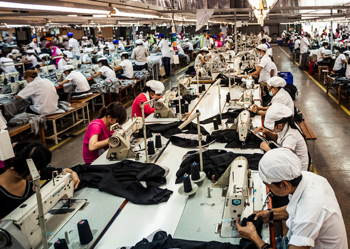
On the 7th (local time), The Wall Street Journal (WSJ) reported that companies with production bases in Asia are struggling to attract young workers.
Languagewearable, a clothing company with a factory in Ho Chi Minh City, Vietnam, recently opened an in-house cafe and started offering free yoga and dance classes for employees. Workers gather once a month for team-building events where they drink beer and enjoy activities like go-karting or bowling. This is to retain young workers who prefer glamorous shopping malls and hotel jobs over working in harsh factory environments. Asian youths, who have received more education than their parents and tend to have fewer children, increasingly prioritize quality of life and are thus avoiding factory work.
Paul Norris, founder of Languagewearable, said, "Traditional labor force in the apparel industry, workers in their 20s, frequently quit while undergoing company training programs," adding, "Everyone wants to become an Instagrammer, photographer, stylist, or work in a cafe."
This phenomenon is intensifying in China, once known as the "world's factory." Although Chinese factories complain of labor shortages, the urban youth unemployment rate reached 21% in June. More young people are choosing to stay unemployed rather than work in factories.
As a result, wages for factory workers in Asia are also rising. Global toy manufacturer Hasbro raised wages this year due to labor shortages in Vietnam and China, and Mattel, famous for Barbie dolls, is also struggling with rising labor costs. Both companies ultimately increased their product prices. Sportswear company Nike also announced product price hikes in June due to rising labor costs.
The trend of rising labor costs is confirmed by United Nations statistics. According to the International Labour Organization (ILO) under the UN, wages for factory workers in Vietnam currently stand at $320 per month, double that of 2011, which is three times the wage growth rate in the United States. In China, factory worker wages rose by 122% from 2012 to 2021.
The WSJ pointed out that it is difficult for companies to turn to cheaper labor in Africa or South Asia instead of Southeast Asia. There is a shortage of skilled workers, and political instability in regions like Africa poses significant risks to companies.
Accordingly, there is a growing outlook that consumers in major developed countries will find it increasingly difficult to benefit from ultra-low-cost products based on cheap Asian labor. In the 1990s, Asia, led by China, emerged as a global manufacturing hub, driving down prices of consumer goods worldwide, but going forward, consumers are likely to pay higher costs when purchasing products.
The WSJ reported, "Factories in Asia are striving to attract young workers," adding, "Americans accustomed to cheap fashion and flat-screen TVs should now expect higher costs. The era of ultra-low-cost products is under threat."
© The Asia Business Daily(www.asiae.co.kr). All rights reserved.
![Clutching a Stolen Dior Bag, Saying "I Hate Being Poor but Real"... The Grotesque Con of a "Human Knockoff" [Slate]](https://cwcontent.asiae.co.kr/asiaresize/183/2026021902243444107_1771435474.jpg)















