Food Industry Q2 Performance Diverges by Company
Overseas Market Results Expected to Determine This Year's Performance
This year, the performance of the food industry is expected to be determined by its overseas market results. With domestic consumption capacity declining and the government exerting pressure to lower prices, causing companies to lose some control over pricing, the industry must compensate for the shortfall in domestic sales through overseas markets.

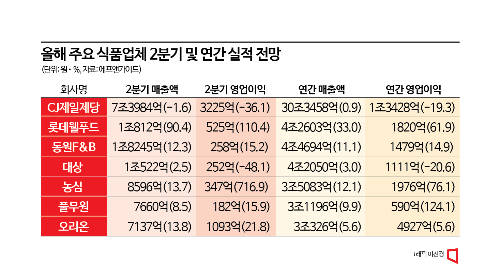
According to financial information firm FnGuide on the 18th, the second-quarter performance of domestic food companies is expected to vary by company. Companies that raised product prices or increased their overseas sales ratio in response to rising international grain prices, logistics costs, and labor expenses in the first quarter succeeded in capturing overseas markets and posted strong results, while those that froze prices recorded poor performance. A similar trend is expected to continue in the second quarter.
Orion's operating profit for the second quarter is estimated at 109.3 billion KRW, a 21.8% increase compared to the same period last year, with sales reaching 713.7 billion KRW, up 13.8%. Companies such as Lotte Wellfood, Dongwon F&B, Nongshim, and Pulmuone are also expected to record not only sales growth but double-digit operating profit increases. However, CJ CheilJedang and Daesang, which are experiencing sluggishness in their raw materials divisions, are expected to see operating profits decline by 36.1% and 48.1%, respectively, during the same period.
Accordingly, the food industry's second-half performance also appears to hinge on overseas markets. The domestic market clearly shows limitations in external growth due to economic downturn and inflation burdens weakening consumer spending power. Generally, food companies consider price increases and cost relief from raw material price drops as key factors for margin improvement. However, following Deputy Prime Minister and Minister of Economy and Finance Choo Kyung-ho's recommendation to lower ramen prices last month, the food industry, including flour, confectionery, and bakery sectors, has consecutively reduced prices. From the food companies' perspective, government pressure to lower prices has impaired their pricing power, temporarily damaging one pillar of domestic business margin improvement.
On the other hand, overseas markets are largely unaffected by domestic price adjustment issues and, since K-Food is classified as a discretionary rather than essential food, it is relatively free from price pressure. Moreover, growing overall interest in K-Food is steadily expanding both its potential and importance as a new sales channel. Sanghoon Cho, a researcher at Shinhan Investment Corp., explained, "Offsetting domestic performance declines with overseas markets is key to future food industry results. Unlike domestically, overseas food demand is steadily increasing, periodic price increases are possible, and competition is relatively less intense."
As expanding overseas business becomes a necessity rather than a choice, food companies are expected to continuously strengthen their efforts in overseas markets. Currently, Korean cuisine and processed foods have a relatively reasonable price with a premium and well-being image, and companies are likely to focus on this aspect. For example, CJ CheilJedang’s ‘Bibigo Dumplings’ and Pulmuone’s ‘Yalpi Dumplings’ differentiate themselves by emphasizing a healthy taste and image, highlighting the thin skin filled harmoniously with meat and vegetables, unlike Chinese or Japanese dumplings.
Additionally, the growing demand for ‘cost-effective’ food overseas is expected to be an important factor for some companies in strengthening their position in foreign markets. Inflation burdens are not limited to Korea. Ramen, symbolizing cost-effective food, is a representative example. Recently, Nongshim’s Chairman Shin Dong-won announced a goal to triple sales in the U.S. market by 2030 and become the market leader there.
Meanwhile, the negative impact of government price reduction pressure on the food industry’s second-half performance is expected to be limited. Sangjun Park, a researcher at Kiwoom Securities, said, "The average selling price decline due to price cuts is relatively small, around 1%, and compared to the past, the proportion of overseas performance has increased, while raw material input costs, centered on corn, wheat, and palm oil, are stabilizing."
© The Asia Business Daily(www.asiae.co.kr). All rights reserved.
![Clutching a Stolen Dior Bag, Saying "I Hate Being Poor but Real"... The Grotesque Con of a "Human Knockoff" [Slate]](https://cwcontent.asiae.co.kr/asiaresize/183/2026021902243444107_1771435474.jpg)
















