Surge in Launches of Large and Premium TVs
LG Electronics' 80 Million KRW 'Gold-Plated PDP TV' Opened Market in 2004
Intense Competition in Billion-KRW TVs Since 2013
Samsung Electronics and LG Electronics are consecutively launching ultra-high-end new TV models priced over 40 million KRW. As global economic downturns have led to sluggish TV demand, the companies seem to be aiming to recover profitability through large-sized, premium products. Although both companies remain tight-lipped about the exact sales figures of these ultra-high-end TVs, they say purchases are being made among 'super rich' (ultra-high-net-worth individuals) who desire luxury TVs. These products also carry symbolic significance in showcasing the companies' technological capabilities, attracting interest not only from consumers but also from industry insiders.
On the 14th, Samsung Electronics and LG Electronics each released their new models in Korea: the 98-inch Neo QLED 8K (QNC990) and the wireless OLED (organic light-emitting diode) TV, 'LG Signature OLED M,' respectively. Given their extra-large sizes, the prices are also ultra-high-end. Samsung’s new product has a retail price of 49.9 million KRW, which is over 5 million KRW higher than the 45 million KRW price of the 4K model from the same line released last year. LG Electronics’ new product is priced at 43.9 million KRW domestically. These products are more expensive than most cars.
There is no separate market concept specifically called 'ultra-high-end TV.' However, ultra-high-end TVs have established themselves as a new growth engine driving the stagnant TV market.
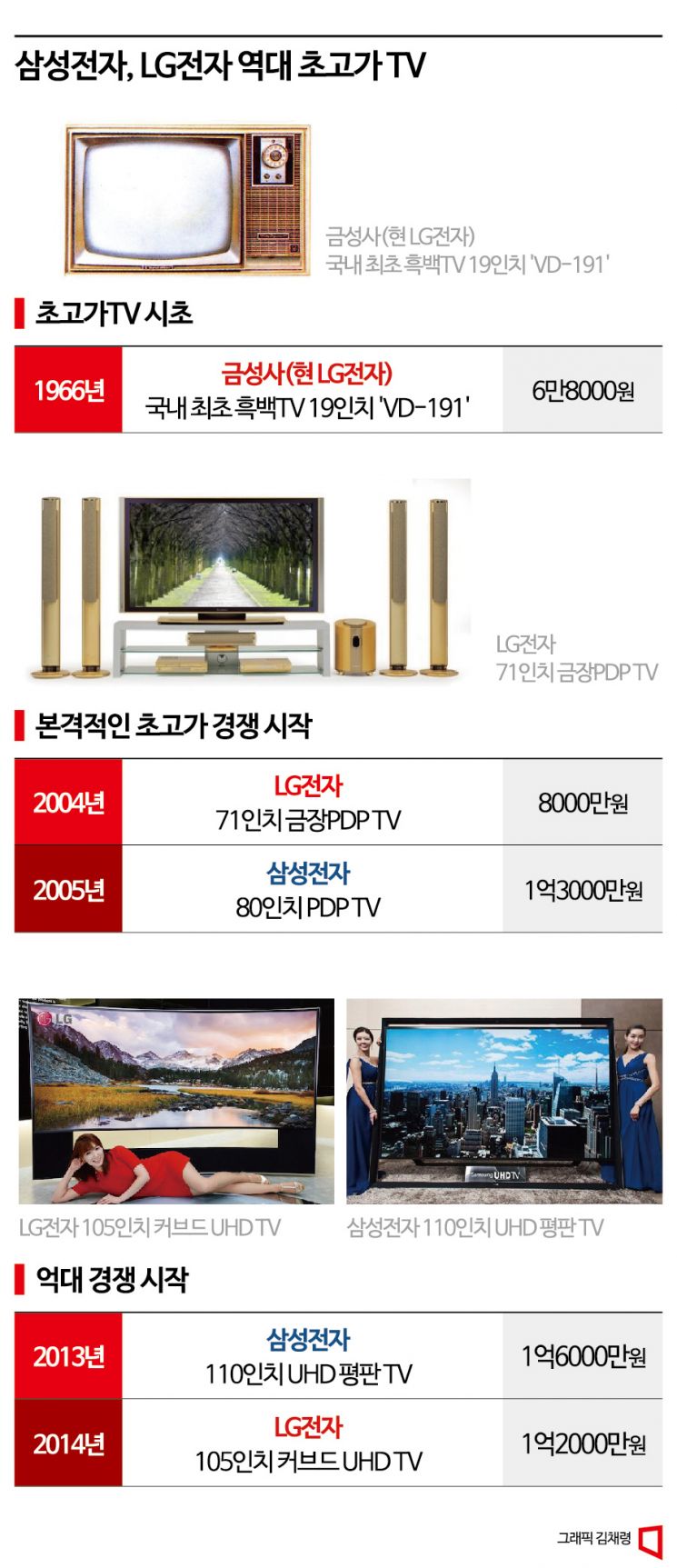
So, what have been the historically ultra-high-end TVs? The first product launched at a strikingly high price was LG Electronics’ 71-inch gold-plated PDP TV in 2004. The price was about 80 million KRW. The TV bezel and home theater package were decorated with 24k gold, attracting attention. It was so popular that over 300 units were ordered from the Middle East upon release, and it was even installed in the presidential palace of Peru, becoming a hot topic. It was also supplied to royal families in major countries, earning the nickname 'Royal TV.' Considering that a 65-inch PDP TV was sold for 19.5 million KRW at the time, the 80 million KRW price was groundbreaking. It was regarded as the most expensive TV in the world, comparable to the cost of a typical rental deposit.
The following year, Samsung Electronics released an 80-inch PDP TV with a price tag of 130 million KRW. Purchasing just the TV and display cabinet cost 130 million KRW, and including the full home theater package raised the price to 150 million KRW. The design incorporated lacquer craftsmanship by intangible cultural asset master Son Dae-hyun, and customers’ signatures were engraved on the product. This was the first time TVs began to be sold at prices in the hundreds of millions of KRW. However, due to its large size, it was selectively displayed and sold mainly at some large department stores such as Harrods in the UK. It remained popular among wealthy individuals in the Middle East.
The two companies began their pride competition with 'hundred-million KRW' TVs after late 2013. As PDP transitioned to LCD in 2012, manufacturers showcased 100-inch-class TVs priced over 100 million KRW to demonstrate their technology. Samsung Electronics boldly launched a 110-inch UHD flat-panel TV priced at 160 million KRW in 2013. In response, LG Electronics released a 105-inch curved UHD TV priced at 120 million KRW in 2014. These were not developed for general consumers but were available through custom orders and were closer to exhibition pieces. Annual sales did not exceed 100 units, with some sales occurring mainly in the Middle East and China.
However, demand for premium products has remained steady. For example, the first domestic black-and-white TV, the 'VD-191,' released by GoldStar (now LG Electronics) in 1966, was priced at 68,000 KRW. At that time, a 80kg sack of rice cost 2,500 KRW, and the average monthly income of a salaried worker was about 12,000 KRW. It was calculated that a worker would have to save every penny for five months to buy one TV. Despite this, the VD-191 was so popular that it had to be sold by lottery.
Now, the atmosphere has changed. As companies release mass-produced ultra-high-end products that general consumers can also purchase, the entry barrier to the ultra-high-end TV market is considered to have lowered. Riding the trend of extra-large and ultra-high-definition TVs, Samsung Electronics and LG Electronics have started offering products that can be purchased at any time. An industry insider said, "Ultra-high-end TVs are important products with great symbolic value and indirect advertising, even if they do not show high sales volume," adding, "They also serve to differentiate from Chinese manufacturers."
© The Asia Business Daily(www.asiae.co.kr). All rights reserved.
![Clutching a Stolen Dior Bag, Saying "I Hate Being Poor but Real"... The Grotesque Con of a "Human Knockoff" [Slate]](https://cwcontent.asiae.co.kr/asiaresize/183/2026021902243444107_1771435474.jpg)















