The North Atlantic Treaty Organization (NATO) summit concluded on the 12th (local time) after a two-day schedule. Contrary to the expectations of Ukrainian President Volodymyr Zelenskyy, no specific timeline for Ukraine's NATO membership was announced. Instead, the Group of Seven (G7) pledged support for security guarantees. Additionally, NATO allies and Indo-Pacific partner countries, including South Korea, condemned North Korea's missile launches.
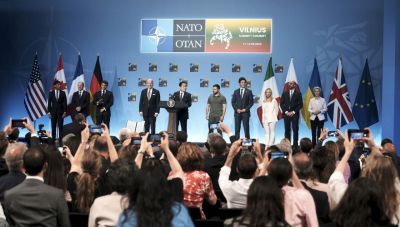
Jens Stoltenberg, NATO Secretary General, stated at the closing press conference of the summit held in Vilnius, Lithuania, on the 12th (local time), "Ukraine is closer to NATO than ever before," adding, "Today we meet as equals. We look forward to the day we meet as allies." On the same day, Secretary General Stoltenberg chaired the first NATO-Ukraine Council with President Zelenskyy in attendance. This council is a forum where Ukraine consults and makes decisions on an equal footing with the leaders of NATO's 31 member countries.
Immediately after the council, G7 leaders, including U.S. President Joe Biden, pledged security guarantees to Ukraine through a joint statement. The G7 promised to provide modern military equipment across land, sea, and air to the Ukrainian forces to prevent further Russian invasions and the recurrence of war even after the conflict ends. They also committed to measures to strengthen Ukraine's economic stability and recovery.
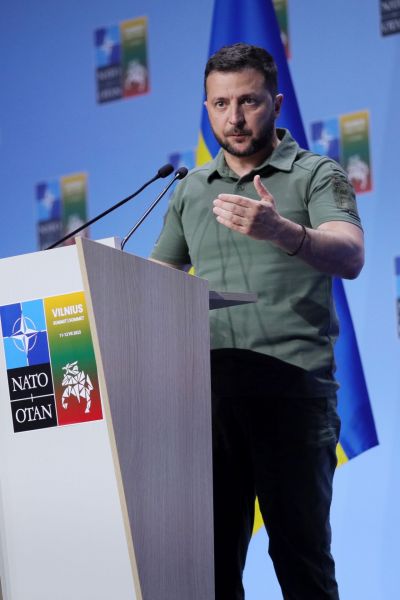
President Zelenskyy, who attended the event, described it as a "meaningful success," stating, "The G7 countries have agreed to provide long-term security guarantees until Ukraine joins NATO." However, he also pointed out that these security guarantees cannot replace NATO membership. In a subsequent press conference, Zelenskyy said, "This is not a substitute for NATO but a security guarantee on our path toward integration (into NATO)." He emphasized, "I am confident that Ukraine will become a member of NATO after the war ends, and we will do everything possible to achieve this."
This NATO summit attracted attention as it was held in Lithuania, adjacent to Russia, marking 500 days since Ukraine was invaded by Russia. Detailed discussions on Ukraine's NATO membership were expected. However, due to the ongoing war and resulting disagreements within NATO, the 31 countries ultimately agreed only to streamline the membership process for Ukraine without specifying a concrete timeline. President Zelenskyy, who sought a firm commitment from NATO regarding the post-war membership schedule, expressed disappointment the day before, saying, "This motivates Russia to continue its invasion."
Russia has opposed the support moves by the G7 and NATO. Dmitry Peskov, Kremlin spokesperson, stated, "By providing security guarantees to Ukraine, these countries are disregarding the international principle of indivisible security," adding, "This decision will make Europe a more dangerous place for years to come."
Meanwhile, voices condemning North Korea's missile launches also emerged during the talks. Secretary General Stoltenberg said at the closing press conference that North Korea's intercontinental ballistic missile (ICBM) launches undermine the foundations of global peace and security, stating, "NATO, the European Union (EU), South Korea, and Indo-Pacific partner countries condemn North Korea's recent missile launches and its nuclear and missile programs that violate multiple United Nations Security Council resolutions."
He also emphasized, "China's global unilateralism and Russia's war against Ukraine require much closer cooperation among NATO, the EU, and Indo-Pacific partner countries," highlighting plans to strengthen cooperation with four Indo-Pacific countries, including South Korea.
© The Asia Business Daily(www.asiae.co.kr). All rights reserved.
![Clutching a Stolen Dior Bag, Saying "I Hate Being Poor but Real"... The Grotesque Con of a "Human Knockoff" [Slate]](https://cwcontent.asiae.co.kr/asiaresize/183/2026021902243444107_1771435474.jpg)
















