Consumer Price Index Also Rises by 6.84 Percentage Points
There has been a claim that since the minimum wage increase can cause a decrease in Gross Domestic Product (GDP) and a rise in prices, further worsening the domestic economic situation, it is necessary to refrain from raising the minimum wage and to promote differentiated minimum wages by industry.
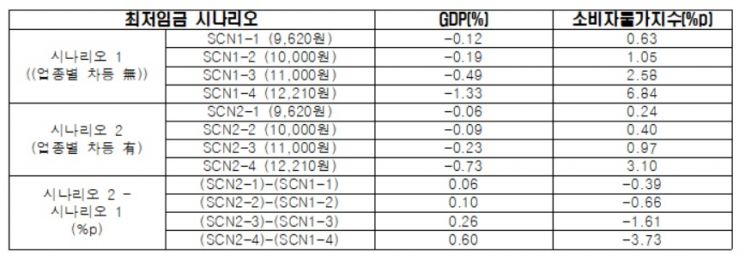
On the 7th, the Korea Economic Research Institute (hereinafter KERI) estimated in its report titled "Issues and Economic Impact of the Minimum Wage" that if the minimum wage for 2024 is raised to 10,000 won, GDP would decrease by 0.19% and the consumer price index would rise by 1.05 percentage points. If the minimum wage is raised to 12,210 won as initially demanded by the labor sector for 2024, GDP is expected to decrease by 1.33%, and the consumer price index would increase by 6.84 percentage points. This indicates that the larger the increase in the minimum wage, the greater the negative impact on the economy.
The report stated that even if the minimum wage is raised, differentiating it by industry can reduce the negative impact of the minimum wage increase by about 50%. Even if the minimum wage is raised to 12,210 won, applying industry-specific differentiation would limit the GDP decrease to 0.73% and the consumer price index increase to 3.10 percentage points, thus reducing the extent of the rise. Compared to the case without differentiation, the negative impact on GDP would be reduced by about 45%, and the impact on the consumer price index would decrease by about 55%.
If the current minimum wage level is maintained but industry-specific differentiation is applied, GDP is estimated to decrease by only 0.06%, and the consumer price index would rise by about 0.24 percentage points.
KERI noted that although the minimum wage system was implemented with the intention of guaranteeing a minimum wage level for workers to stabilize the livelihoods of low-wage workers and improve income distribution, in reality, the damage caused by minimum wage increases is relatively greater for low-income groups.
In fact, analysis of the impact of minimum wage increases on income distribution showed that the lowest income quintile experienced the largest decrease in earned income. If the minimum wage rises to 12,210 won, earned income in the first income quintile would decrease by about 27.8%, whereas the tenth income quintile would see almost no change in earned income. Regarding this background, KERI explained, "Low-wage workers often work at small businesses, so when the minimum wage increases, the probability of losing their jobs rises, which ironically leads to a reduction in income."
Jo Kyung-yeop, a senior research fellow at KERI, said, “Although it was decided not to apply industry-specific differentiation of the minimum wage in 2024, it is necessary to apply differentiation from 2025 to reduce the side effects of minimum wage increases and minimize damage to low-income groups.” He added, “Since the economic situation in our country is not favorable, it is necessary to freeze next year’s minimum wage and closely monitor the economic situation.”
© The Asia Business Daily(www.asiae.co.kr). All rights reserved.
![Clutching a Stolen Dior Bag, Saying "I Hate Being Poor but Real"... The Grotesque Con of a "Human Knockoff" [Slate]](https://cwcontent.asiae.co.kr/asiaresize/183/2026021902243444107_1771435474.jpg)
















