Superintendent Cho Hee-yeon 3rd Term 1st Anniversary Press Conference
Transition to Innovative Future Education through '3-Stage Education Revolution'
The Seoul Metropolitan Office of Education is preparing career and college admission counseling programs to reduce private education burdens and introducing an urban branch school model in response to the decline in student numbers.
On the morning of the 6th, Jo Hee-yeon, Superintendent of the Seoul Metropolitan Office of Education, held a "1st Anniversary Press Conference of the 3rd Term Superintendent" at the Seoul Metropolitan Office of Education and unveiled a blueprint for transitioning to innovative future education through the "3-Stage Educational Revolution." Superintendent Jo emphasized that the innovative education pursued so far will become richer through the realization of "high-quality public education" and "education of coexistence."
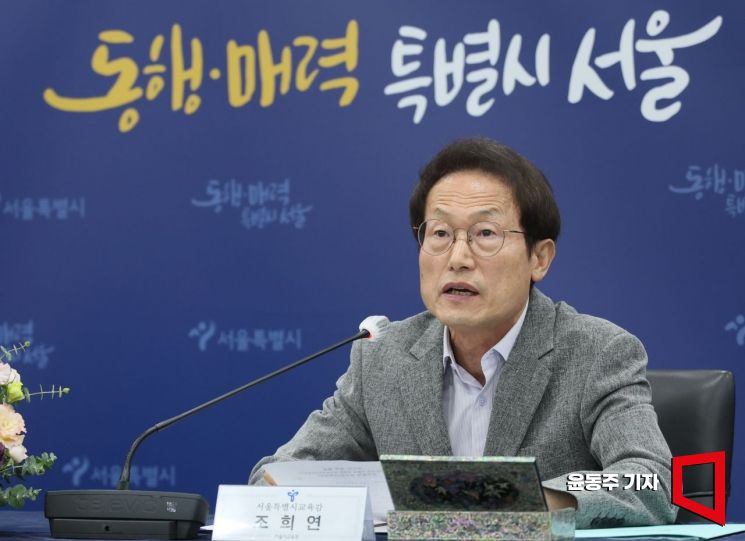
The contents of the 3-stage educational revolution revealed by Superintendent Jo are broadly divided into five categories.
First, the Seoul Metropolitan Office of Education plans to establish a comprehensive plan for the internationalization of Seoul education and announce it in the second half of the year. Starting with the additional placement of native English assistant teachers, it aims to improve the English learning environment and is discussing the development and utilization of an artificial intelligence (AI)-based English learning system. Along with this, as the number of multicultural families increases, the office plans to support schools in areas densely populated by multicultural students to become global future schools. The intention is to enhance the bilingual capabilities of multicultural students through special classes, bilingual classrooms, AI and digital content.
Coexistence-type debate education, where students switch perspectives and debate various social topics, will also be conducted. Through elementary school classes called "Classrooms that Grow Thinking" and middle and high school classes called "Classrooms that Write Thinking," classroom innovation will be implemented to foster students' critical and creative thinking skills. Additionally, a Korean-style Baccalaureate (KB)?a future-oriented school education system and teaching and evaluation system based on absolute evaluation granting general public university admission qualifications to everyone?will be established.
Furthermore, students will be nurtured as future knowledge producers by providing customized learning using digital devices on their own. The plan includes strengthening AI literacy diagnosis and support through the development of a Seoul-type artificial intelligence (AI) literacy diagnostic tool and establishing Seoul-type AI ethics education to help students grow into mature digital citizens.
“Ecological transition education” for future survival will also be continuously strengthened. The Seoul Metropolitan Office of Education plans to establish a new school model that reduces carbon emissions and activate cross-curricular ecological transition education linked to the curriculum. Additionally, rural study programs will be expanded to Gangwon Province in September, following Jeonnam and Jeonbuk, to broaden opportunities for students to cultivate ecological sensitivity.
In preparation for the elementary school student population, which is expected to decrease by about 50%, an "urban branch school model" will also be introduced. The Seoul Metropolitan Office of Education explained that it is designing new school models such as linkage with office or residential buildings, mini schools, and campus-sharing integrated schools.
Moreover, the office will develop and distribute the "Sen Jin-hak Mobile App," a career and college admission counseling program for students and parents, to reduce parents' private education expenses. The Sen Jin-hak Mobile App provides customized career and college admission services such as checking universities students can apply to, preparing for comprehensive student record screening, career tests, and one-on-one counseling. Existing services like the Wee Center and Special Education Support Center, which have been operated separately, will be integrated into one location to provide demand-tailored integrated support for students, parents, and staff.
Superintendent Jo Hee-yeon said, "The 3-stage educational revolution requires the empathy and support of Seoul citizens and the educational community," adding, "We will achieve balance and harmony in innovative education through complementary innovation and devote ourselves to transitioning to innovative future education through the 3-stage educational revolution."
Meanwhile, to mark the 1st anniversary of Superintendent Jo's 3rd term, the Seoul Metropolitan Office of Education will hold events to share and communicate the direction of Seoul's future education. On the 7th and 12th, lectures and discussions by notable figures will be held under the theme "The Future of Seoul Education, Asking the Change Makers," and on the 18th, a "Future Education Thought Sharing Meeting" will be held where about 80 Seoul students and the superintendent will have an open conversation.
© The Asia Business Daily(www.asiae.co.kr). All rights reserved.
![Clutching a Stolen Dior Bag, Saying "I Hate Being Poor but Real"... The Grotesque Con of a "Human Knockoff" [Slate]](https://cwcontent.asiae.co.kr/asiaresize/183/2026021902243444107_1771435474.jpg)















