The Justice Party stated that it "cannot acknowledge or accept" the final report by the International Atomic Energy Agency (IAEA) regarding the discharge of contaminated water from the Fukushima nuclear power plant in Japan.
Lee Jeong-mi, leader of the Justice Party, who has been fasting for 10 days in protest against the discharge of contaminated water, pointed out the issues with the IAEA report during an emergency executive committee meeting held in front of the Japanese Embassy on the 5th. She said, "The report is nothing more than a pardon and an alibi for Japan's ocean dumping." She added, "Instead of ocean dumping, the contaminated water should be stored on land in a 'Peace Safety Tank,'" and stated, "A 100,000-ton oil storage tank facility can store nuclear contaminated water long-term." Lee promised, "The Justice Party will pursue a parliamentary hearing to investigate the risks and illegality of ocean dumping, including this report."
Rafael Grossi, IAEA Director General, visited Japan the previous day and delivered a comprehensive report that provided a final evaluation of the Fukushima contaminated water discharge plan. The IAEA concluded in the report that there are "no safety issues" related to the discharge plan by the Japanese government and Tokyo Electric Power Company (TEPCO).
Kang Eun-mi, head of the Justice Party's Task Force to Prevent Unauthorized Dumping of Fukushima Contaminated Water, criticized the report at a press conference that day, saying, "In conclusion, this final report irresponsibly grants a pardon to the unprecedented marine crime of unauthorized dumping of nuclear contaminated water by the Japanese government, and the IAEA refuses to take responsibility for any damage caused by the unauthorized dumping."
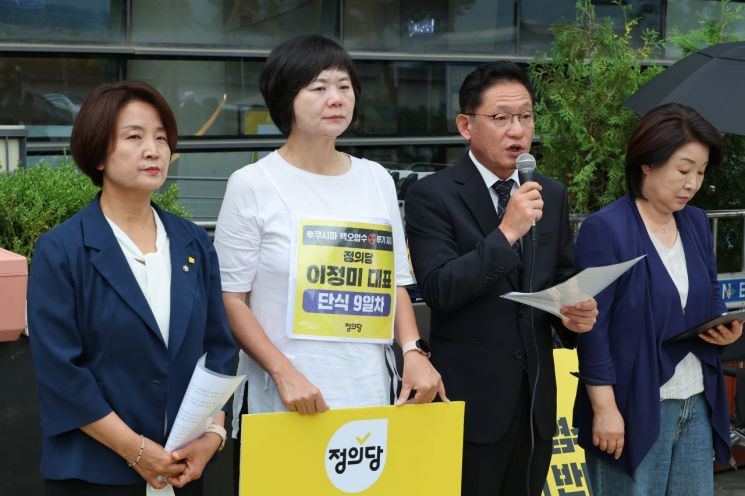
She pointed out, "The IAEA distorted and denied the principles of justification it set for the issue of unauthorized dumping of Fukushima nuclear contaminated water. Although it is clear that damage to fisheries and tourism industries in neighboring countries will occur due to Japan's unauthorized dumping, the report does not even mention any benefits that would outweigh such damage. This is a violation of the IAEA's GSG (General Safety Guide)-8, yet the IAEA shifts responsibility to the Japanese government and distorts the situation as if the principles of justification have been met."
Regarding the newly mentioned radioactive nuclides cobalt-60 and technetium-99 in the report, she said, "The IAEA does not disclose specific details such as whether the detected amounts of these two nuclides exceed the standards, and neither TEPCO nor the IAEA reveals the total amount of radioactive nuclides generated through the contaminated water," adding, "This proves that the ongoing issues concerning the reliability of nuclide data and information from TEPCO and the IAEA have not been resolved."
Furthermore, she criticized, "The issue of bioaccumulation through the ecosystem's food chain, which leading scientists continue to point out, is nowhere to be found in the report," and stated, "As the National Marine Research Institute Association opposed and revealed, the report thoroughly ignores biological processes."
© The Asia Business Daily(www.asiae.co.kr). All rights reserved.
![Clutching a Stolen Dior Bag, Saying "I Hate Being Poor but Real"... The Grotesque Con of a "Human Knockoff" [Slate]](https://cwcontent.asiae.co.kr/asiaresize/183/2026021902243444107_1771435474.jpg)
















