'Rebuking the North Korea Support Department... Budget Cuts Ordered for Affiliated Agencies
"Already the Minimum Organization, Essentially Restructuring"
Fluctuations with Regimes "Cannot Guarantee Continuity of Work"'
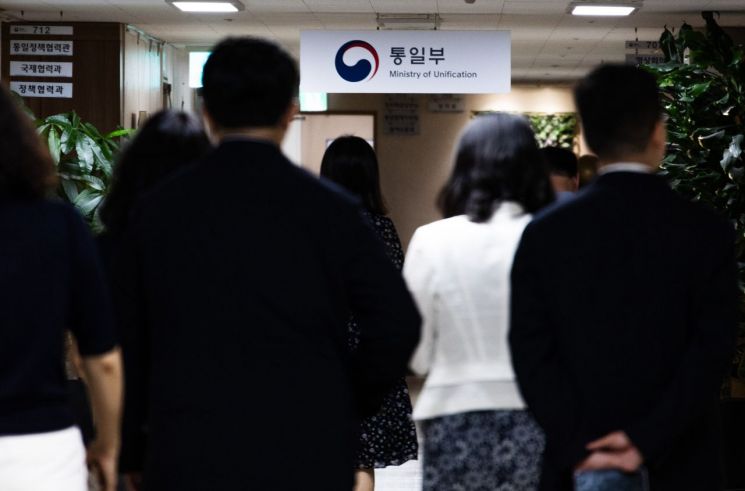
The Ministry of Unification, which President Yoon Suk-yeol has ordered to 'reform,' has effectively begun additional restructuring. It has instructed its affiliated organizations responsible for the Kaesong Industrial Complex and inter-Korean exchange and cooperation to reduce their budgets. Following a large-scale organizational overhaul in April this year, the reduction in the inter-Korean exchange budget has raised concerns about potential side effects. Critics point out that losses due to a lack of continuity in work are inevitable as the ministry is swayed by the ruling party's tendencies.
According to the government on the 5th, the Ministry of Unification recently instructed two affiliated organizations, ▲Kaesong Industrial Complex Support Foundation and ▲Inter-Korean Exchange and Cooperation Support Association, to prepare operational improvement plans. A ministry official explained, "Since the Kaesong Industrial Complex has been suspended for a long time and inter-Korean exchange and cooperation have almost come to a halt, the workload of these two organizations has significantly decreased."
The foundation has played a role in supporting permits, approvals, and facility management for companies residing in the Kaesong Industrial Complex. However, it lost its core functions when the Kaesong Industrial Complex operations were suspended in February 2016. The association is responsible for administrative procedures necessary during inter-Korean exchanges, such as reporting contact with North Korean residents and approving applications for the import and export of goods. This organization is also currently facing no demand for its services due to the ongoing stagnation in inter-Korean relations.
However, these organizations have already had their upper budget limits cut, and about 90% of their current budgets are reportedly allocated to fixed minimum costs such as personnel expenses and building rents. The instruction to further reduce the budget is effectively interpreted as a 'personnel restructuring.' A Ministry of Unification official cited the "government's budget reduction policy for the next year" as the reason but also hinted at personnel changes, saying, "I think special efforts are necessary."
Inside and outside the Ministry of Unification, voices are emerging expressing concern about the loss of the ministry's capabilities due to frequent reorganizations. In April this year, there was already a major change that drastically reduced the exchange and cooperation organization within the ministry's headquarters and strengthened the 'North Korean human rights' sector. Additionally, President Yoon recently referred to the Ministry of Unification as the 'North Korea Support Department,' and there are talks that if Minister nominee Kim Young-ho assumes office as planned, personnel reshuffles will follow.
A former Ministry of Unification official said, "The Ministry of Unification is the most inconsistent ministry every time the administration changes," adding, "Reform is not just about abolishing organizations that will be rebuilt someday. It is a move by the government to eliminate 'North Korea negotiation experts' themselves."
Critics argue that increasing or decreasing the organization according to the ruling party's tendencies results in losses in terms of work continuity and expertise. In fact, during the Lee Myung-bak administration, the exchange and cooperation organization was downsized, and the 'North Korea intelligence' function was significantly strengthened. The Situation Analysis Bureau, which collects and analyzes information on North Korea, was established at that time. Subsequently, the Park Geun-hye administration reduced the intelligence function and expanded the humanitarian support organization. During former President Park's term, the North Korean Human Rights Act was enacted, and policies emphasizing human rights were promoted. However, under the Moon Jae-in administration, the humanitarian cooperation bureau was revived, and the exchange and cooperation bureau was elevated to a division. The inter-Korean joint liaison office, which North Korea later destroyed, was also established during this period. The Yoon Suk-yeol administration upgraded the humanitarian cooperation bureau to the Human Rights and Humanitarian Division and downgraded the exchange and cooperation division back to a bureau in April.
A senior official said, "Since this government took office, the organization has been significantly shrunk due to incidents such as the defection of North Korean fishermen and forced repatriation cases, which led to investigations and inspections of field personnel," adding, "Who would want to lead tasks at the forefront if the organization is shaken every time the administration changes? The signal is that if you are loyal under a conservative government, you get cut under a progressive government, and if you work hard under a progressive government, you get fired under the next conservative government."
There are also concerns that this could lead to miscalculations by North Korea. One of the principles the Yoon Suk-yeol administration aims for in its North Korea policy is 'dialogue without conditions,' but by effectively blocking dialogue functions, it may send a signal to North Korea that there is no room for negotiation. While leading international pressure on North Korea over human rights issues, experts advise that keeping the possibility of dialogue open is a more effective strategy for South Korea.
© The Asia Business Daily(www.asiae.co.kr). All rights reserved.
![Clutching a Stolen Dior Bag, Saying "I Hate Being Poor but Real"... The Grotesque Con of a "Human Knockoff" [Slate]](https://cwcontent.asiae.co.kr/asiaresize/183/2026021902243444107_1771435474.jpg)















