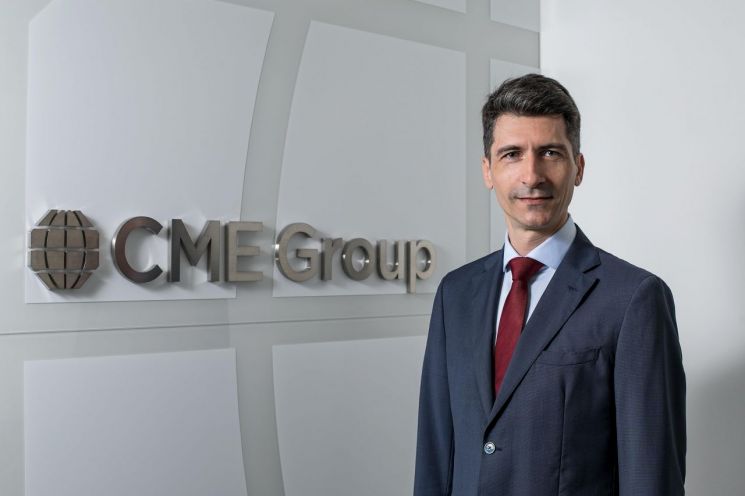
Nicolas Dupuy, Executive Director in Charge of Energy and Environmental Products for the Asia-Pacific Region at CME Chicago Mercantile Exchange
Price Risk Management Essential to Prepare for Rapid Changes Such as War... "Derivative Trading Will Increase Further"
"Education has become important."
This was the purpose of Nicolas Dupuis, Executive Director in charge of Energy and Environmental Products for the Asia-Pacific region at the Chicago Mercantile Exchange (CME), when he recently visited Korea for an interview with Asia Economy. He added that the education target was Korean energy companies. Dupuis said, "Situations that seemed unlikely to happen again, like the second COVID-19, may occur more frequently in the future," and emphasized, "Crisis management through price hedging is essential." Hedging refers to setting a position opposite to the spot price trend by using derivatives such as futures or options to reduce potential losses caused by spot price fluctuations.
Dupuis pointed to crude oil as a product that Korean energy companies should pay significant attention to. Recently, the United States has become a major oil supplier to Korea. In 2017, Korea imported 37,000 barrels of crude oil per day from the U.S., ranking 11th among all countries. However, last year, Korea imported 374,000 barrels per day, making it the second-largest importer after Saudi Arabia. The share of U.S. crude oil imports was only 1% in 2017 but rose to 13% last year. This was because U.S. crude oil was relatively cheaper amid heightened geopolitical tensions in the Middle East.
Dupuis said, "Since the price of crude oil imported by Korea is determined based on the West Texas Intermediate (WTI) futures price, Korean energy companies will react sensitively to WTI futures prices," adding, "As U.S. production and export capacity strengthen, sensitivity to the U.S. benchmark WTI price will increase."
The number of open interest (OI) contracts, an indicator used to evaluate hedging, is also increasing. As the U.S. share in the crude oil market expands, WTI OI increased by 30% last year compared to the previous year. Open interest means that a specific futures contract has not yet been completed. It can be used to gauge the market's interest in a particular product. A decrease indicates cooling market enthusiasm and capital outflow from that product.
Dupuis also predicted that focus on U.S. Henry Hub Price futures, used as a benchmark for natural gas prices, will increase. After Russia's invasion of Ukraine last year, European countries emerged as new buyers of U.S. natural gas, starting price competition with existing Asian customers. He analyzed, "Demand for Henry Hub, which has attractive pricing, will continue, and the importance of the U.S. in the natural gas market will grow," adding, "Investor demand to hedge price volatility through Henry Hub futures will inevitably expand." Currently, U.S. LNG exports are about 80 million tons annually but are expected to increase to 120 million tons by 2026.
Products related to 'carbon emissions' are expected to become mainstream in the future. CME offers carbon emission-related products composed of the Emissions Trading System (ETS) and 'voluntary carbon offset futures,' where companies purchase credits to reduce their carbon footprint voluntarily. Voluntary carbon offset futures are an index introduced by CME Group with interest. It allows trading bonds issued by companies to reduce carbon emissions in a specific year. Dupuis explained, "From an ESG (Environmental, Social, and Governance) perspective, I thought it was important to offer new products related to the carbon emissions market," adding, "In the Korean market, some large corporations are beginning to invest in large-scale projects issuing carbon emission-related bonds."
CME Group is the world's largest derivatives exchange group. It owns four major U.S. derivatives exchanges as subsidiaries: Chicago Board of Trade (CBOT), Chicago Mercantile Exchange (CME), New York Mercantile Exchange (NYMEX), and Commodity Exchange (COMEX). It offers various products based on underlying assets such as interest rates, stock indices, foreign exchange, energy (crude oil, natural gas, carbon emission rights, etc.), agricultural products (corn, soybeans, etc.), and metals. As a market mainly dealing with derivatives futures and options trading, it is a gathering place for global investors who need risk management. It operates 23 hours a day and specializes in investor-tailored responses due to the wide range of products handled by asset class.
Nicolas Dupuis joined CME Group in September 2016 and leads the Asia-Pacific energy and environmental business. Previously, he was responsible for Asia-Pacific energy derivatives at Soci?t? G?n?rale (SG).
© The Asia Business Daily(www.asiae.co.kr). All rights reserved.










![The Special Connection Between the Statue of Martyr Lee Jun in Jangchungdan Park and Mayor Oh Sehoon ③ [Current Affairs Show]](https://cwcontent.asiae.co.kr/asiaresize/319/2026012110001599450_1768957215.jpg)
