Hyosung Hydrogen·GS Construction Roundtable
Former Nuclear Society President Professor Jeong Dong-wook of Chung-Ang University Moderates
"After Introducing CFE, a Grading System Should Be Created to Verify Achievement Levels"
Editor's NoteThe government has promised to achieve carbon neutrality by 2050 and the 2030 Nationally Determined Contribution (NDC) for greenhouse gas reduction. However, companies respond that it is not easy to realize. Also, compared to RE100, which requires 100% of electricity to be supplied by renewable energy, the CFE campaign, which recognizes all zero-carbon power sources including nuclear and hydrogen as eco-friendly energy, is considered more suitable for Korea's circumstances.
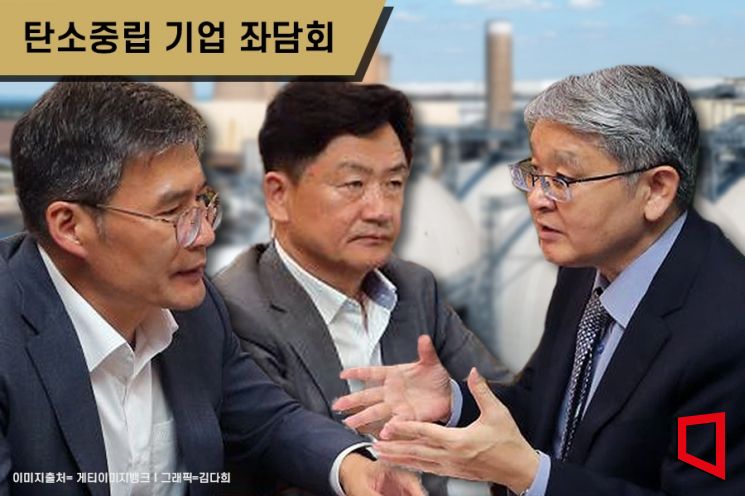
We reviewed the status of corporate energy business in South Korea in 2023 with Son Soon-geun, Executive Director of Hyosung Hydrogen, Lee Jong-hwa, Executive Director in charge of Renewable Development and Nuclear Business at GS Construction ECO Business Division, and Professor Jung Dong-wook of the Department of Energy Systems Engineering at Chung-Ang University. The discussion took place on the 20th at Asia Media Tower in Jung-gu, Seoul.
Business of Each Company
◆Moderator = Professor Jung Dong-wook, Department of Energy Systems Engineering, Chung-Ang University
I understand that Hyosung plans to start commercial production of liquefied hydrogen by the end of the year. It is the fastest among domestic companies.
Hyosung Heavy Industries has been engaged in compressed natural gas (CNG) bus refueling facility business. Around 2008, Hyundai Motor Company requested collaboration with Hyosung Heavy Industries. Since then, we started the hydrogen refueling station business. Afterwards, we connected with Linde, the world's largest industrial gas producer based in Germany.
Currently, there are 132 refueling stations in Korea. Does Hyosung supply all of them?
We supply 37 of them. We hold the number one market share, about 25-30%.
Are you also involved in storage-related business as well as refueling?
Yes. When liquefied hydrogen is produced at the manufacturing plant, it is transported by trailer. We also operate refueling facility business.
GS Construction seems to be expanding its hydrogen business area recently. Which part are you mainly focusing on?
Last year, we established the Future Technology Research Institute. Currently, about 300 people work there. Within the institute, there are various research labs related to future businesses. One of them conducts research on hydrogen production. We focus on production and transportation among hydrogen production, storage, transportation, and utilization. We conduct research on membrane technology, device technology evaluation, and develop water electrolysis technology ourselves. We also research ammonia transportation and liquefied transportation technology.
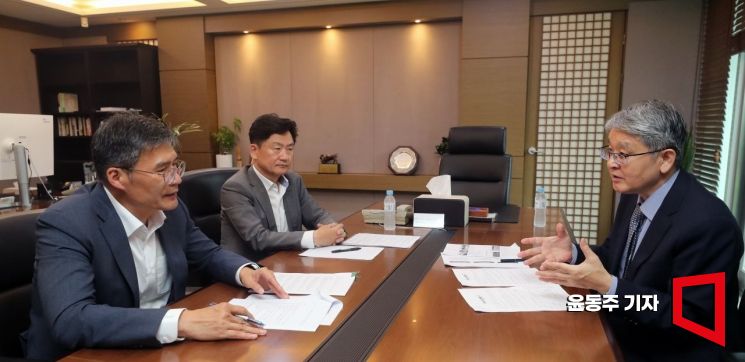 Jonghwa Lee, Executive Director in charge of New Renewable Development and Nuclear Business at GS Construction ECO Business Division (clockwise from the left), Soongeun Son, Executive Director at Hyosung Hydrogen, and Dongwook Jung, Professor in the Department of Energy Systems Engineering at Chung-Ang University. Photo by Dongju Yoon doso7@
Carbon Neutral Business
The government launched the CFE Forum. Do you think the CFE Forum will help corporate activities or act as a burden?
Overseas companies request us to submit plans to comply with RE100. CFE recognizes nuclear power and fuel cells as eco-friendly energy. Since Korea is a nuclear power stronghold, switching to CFE rather than RE100 is expected to strengthen the competitiveness of Korean companies and reduce difficulties.
Do you mean that CFE should become an internationally accepted standard like RE100?
Yes. Hyosung exports many materials. If CFE expands, we believe we can maintain cost competitiveness at the current level. Also, CFE recognizes fuel cells as eco-friendly energy. Currently, most fuel cell businesses use by-product hydrogen or LNG reforming hydrogen. As technology develops, the use of blue hydrogen or green hydrogen may increase. If nuclear power expands, the production of 'pink hydrogen' made using nuclear power will also increase. Increased supply will act as a driving force to create demand.
From Korea's perspective, adopting CFE is appropriate. The key is whether CFE is recognized as an international standard. Whether led by private or international organizations, it must be internationally recognized and followed.
Not something the government manages?
Correct. The Korea Chamber of Commerce and Industry should cooperate with overseas private organizations to establish CFE standards. For example, it is necessary to classify achievement levels such as 40% CFE, 100% CFE. Especially, a system should be created to allow domestic CFE achievement results to be recognized as performance under the European Union Emissions Trading System (EU ETS). If carbon tax can be reduced according to CFE grades, adopting CFE is appropriate.
It sounds like you are saying CFE should become an international standard and operate as a system that encourages voluntary corporate participation rather than government regulation. You interpret that introducing a grading system in the process is worth considering.
Exactly.
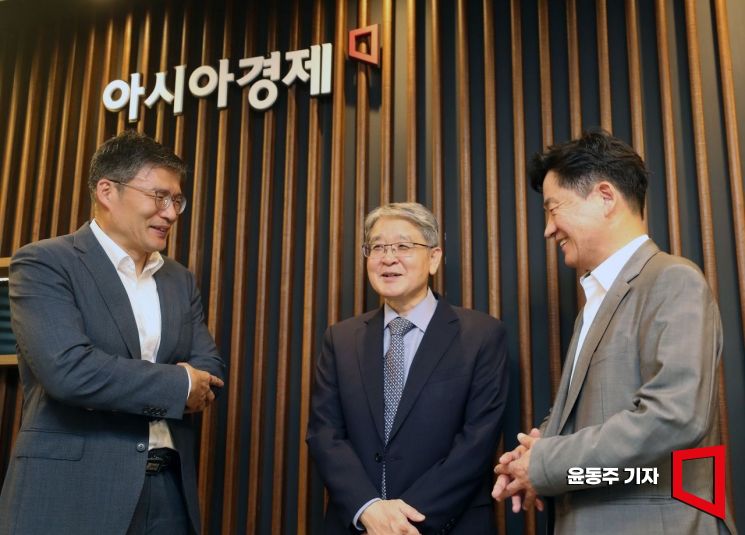 Lee Jong-hwa, Executive Director in charge of New Renewable Development and Nuclear Business at GS Construction ECO Business Division (clockwise from the left), Son Soon-geun, Executive Director at Hyosung Hydrogen, and Jung Dong-wook, Professor in the Department of Energy Systems Engineering at Chung-Ang University. Photo by Yoon Dong-joo doso7@
If overseas competitors produce products with lower carbon emissions and higher price competitiveness during export, Korean companies may face difficulties.
The term 'transition risk' is used. For example, if a global client requires eco-friendly certification related to carbon reduction and the company fails to meet it, there is a possibility of being disqualified or restricted from participating in new bids. There could even be a risk of losing contract opportunities. There is difficulty in proactively responding to overseas client demands.
Can CFE help reduce transition risk?
It will help.
It seems CFE will also help GS Construction.
Yes.
© The Asia Business Daily(www.asiae.co.kr). All rights reserved.
![Clutching a Stolen Dior Bag, Saying "I Hate Being Poor but Real"... The Grotesque Con of a "Human Knockoff" [Slate]](https://cwcontent.asiae.co.kr/asiaresize/183/2026021902243444107_1771435474.jpg)

















