Sangui, World Bank Logistics Performance Index Analysis
Most Top-Ranked Countries Are European
South Korea's logistics competitiveness ranked 17th in the world, entering the top 20 for the first time. While customs clearance and logistics infrastructure were at a top-tier level, competitiveness in software aspects such as cargo tracking was found to be relatively weak.
The Korea Chamber of Commerce and Industry announced this after analyzing the 2023 Logistics Performance Index (LPI) report released by the World Bank, stating that South Korea's logistics competitiveness has rebounded after a declining trend over the past decade. Among the six LPI subcategories, customs clearance (7th) and logistics infrastructure (9th) were rated within the top 10 worldwide.
The Logistics Performance Index is a representative indicator that measures the logistics competitiveness of countries. The World Bank publishes it every two years for over 160 countries, evaluating six categories: customs clearance, logistics infrastructure, ease of arranging shipments, logistics services, cargo tracking, and timeliness. This report was released for the first time in five years since 2018 due to COVID-19.
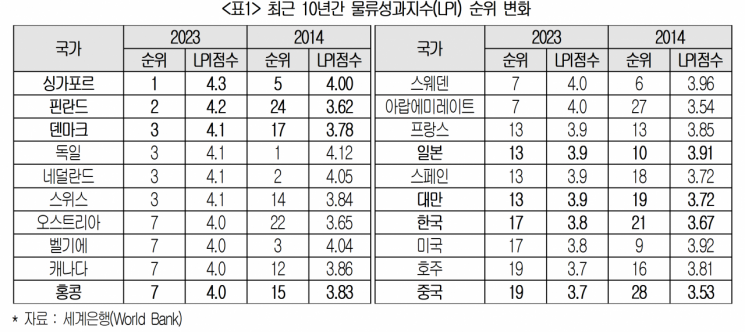
In Asia, Singapore (1st), Hong Kong (7th), Japan and Taiwan (13th), and China (19th) were positioned within the top 20 alongside South Korea. Most of the top 20 countries were European, with Finland (2nd) and Denmark (3rd) showing significant rank improvements compared to ten years ago.
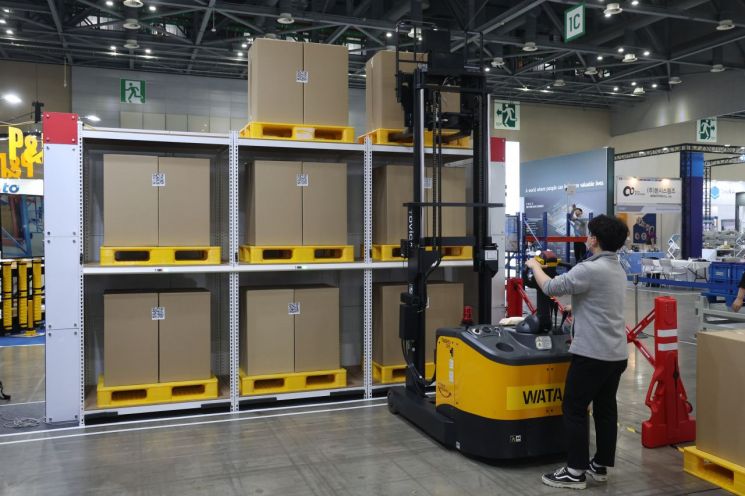 On April 18th, at the 13th International Logistics Industry Exhibition held at KINTEX in Goyang-si, Gyeonggi Province, an official demonstrated an AI space management platform. [Image source=Yonhap News]
Looking at rank changes among neighboring countries competing with South Korea, China and Taiwan, which had similar rankings to South Korea ten years ago, rose by 9 and 6 places respectively, ranking 19th and 13th. Singapore climbed from 5th to 1st, becoming the country with the highest logistics competitiveness globally. Japan dropped three places from 10th to 13th.
Professor Shin Kwang-seop of the Graduate School of Northeast Asian Logistics at Incheon National University said, “As logistics competitiveness among Northeast Asian countries has leveled up, competition among countries vying for logistics hubs appears to have intensified.” He added, “National logistics competitiveness is directly linked to companies’ global competitive advantage and also promotes foreign investment and transshipment cargo attraction, so the government needs to take active measures.”
Urgent Need for South Korea to Secure Software Competitiveness
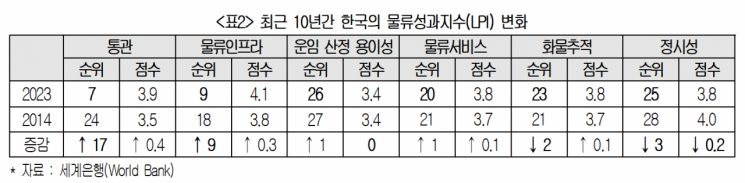
Examining South Korea’s Logistics Performance Index over the past decade by category, customs clearance ranked 7th and logistics infrastructure 9th. This improvement is attributed to the simplification of customs procedures through electronic customs systems like UNI-PASS and the introduction of AI-based X-ray reading systems, as well as upgrades to logistics infrastructure such as airports and ports. Busan Port ranks 7th globally in container throughput, and Incheon Airport ranks 2nd worldwide in international cargo handling.
However, the remaining rankings?cargo tracking (23rd), timeliness (25th), ease of arranging shipments (26th), and logistics services (20th)?were all outside the top 20. Rankings for cargo location tracking and timeliness, which measures receiving cargo within the scheduled period, declined. There was no change in the score for ease of arranging international shipping costs. The Korea Chamber of Commerce and Industry suggested that securing software competitiveness for logistics service provision and operation is urgent.
The average LPI score for the top-tier group is 4.1 points. South Korea received an average of 3.8 points. Customs clearance and infrastructure scores were similar to the top-tier group average. In software-related competitiveness categories such as logistics services, timeliness, cargo tracking, and ease of international shipping cost calculation, South Korea scored below the average of top-ranking countries.
Integrated Logistics Transport Platform Combining Land, Sea, and Air Should Be Established Three Years Earlier by Next Year
The Korea Chamber of Commerce and Industry advised accelerating the digital transformation (DX) of the logistics industry and building an integrated data platform to improve cargo transport traceability and timeliness to enhance South Korea’s global logistics competitiveness. They recommended advancing the completion of an integrated platform for logistics transport data, currently separated by land, sea, and air, by at least three years to the end of 2024 and establishing a national-level data standard system simultaneously. They also mentioned expanding support for small and medium logistics companies, as these firms, relatively lacking capital, are slower to adopt systems and equipment, so financial support to promote this is necessary.
Jang Geun-mu, Director of the Korea Chamber of Commerce and Industry’s Distribution and Logistics Promotion Institute, emphasized, “As logistics industry DX accelerates with AI and unmanned delivery, competition to create new markets and secure market dominance is intensifying,” adding, “The government must boldly improve regulations, and the private sector should increase investment in the development and commercialization of automation and smart technologies.”
© The Asia Business Daily(www.asiae.co.kr). All rights reserved.
![Clutching a Stolen Dior Bag, Saying "I Hate Being Poor but Real"... The Grotesque Con of a "Human Knockoff" [Slate]](https://cwcontent.asiae.co.kr/asiaresize/183/2026021902243444107_1771435474.jpg)

















