Bank of Korea Financial Stability Report
5 out of 10 New Delinquent Borrowers Are Vulnerable Borrowers
Vulnerable Borrowers' Household Loans Concentrated in Secondary Financial Institutions
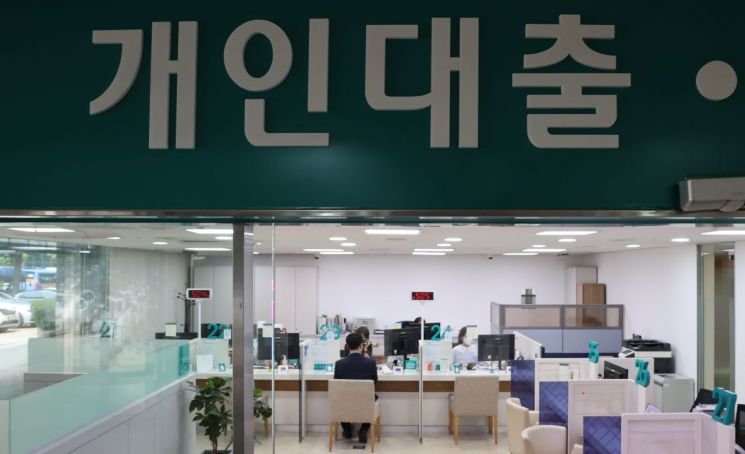
The Bank of Korea revealed that the increase in household loan delinquent debts since the end of last year mainly originated from vulnerable borrowers. In particular, it predicted that the rise in delinquency rates for loans issued since 2020 would be significantly evident in non-bank financial institutions.
According to the Financial Stability Report released by the Bank of Korea on the 21st, vulnerable borrowers accounted for 58.8% and 62.8% of new delinquent borrowers and new delinquent balances, respectively, in the second half of last year. New delinquency refers to borrowers and balance amounts whose delinquent balances increased from the end of Q2 last year to the end of Q4 last year.
Moreover, among the newly delinquent vulnerable borrowers, 39.5% had new delinquent balances exceeding their annual income. The report stated, "It is difficult to rule out the possibility that a significant portion of the recently increased delinquent debts will result in non-performing loans overdue by more than three months, negatively impacting the asset soundness of financial institutions."
Additionally, for loans issued since 2020, the report noted that some increase in deferred delinquencies is inevitable due to rising loan interest rates and reduced policy support. It explained, "Thanks to low interest rates and COVID-19 policy support, the upward trend in delinquency rates has been moderate compared to household loans issued between 2013 and 2019, and it is estimated that the peak has not yet been reached."
Since the second half of last year, household loan delinquency rates have been rising across the financial sector. However, these rates remain lower than during the global financial crisis and even below the long-term average before COVID-19 (2009?2019). As of the end of March, the delinquency rates for household loans at savings banks and credit card companies were relatively high at 5.6% and 2.8%, respectively, but still below their long-term averages (9.3% and 3.2%). They are significantly lower than during the global financial crisis (15.8% and 6.3%).
Nonetheless, the pressure for rising delinquency rates on loans issued since 2020 is expected to be more pronounced in non-bank financial institutions. This is because the delinquency rate for household loans received by vulnerable borrowers since 2020 has been sharply increasing recently, and vulnerable borrowers’ household loans are more concentrated in non-bank financial institutions than in banks.
The report stated, "The delinquency rate for household loans issued by non-bank financial institutions since 2020 is still considerably suppressed compared to loans issued before then, suggesting significant room for future increases."
It added, "Despite the expansion of household loan delinquencies, the resilience of financial institutions is expected to remain at a good level. However, since delinquencies may increase faster than anticipated, it is necessary for financial institutions to strengthen capital and for the government and supervisory authorities to enhance monitoring of new delinquent debts."
© The Asia Business Daily(www.asiae.co.kr). All rights reserved.
![Clutching a Stolen Dior Bag, Saying "I Hate Being Poor but Real"... The Grotesque Con of a "Human Knockoff" [Slate]](https://cwcontent.asiae.co.kr/asiaresize/183/2026021902243444107_1771435474.jpg)















