Law Firm Taepyungyang Seminar 'How to Respond to Serious Accidents'
290 Serious Accidents from January Last Year to End of March This Year
18 Cases Closed Before Criminal Charges, 51 Referred to Prosecution, etc.
#Construction company A was contracted for an extension project of a nursing hospital and subcontracted part of the work to subcontractor B. A worker from B was responsible for lifting heavy fixed angles up to the 6th floor of the building but fell to his death from the 5th floor due to the absence of safety railings or safety harnesses. The CEO was sentenced to 1 year and 6 months in prison with a 3-year probation. - First ruling applying the Serious Accidents Punishment Act
#A subcontractor worker of steel company C died when a fiber belt snapped while lifting a 1,220 kg steel heat shield with a crane. The CEO was sentenced to 1 year in prison and was taken into custody in court. - Second ruling applying the Serious Accidents Punishment Act
Both cases violated the Serious Accidents Punishment Act and were settled with the bereaved families. However, one CEO received a suspended sentence while the other was imprisoned. What was the difference? The history of prior safety accidents influenced the verdict. The CEO of company C had three prior fines for violations of the Occupational Safety and Health Act. Additionally, the fatal accident occurred while a criminal trial was ongoing for similar safety accidents at the workplace. Attorney Jeong Sang-cheol stated, “Prior penalties for violations of the Occupational Safety and Health Act or previous similar industrial accidents greatly affect sentencing,” and added, “From a corporate perspective, it is essential to faithfully establish and implement a safety and health management system.”
On the 20th, law firm Bae, Kim & Lee held an online seminar titled ‘How to Respond to Serious Accidents? Recent Case Trends and Strategies.’ The event was organized to understand investigation and ruling trends under the Serious Accidents Punishment Act and to discuss response strategies. Attorneys from the Serious Accident Response Headquarters of Bae, Kim & Lee served as presenters.
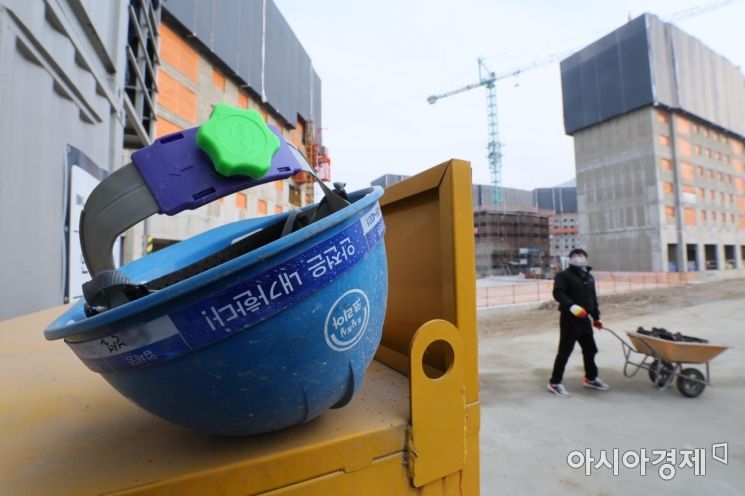 The scene of an apartment construction site in Gyeonggi Province on January 27 last year, the first day of the enforcement of the Serious Accidents Punishment Act, which allows for the punishment of management officials if serious accidents such as worker fatalities occur. Photo by Hyunmin Kim kimhyun81@
“Duty to Ensure Safety and Health Is Most Important”
Attorney Choi Jin-won emphasized that among the issues related to the application of the Serious Accidents Punishment Act, fulfilling the duty to ensure safety and health is most important for accident prevention and managing criminal liability risks. The Ministry of Employment and Labor, police, and prosecution, who hold investigative authority, focus on enforcement decree Article 4 provisions most related to accident occurrence: improvement of harmful and dangerous factors (No. 3), granting authority and budget to safety and health management officers and evaluating their performance (No. 5), listening to workers’ opinions (No. 7), and action manuals in case of serious accidents (No. 8). Attorney Choi stated, “Even if a serious accident occurs, if the safety and health management system was established in advance and safety and health duties prescribed by law, such as biannual inspections, were faithfully performed, it is possible to exempt management responsibility or the corporation.”
Management is obligated to properly manage and support the implementation of safety and health measures under the Occupational Safety and Health Act at the workplace. The Serious Accidents Punishment Act stipulates that if a serious accident occurs without fulfilling this duty, punishment will follow. Attorney Choi explained, “To hold management responsible, a causal relationship must be recognized between the violation of the duty to ensure safety and health and the occurrence of the serious accident,” and added, “In prosecution cases, there is a tendency to broadly recognize the causal relationship by combining violations of various duty provisions with the failure to ensure safety and health and the occurrence of serious accidents.”
Strict Judgment on Whether Office Workplaces Are Exempt from Duties
Office workplaces cannot be complacent either. The Ministry of Employment and Labor narrowly interprets workplaces employing only office workers to exclude them from the Serious Accidents Punishment Act obligations through administrative interpretations and guidance. Attorney Song Jin-wook stated that sales, development, and building management workers are not considered office workers and said, “If even one worker in these roles exists in the entire workplace, the Serious Accidents Punishment Act obligations must be complied with.” Office workplaces are not required to comply with several duties such as establishing safety and health systems, designating safety managers, health managers, or overall safety and health officers, and managing safety and health.
Attorney Song noted, “In serious accident investigations, compliance with risk assessment procedures is closely examined. The Ministry of Employment and Labor’s guidelines have been revised, significantly changing the risk assessment part,” and added, “If procedures are not followed, it is judged that harmful and dangerous factors have not been properly improved, leading to prosecution recommendations.” He also said, “Even if the risk assessment was conducted by the working-level team, if management did not receive reports or properly approve it, it is considered insufficient,” emphasizing that “management must definitely oversee this.”
Many cases also miss evaluating the performance of safety and health management officers. Attorney Song said, “There are many cases prosecuted for failing to conduct performance evaluations,” and stressed, “Evaluation criteria must be established, and management must conduct evaluation and management at least once every six months.”
CEO Receiving ‘Criminal Punishment’ Principally Liable for Damages in Shareholder Derivative Suits
The recently highlighted shareholder derivative suits were also discussed. Attorney Kim Jun-mo responded to the question, “Is a CEO who has been criminally punished likely to be held liable for damages in shareholder derivative suits?” by saying, “In principle, there is liability for damages to the company,” explaining, “This is because if the CEO is punished for violating the Occupational Safety and Health Act or the Serious Accidents Punishment Act, it constitutes a violation of laws or neglect of duties.” This is based on Article 399 of the Commercial Act, which stipulates that a CEO is liable for damages to the company if they intentionally or negligently violate laws, articles of incorporation, or neglect their duties.
Since the law’s enforcement in January last year until March 31 this year, 290 serious accidents have occurred. The law considers fatal accidents at workplaces of companies with 50 or more regular employees (non-construction) or construction projects worth 5 billion KRW or more (construction) as serious accidents. Among these, 18 cases were investigated and closed before criminal charges (suspect registration), 51 cases were referred to prosecution, and 221 cases are under investigation by the Labor Office.
© The Asia Business Daily(www.asiae.co.kr). All rights reserved.
![Clutching a Stolen Dior Bag, Saying "I Hate Being Poor but Real"... The Grotesque Con of a "Human Knockoff" [Slate]](https://cwcontent.asiae.co.kr/asiaresize/183/2026021902243444107_1771435474.jpg)
















