Amid the rapid growth of the 'digital healthcare' industry following the COVID-19 pandemic, the technological competition between Apple and Samsung Electronics to dominate this market is intensifying. Leading the way, Apple is rolling out a major OS update focused on 'mental health' and 'vision health,' while Samsung Electronics aims to change the market landscape by emphasizing its 'sleep' features.
◆ Apple strengthens 'mental and vision health' features = On June 5 (local time), Apple announced a major OS update at the Worldwide Developers Conference (WWDC), introducing new health features across multiple platforms including iOS 17, iPadOS 17, and watchOS 10. The main keywords are 'mental health' and 'vision health.'
First, the Health app in iOS 17 and iPadOS 17, along with the Mindfulness app in watchOS 10, which will be updated later this year, offer users intuitive ways to reflect on their mental state. In the mood tracking feature, users can select their feelings ranging from 'very good' to 'very bad.' They can choose the 'correlation' factors that most influence their emotions, such as travel or family, and describe their feelings with words like 'grateful' or 'worried.'
Depression and anxiety assessments, commonly used in hospitals, will be easily accessible anytime through the Health app. These assessments help users check their risk levels for depression and anxiety and assist in creating PDFs to share with doctors.
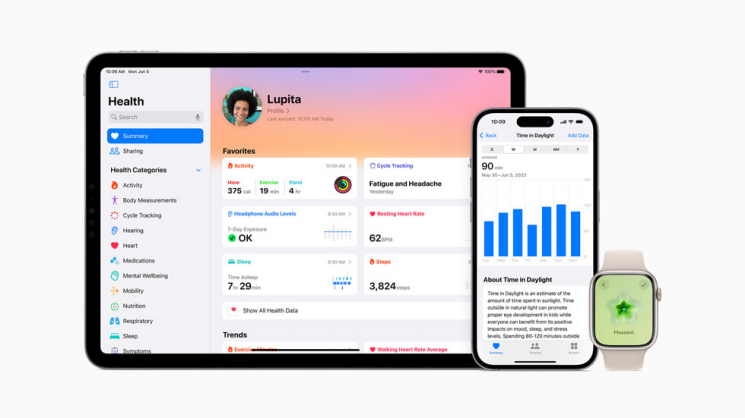
Apple is also incorporating various features into its devices to support children's vision health. The International Myopia Institute recommends that children spend at least 80 to 120 minutes outdoors daily to reduce the risk of myopia. In response, Apple supports a feature in watchOS 10 and Apple Watch that uses ambient light sensors to measure sunlight exposure. When the Apple Watch measures sunlight exposure, users can view this data in the Health app on iOS 17 and iPadOS 17.
Children without iPhones can pair their Apple Watch with a parent's iPhone using Family Setup. This allows parents to monitor their child's sunlight exposure at a glance through the Health Sharing feature.
Additionally, a new screen distance feature using the TrueDepth camera encourages users to move their device away if they have been viewing it too closely?less than 30cm?for an extended period.
Sumbul Desai, Apple's Vice President of Health, said, "Our goal is to help people take care of their own health." She added, "By integrating health features across multiple platforms such as iPhone, iPad, and Apple Watch, we want users to better understand their health."
◆ Samsung Health's future strategy: 'Sleep' = Apple's major healthcare updates are seen as a move to counter Samsung Electronics' rapidly advancing health management solution, Samsung Health. Covering sleep, fitness, mental health services, and health metric monitoring, Samsung Health has grown into a global health solution used by 64 million people worldwide every month.
In particular, Samsung Electronics recently highlighted sleep functionality as one of Samsung Health's future strategies. This is based on the understanding that quality sleep is essential for physical and mental health and is a critical factor connected to overall well-being.
Among all Galaxy Watch users, half use the sleep feature weekly, and 40% of them use it at least three times a week to monitor their sleep health.
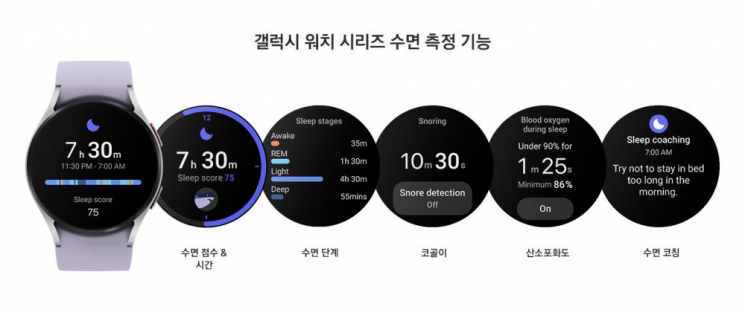
Galaxy Watch users can check various health data through the device's built-in BioActive Sensor. The accelerometer measures tossing and turning during sleep to analyze sleep cycles, while the optical heart rate sensor analyzes sleep depth based on heart rate and oxygen saturation. The BioActive Sensor also measures blood pressure and electrocardiograms to support users' heart health monitoring.
To support users' actual sleep improvement, Samsung Electronics offers personalized sleep coaching programs based on different sleep patterns. These programs are designed to help improve sleep according to classified sleep types. Developed in collaboration with research institutions, the programs are based on cognitive behavioral therapy for insomnia (CBTI), which aids sleep improvement without medication.
The sleep coaching program provides users with easy-to-follow sleep guides and tips for daily life and continuously offers result analysis and encouraging messages to motivate users.
Meanwhile, according to a health industry brief analyzed last year by the Korea Health Industry Development Institute, the global digital healthcare market size is expected to grow from $141.8 billion in 2020 at an annual rate of 17.4%, reaching $426.9 billion by 2027.
© The Asia Business Daily(www.asiae.co.kr). All rights reserved.
![Clutching a Stolen Dior Bag, Saying "I Hate Being Poor but Real"... The Grotesque Con of a "Human Knockoff" [Slate]](https://cwcontent.asiae.co.kr/asiaresize/183/2026021902243444107_1771435474.jpg)
















