10 Climate-Related Bills Among 3,239
99% of National Assembly Members Agree 'Climate Crisis = Economic Crisis'
Nuclear Power, Renewable Energy... Despite Differences, Bipartisan Deliberation Expected
Although the political sphere unanimously identifies 'climate crisis response' as a future policy task for the Republic of Korea, legislative activities have fallen short of expectations.
According to the Legislative Information System on the 9th, a total of 3,239 bills were proposed from January 1 to the 8th of this year. While an average of 20 bills are introduced daily, only 10 bills related to climate crisis response were proposed, accounting for just 0.30% of the total.
During the same period, there were 8 proposals related to disciplinary actions against members of the National Assembly and 2 proposals for consent to arrest, matching the number of bills proposed for climate crisis response. This is a clear example showing that lawmakers treat major discourses like the climate crisis and partisan political disputes with similar weight.
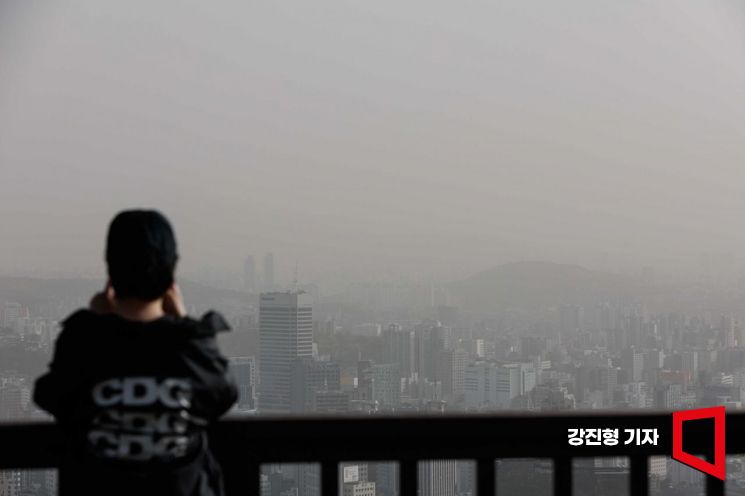 On the 12th, when a fine dust warning was issued across Seoul, the city center viewed from Namsan in Seoul was shrouded in fine dust accompanied by yellow dust. Photo by Jinhyung Kang aymsdream@
8 out of 10 National Assembly Members Say 'Climate Response is Important'... Passive in Legislation
Recently, domestic youth environmental groups such as Greenpeace and Big Wave commissioned the Korea Society Opinion Institute (KSOI) to conduct a 'Climate Crisis Awareness Survey' targeting 299 members of the National Assembly. Among the 101 respondents, 81 (80%) answered that 'responding to the climate crisis is important in legislative activities.' Additionally, 99% of the responding lawmakers agreed that 'the climate crisis is an economic crisis.'
Although the majority of lawmakers recognized the seriousness of the climate crisis, they failed to adequately respond when asked how they are actually addressing it. Only 34% answered the question about 'representative legislative activities contributing to climate crisis response during the first half of the 21st National Assembly,' and only 20% mentioned legislative enactment or amendment activities. This contrasts with the 58.4% (multiple responses, based on first priority) who answered that the role of the National Assembly in responding to the climate crisis is 'enacting and amending policies and laws related to climate crisis response.'
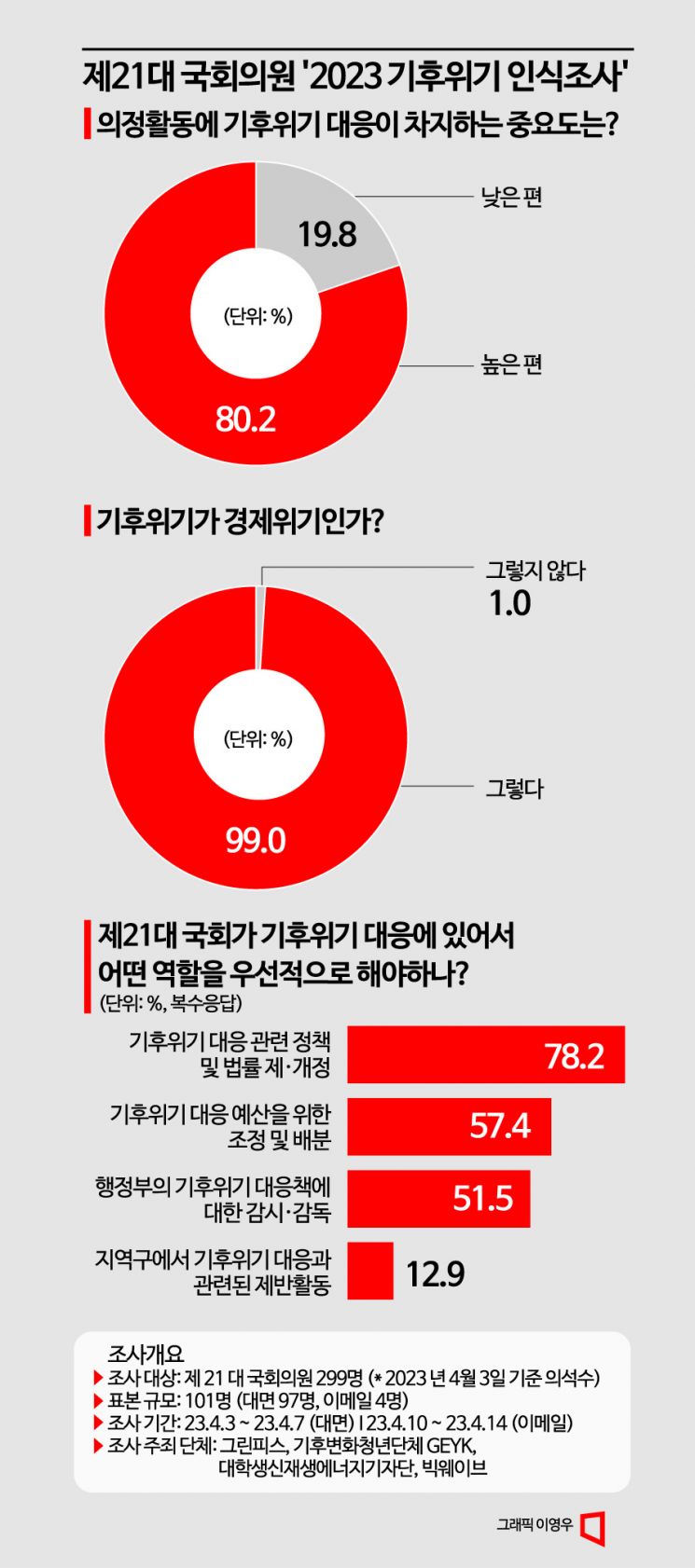
Lee Seon-ju, Greenpeace Climate and Energy Campaigner, said, "With the general election just over 300 days away, the National Assembly must listen to the voices of the public, including the younger generation, and respond to the climate crisis."
President Yoon Promises 30% Reduction in Fine Dust... Renewable Energy Share Must Increase
One of the major tasks in responding to the climate crisis is carbon neutrality. However, some criticize the current government for converging this task solely on 'nuclear power.'
During his presidential campaign, President Yoon Seok-yeol promised to reduce the share of fossil fuel power generation such as coal to two-thirds of the current level and cut fine dust by more than 30%. He also pledged to reverse the phase-out of nuclear power and expand both renewable energy and nuclear power.
According to the '1st National Carbon Neutrality and Green Growth Basic Plan' announced in March this year by the Presidential Committee on Carbon Neutrality and Green Growth 2050, total carbon emissions in 2030 are expected to be 436.6 million tons, a 40% reduction compared to 727.6 million tons in 2018. Reduction measures include reducing oil and coal power generation and expanding renewable energy generation. According to the government's 10th Basic Plan for Electricity Supply and Demand, the share of nuclear power generation increased from 23.9% announced in the 2021 '2030 National Greenhouse Gas Reduction Target (NDC) Enhancement Plan' to 32.4%. Meanwhile, the share of renewable energy generation was revised downward from 30.2% to 21.6%.
Accordingly, opposition parties argue that the share of domestic renewable energy generation must increase significantly to respond not only to the climate crisis but also to initiatives such as RE100 (Renewable Energy 100), which requires 100% renewable energy use at domestic and overseas business sites, and carbon border taxes. Lee Jae-myung, leader of the Democratic Party of Korea, said at the party's Carbon Neutrality Committee launch ceremony last year, "The Yoon Seok-yeol government only emphasizes 'nuclear power expansion' as a solution," adding, "The Democratic Party will open the future of energy policy through coal phase-out, nuclear power reduction, and renewable energy expansion." Earlier this year at the Supreme Council meeting, he again criticized, "We must reflect on the distorted energy business strategy that only emphasizes 'nuclear power.'"
Ruling and Opposition Parties Speak with One Voice on Climate Crisis Response
Although there are differences in solutions regarding carbon neutrality, it is encouraging that the political sphere is speaking with one voice on climate crisis response.
Currently, the 'National Assembly Climate Change Forum,' co-chaired by Yoo Ui-dong of the People Power Party and Han Jeong-ae of the Democratic Party, is active in the National Assembly. Right after the opening of the 21st National Assembly, they led the proposal of climate crisis response-related laws such as the Carbon Neutrality and Green Growth Basic Act and emphasized the need to form a special committee on climate, laying an important foundation for its establishment.
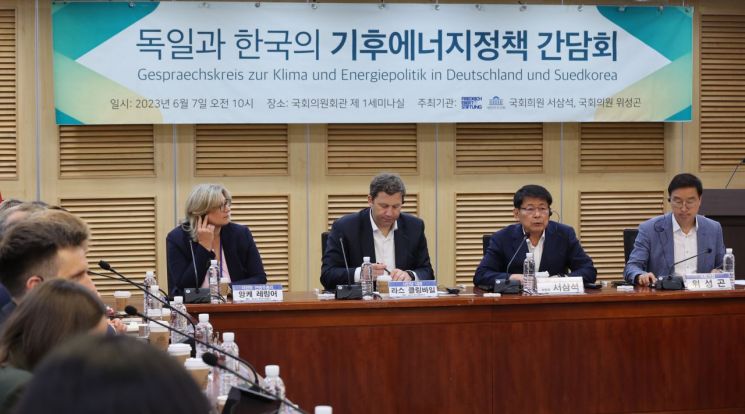
On the 8th, members of the National Assembly Climate Crisis Special Committee held a policy meeting on climate and energy with the leader of the German Social Democratic Party. Seo Sam-seok, chairman of the National Assembly Climate Special Committee, emphasized expanding renewable energy, saying, "The share of renewable energy must be increased for carbon neutrality."
According to Seo's office, Germany's share of renewable energy, which was only 6.2% in 2000, rose to over 40% in 2022, and to steadily increase this share, Germany enacted the 'Climate Protection Act' in 2019. A staff member from the office said, "Regarding climate crisis policies and bills, the National Assembly Climate Special Committee continues to meet and discuss measures with lawmakers from both ruling and opposition parties."
Attention is also focused on the recently surfaced meeting between the leaders of the ruling and opposition parties. So far, People Power Party leader Kim Gi-hyeon and Democratic Party leader Lee Jae-myung have been struggling over the format of the meeting, but since both agreed to the meeting itself, there is hope that if the meeting takes place, deliberations on solutions to the climate crisis will be conducted between the ruling and opposition parties. Ryu Ho-jeong of the Justice Party said, "With various issues such as low birthrate, aging population, climate crisis, and security piling up, it seems necessary to change to a progressive attitude and engage in dialogue."
© The Asia Business Daily(www.asiae.co.kr). All rights reserved.
![Clutching a Stolen Dior Bag, Saying "I Hate Being Poor but Real"... The Grotesque Con of a "Human Knockoff" [Slate]](https://cwcontent.asiae.co.kr/asiaresize/183/2026021902243444107_1771435474.jpg)

















