"I've lived in New York, USA for over 30 years, but I've never seen anything like this." "It feels like the whole world is covered with a sepia (dark brown) filter."
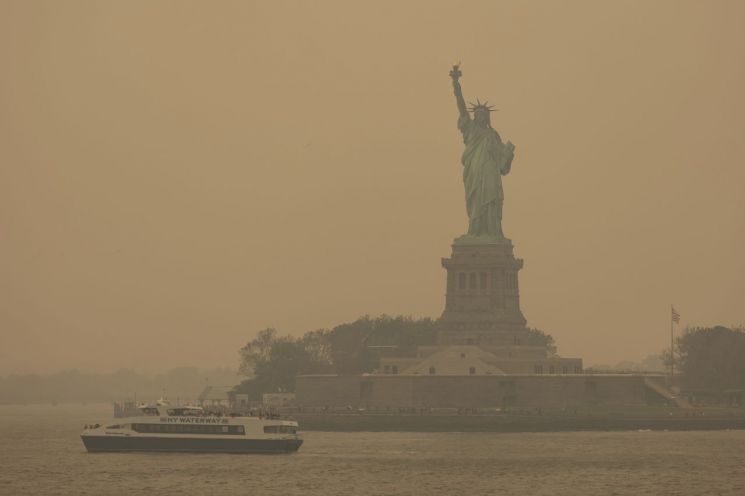 On the 7th (local time), the Statue of Liberty seen from the Staten Island Ferry is covered in smoke.
 [Image source=AP Yonhap News]
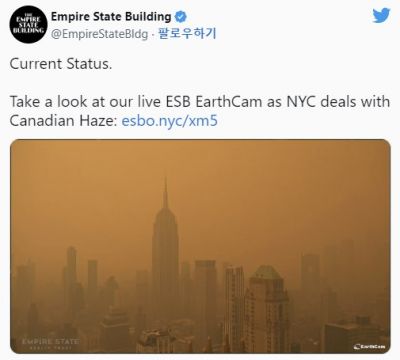
The sky over New York, USA was covered in orange smoke. On the morning of the 7th (local time), the sky looked like it was shrouded in gray fog, but as lunchtime approached, it gradually turned into a deep orange tone. It was as if an Instagram filter had been applied. The Manhattan skyline, an iconic symbol of New York, was engulfed in smoke throughout the day, and a strong smell reminiscent of burnt campfires lingered throughout the city. On the streets, many people were seen taking out masks they used during the pandemic or covering their noses with clothes instead of masks. Caitlin, whom we met near the Bryant Park subway station in Manhattan that afternoon, sighed, "Have you ever seen a situation like this? I've lived in New York for 30 years, but this is the first time. I've canceled all my plans and am heading home."
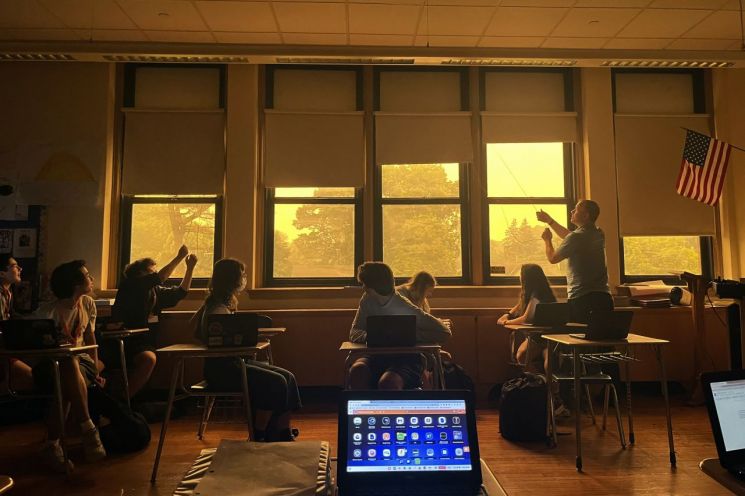
This was due to the aftermath of massive wildfires that had earlier engulfed parts of Canada, spreading to New York and other regions in the United States. Especially with the cold front moving south, the smoke drifted southeast, worsening the situation in New York City. The thick smoke made landmarks like the Empire State Building and the Statue of Liberty barely visible to the naked eye. Shortly after going outside, my throat felt scratchy. Even after returning home, a mild headache persisted. Frederick, who lives in Harlem, New York, shook his head saying, "The whole world is sepia-toned." Emily, who works in Midtown Manhattan, expressed her dismay, saying, "It's getting covered in darker brown smoke. It feels apocalyptic."
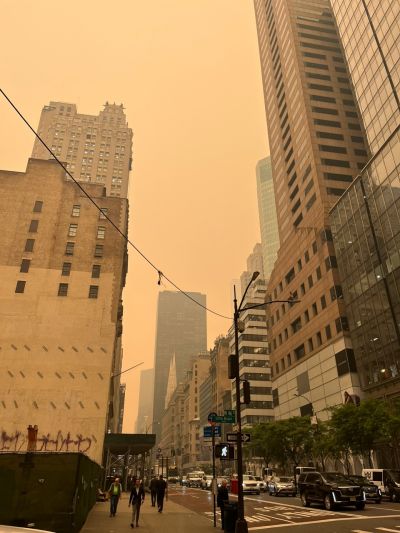 On the 7th (local time), Manhattan downtown New York covered in smoke
 Photo by Joeslgina, New York Correspondent
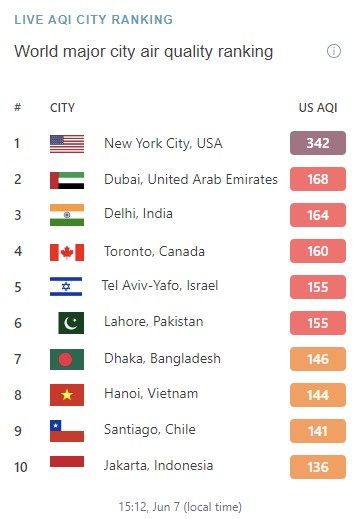
ABC News reported, citing IQ Air, which monitors global air quality, that New York City ranked first in the world for the worst air quality due to this incident. The Air Quality Index (AQI) in New York City reached 342 that afternoon. This was a further deterioration from the previous night's 218, which was reported as the worst air quality among major cities worldwide after New Delhi, India. The AQI, which measures up to 500, is generally considered unhealthy for breathing above 100, and a level above 300 is classified as 'hazardous.' Especially people with heart or lung diseases, the elderly, children, and teenagers are advised to avoid outdoor activities. Dr. Daniel Sterman, head of pulmonary medicine at NYU Langone Health, warned the New York Times (NYT) that due to the spread of COVID-19, many people are more vulnerable to respiratory attacks, increasing the risk of complications.
Currently, New York City has issued air quality health advisories simultaneously across its five boroughs. New York State Governor Kathy Hochul called it an "emergency crisis" and urged people to stay indoors if possible and refrain from outdoor activities. New York City Mayor Eric Adams also described the city's air quality as the worst since the 1960s, calling it an "unprecedented event." He warned, "It is expected to temporarily improve from late tonight until tomorrow morning, but it may worsen again tomorrow afternoon and evening." He explained that this situation could persist for several days.
New York City public schools have all canceled outdoor activities. At New York LaGuardia Airport and New Jersey Newark Liberty International Airport, some flight disruptions and delays are occurring. The New York City Zoo closed earlier than usual at 3 p.m. for the health of animals, staff, and visitors. Mike Hardiman, a meteorologist at the National Weather Service, tweeted, "Upstate New York looks like Mars." In Syracuse and Binghamton, which are closer to the Canadian border than New York City, the AQI exceeded 400. Photos showing thick smoke from wildfires engulfing major landmarks have also been posted online from areas such as Washington and Philadelphia.
However, the Canadian wildfires that caused this situation remain uncontrolled. ABC News reported that 8.7 million acres have burned in Canada during this wildfire season alone, an area larger than the state of Vermont. As of that morning, nearly 250 wildfires were simultaneously burning in eastern and western Canada, prompting smog alerts in parts of Quebec and Ontario. CNN reported that more than 55 million people living in the northeastern, midwestern, and eastern coastal regions of the U.S. are under air quality deterioration warnings.
© The Asia Business Daily(www.asiae.co.kr). All rights reserved.
![Clutching a Stolen Dior Bag, Saying "I Hate Being Poor but Real"... The Grotesque Con of a "Human Knockoff" [Slate]](https://cwcontent.asiae.co.kr/asiaresize/183/2026021902243444107_1771435474.jpg)

















