A blueprint has been presented to expand exports in the health and medical service sector, including increasing the number of foreign patients visiting Korea to 700,000 by 2027 and expanding the overseas advancement of medical institutions to 70 cases. On the 5th, the Ministry of Health and Welfare unveiled the "Plan to Promote Export Activation in the Health and Medical Service Sector" at the 'Service Industry Development TF'.
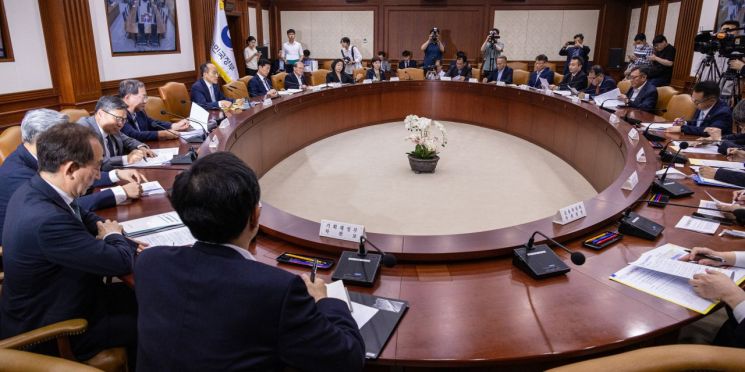 On the afternoon of the 5th, the full meeting of the 'Service Industry Development TF' was held at the Government Seoul Office. [Image source=Yonhap News]
The government plans to first expand the attraction of foreign patients. To this end, the number of excellent institutions authorized by the Ministry of Justice to apply for electronic visas will be expanded from the current 27 to more than 50, and large general hospitals with more than 300 beds will be given additional points if they apply for designation. The quota for simultaneously issued visas will also be raised from 5 to 10, and the scope of caregivers and guardians will be expanded along with the relaxation of required documents. The time required to issue electronic visas will be shortened to 3 days to support foreign patients' convenient entry.
Regional specialized projects linking medical services with tourism and industrial infrastructure will also be expanded. Investments of 3 billion KRW and 1 billion KRW will be made respectively for building wellness and medical tourism convergence clusters and developing regional specialized attraction models. Customized strategies by country will be established considering demand and supply, including Korea’s preferred medical fields. In particular, a 'two-track' strategy will be pursued based on medical fields where Korea excels, such as severe and complex diseases and Korean medicine, in addition to plastic surgery and dermatology. To enhance convenience for foreign patients, dedicated caregivers and professional medical interpreters will be trained, and a 'one-stop channel' providing necessary information from before entry to after return will be established. Measures such as institutionalizing non-face-to-face medical treatment for foreign patients for follow-up care and relaxing pre-reporting obligations will also be promoted.
Furthermore, promotion using metaverse solutions and social networking services (SNS) linked with the Korean Wave will be expanded. Plans were also presented to promote Korean medical services and establish local attraction bases by expanding medical sharing projects and foreign medical personnel training programs. From 2011 to last year, 418 foreign patients from 28 countries received free medical treatment in Korea through the medical sharing project, and 486 medical personnel transferred Korea’s advanced medical technology through online free education during the COVID-19 pandemic.
The plan also includes measures to create an ecosystem for activating medical service exports. The scope of reporting will be expanded according to the types of overseas advancement of medical institutions and systems, and the documents required for reporting will be simplified. Excellent medical institutions will be awarded the 'K-Healthcare (tentative name)' mark for support, and a credit evaluation model suitable for advancing medical institutions will be developed to increase fund utilization and open paths for additional fund formation and investment expansion. Additionally, an integrated portal providing international market trends and country-specific regulatory information will be established, and customized education and consulting for training field experts will be supported.
Alongside this, development and support of medical systems will be strengthened focusing on key areas of promising digital healthcare industry cultivation, and a demonstration support project including efficacy verification with major overseas medical institutions will be newly established. An excellent company certification system will be introduced to grant additional points to companies with export performance, and benefits such as public institution priority purchasing and designation as excellent procurement products are also under consideration. At the government level, international exchanges and cooperation with various countries will be strengthened to provide local promotion and export opportunities such as export consultation meetings.
© The Asia Business Daily(www.asiae.co.kr). All rights reserved.
![Clutching a Stolen Dior Bag, Saying "I Hate Being Poor but Real"... The Grotesque Con of a "Human Knockoff" [Slate]](https://cwcontent.asiae.co.kr/asiaresize/183/2026021902243444107_1771435474.jpg)















