In the June mock test for the College Scholastic Ability Test (CSAT) held on the 1st, the English section was generally of similar difficulty to last year's CSAT. However, it included some difficult vocabulary and trap answer choices, which likely increased the perceived difficulty for test-takers.
Etus Education Evaluation Research Institute assessed that the English section was of comparable difficulty to last year's CSAT.
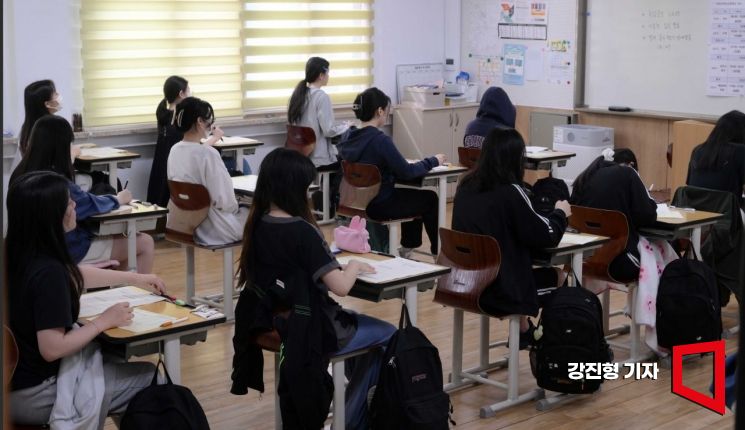 On the morning of June 1st, when the 2024 College Scholastic Ability Test (CSAT) June mock exam was conducted, students at Yeouido Girls' High School in Yeongdeungpo-gu, Seoul, were waiting for the exam start time in their classrooms. Photo by Joint Press Corps
Passages covered a variety of topics such as society, economy, philosophy, science, and technology. Besides the vocabulary with provided annotations, many difficult words were included, making the overall vocabulary level high. Additionally, the presence of trap answer choices likely contributed to a higher perceived difficulty.
Looking at detailed question trends, for the 'blank inference' questions, the answer choices were relatively easy, so if students understood the passage well, the correct answer rate was expected to be not low. However, question 34, which included a sentence with a blank, was difficult to interpret and featured attractive incorrect options, making it challenging for students to find the correct answer.
Unlike recent vocabulary questions that were only underlined, this time the format required selecting the word that fits the context from within a box, which was an unfamiliar question type for test-takers. The passage content also made interpretation and clue inference difficult.
Etus Education Evaluation Research Institute identified questions 34 (blank inference) and 36 (order of the text) as killer questions. In addition, questions 31 (blank inference), 39 (sentence insertion), and 40 (summary) were also evaluated as having traps that could easily cause mistakes.
© The Asia Business Daily(www.asiae.co.kr). All rights reserved.
![Clutching a Stolen Dior Bag, Saying "I Hate Being Poor but Real"... The Grotesque Con of a "Human Knockoff" [Slate]](https://cwcontent.asiae.co.kr/asiaresize/183/2026021902243444107_1771435474.jpg)















