Top 10 Net Purchase Stocks by Domestic Individual Investors in Each Country
Seohak Ants Bet on US Regional Banks but Suffer Losses
Experts Say "Possible Change in Japan's Monetary Policy in the Second Half"
In the first half of this year, a simple comparison of the top 10 net-purchased stock returns among domestic investors known as Donghak Ants and individual investors who invested in the US, China, and Japan showed that Donghak Ants overwhelmingly outperformed. Among overseas stock investors, Ilhak Ants who invested in the Japanese stock market performed well. Although the overall investment scale and index growth rate suggested that Seohak Ants investing in US stocks were likely to have superior performance, many suffered losses by following a 'floor price chasing (Hatta)' strategy, buying US regional bank stocks with high default risk or heavily purchasing 'Meme' stocks.
Donghak Ants Smile Broadly with Secondary Battery Stock Investments
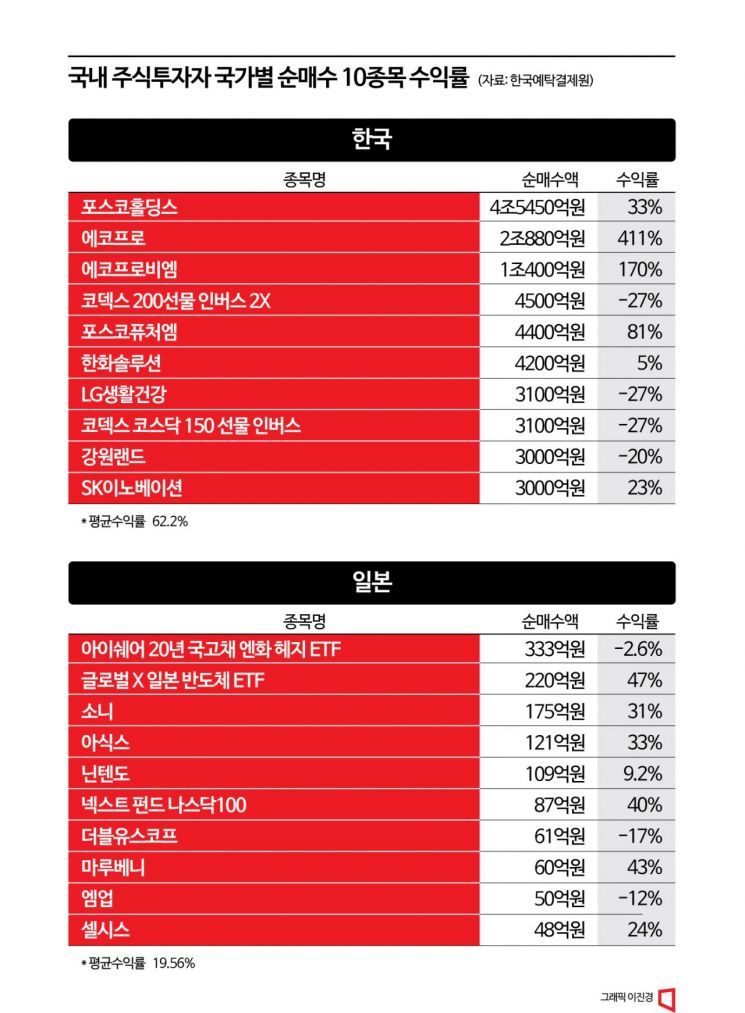
According to the Korea Exchange on the 1st, the simple average return of the top 10 domestic stocks most purchased by individual investors from January 2 to last month 30 was 62%. The average increase rate exceeded 60% because individuals heavily bought secondary battery stocks that showed a sharp rise this year. The stock with the highest return was Ecopro (net purchase of 2.088 trillion KRW). If one had held Ecopro stock since the beginning of this year, it is estimated to have recorded a high return of around 411%. Following were Ecopro BM (170%), POSCO Future M (81%), POSCO Holdings (33%), and SK Innovation (23%). All are representative secondary battery-related stocks.
Ilhak Ants Smile, Seohak Ants and Junghak Ants Cry
Ilhak Ants who invested in the Japanese stock market also showed favorable returns. The average return of the top 10 net-purchased Japanese stocks recorded in the 20% range. Individual investors who invested in China and the US showed poor returns of -15% and -16%, respectively. During the same period, the representative index returns by country were the US Nasdaq index at 25%, followed by the Nikkei Average Stock Price (20.44%), KOSPI (15%), and Shanghai Composite Index (3.5%). However, the returns reflected in individual wallets differed from the index growth rates.
The characteristics of stocks purchased by Ilhak Ants showed a large proportion of consumer discretionary stocks. As the performance of consumer goods companies improved thanks to a solid domestic market, investment sentiment gathered. The total domestic demand share, combining private consumption and private investment in Japan's GDP, reached the 70% range.
Stock prices also showed an upward trend. Sony, the third most purchased stock by Ilhak Ants (17.5 billion KRW), surged 31% this year. Sports brand Asics rose 33%, and Nintendo nearly 10%. Due to the US's aggressive interest rate hikes, the yen-dollar exchange rate dropped to record lows, attracting funds not only to major trading companies but also to stocks that could benefit from the yen's appreciation. Marubeni Corporation, owned by Warren Buffett's Berkshire Hathaway, rose 43% since the beginning of the year. The 'Next Fund Nasdaq 100,' which invests in US Nasdaq stocks in yen, surged 40% solely due to the Nasdaq 100 index rise.
Seohak Ants did not smile despite the index rise. Excessive leverage investment and the failed 'Hatta' strategy targeting the bottom led some investors to record negative returns. Seohak Ants purchased 169.1 billion KRW worth of 'Direxion Daily Semiconductor Bear 3X ETF,' which, if held since early this year, is estimated to have lost over 70%. This is because semiconductor stocks surged sharply in the second quarter due to increased AI-driven semiconductor demand, causing the ETF betting on semiconductor stock declines to plummet. The 'ProShares Ultra Bloomberg Natural Gas ETF' also recorded a -81% return as warmer-than-expected weather led to higher natural gas inventories. Bets on regional banks and meme stocks also failed. Seohak Ants bought US small and mid-sized banks such as 'First Republic' (137.8 billion KRW) and meme stock 'Bed Bath & Beyond' (86.4 billion KRW), both of which were delisted. If not sold in time, they became worthless.
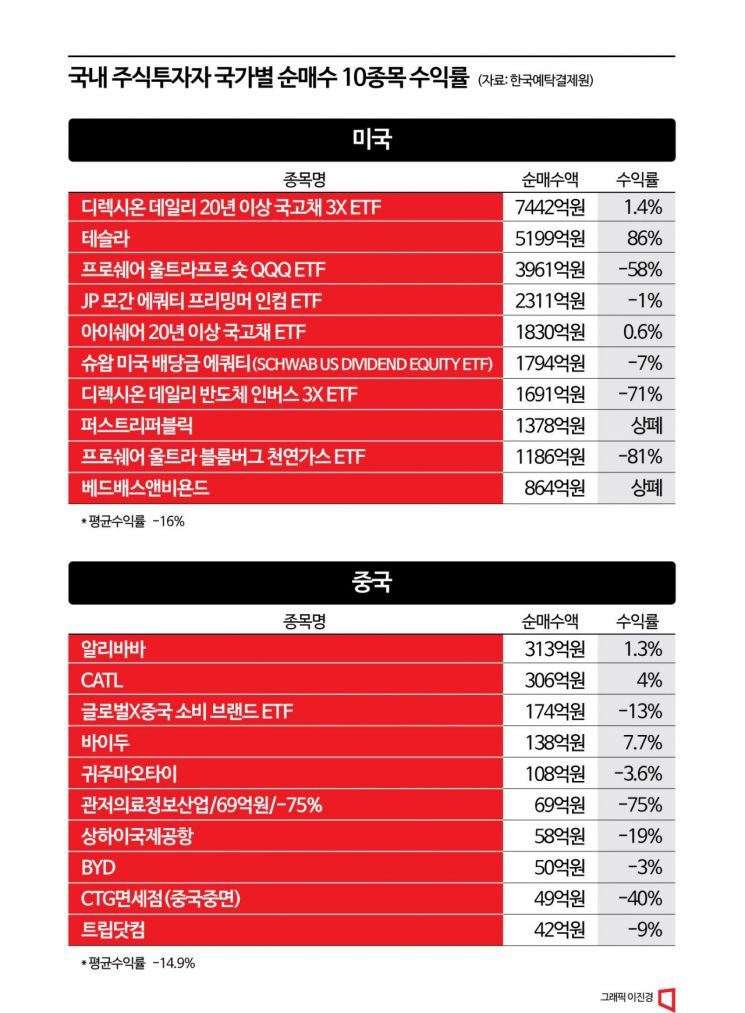
Junghak Ants investing in Chinese or Hong Kong stock markets expected a reopening (economic activity resumption) boom and heavily purchased consumer goods and travel-related stocks. However, due to weak Chinese economic indicators, a sharp drop in the yuan's value, and concerns over a COVID-19 resurgence, both the Chinese stock market and invested companies have shown a downward trend. Recently, the chronic debt problem of the Chinese government resurfaced, keeping the stock market trend unfavorable. Liquor manufacturer Guizhou Maotai fell 3.6% this year. Travel-related stocks such as Shanghai International Airport (-19%), CTG Duty-Free (-40%), and Trip.com (-9%) also declined.
Focus on China's Price Merit, Japan's Monetary Policy Shift, and US Interest Rate Hike Completion
Experts believe that as Chinese stocks have mostly given back their gains due to disappointment over the reopening slump, price merits may revive in the second half of the year. Supported by government policies, attention should also be paid to industries with high growth potential such as secondary batteries, solar power, and finance sectors anticipating domestic demand and corporate profit rebounds.
However, due to weak economic indicators such as last month's retail sales and industrial production growth falling short of market expectations, prolonging the 'Pochi' situation (yuan exceeding 7 per dollar), a long-term approach is advised. Min Byung-gyu, a researcher at Yuanta Securities, predicted, "The insufficient economic momentum to meet heightened expectations and increasing Western containment will be difficult to resolve in the short term."
The Japanese stock market's Nikkei index exceeds 30,000 yen, and foreign investors' net purchases are strong, but caution is needed regarding the Bank of Japan's (BOJ) monetary policy shift. Recently, BOJ Governor Kazuo Ueda indirectly mentioned the possibility of a monetary policy shift through yield curve control (YCC) adjustments, noting that inflation may be higher than expected. Some analyses suggest it is not too late to invest after confirming the scale of corporate profit improvements. Kim Seong-hwan, a researcher at Shinhan Investment Corp., said, "Despite the upward momentum created by Warren Buffett's purchase of Japanese trading company shares, corporate shareholder return policies, and semiconductor companies' investments in Japan, there is no sign of corporate profit improvement yet," expressing concern that "without confirmation of a corporate profit rebound, the continuity of inflows and additional rises will be limited."
The US market is expected to have further upside as the Federal Reserve's interest rate hike cycle nears its end. However, volatility is expected to increase due to US-China conflicts and the 2024 US presidential election. Lee Dong-yeon, a researcher at Korea Investment & Securities, said, "If China's recovery proceeds slowly, US corporate profit forecasts may decline further," adding, "Promising sectors include growth stocks, IT, and government policy beneficiaries."
The domestic stock market is predicted to continue a moderate upward trend under the influence of the US and Chinese economic situations. Especially, expectations for semiconductor industry improvement are strengthening, potentially leading large KOSPI semiconductor stocks such as Samsung Electronics and SK Hynix to drive index gains.
© The Asia Business Daily(www.asiae.co.kr). All rights reserved.
![Clutching a Stolen Dior Bag, Saying "I Hate Being Poor but Real"... The Grotesque Con of a "Human Knockoff" [Slate]](https://cwcontent.asiae.co.kr/asiaresize/183/2026021902243444107_1771435474.jpg)
















