Ministry of Economy and Finance, April National Tax Revenue Status
Despite Tax Collection Like Last Year, 38.5 Trillion Won Shortfall by Year-End
Corporate Income Tax Down 15.8 Trillion Won Due to Deteriorating Operating Profits
This year, the decrease in national tax revenue has reached 34 trillion won, continuing the worst-ever tax shortfall situation. Even if tax revenue for the remaining period comes in at the same scale as last year, a total deficit of 3.85 trillion won will occur.
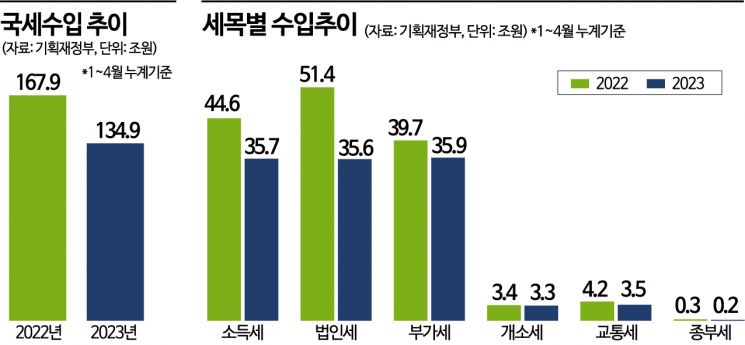
According to the national tax revenue status announced by the Ministry of Economy and Finance on the 31st, the cumulative revenue from January to April was recorded at 134 trillion won. Compared to last year's 167.9 trillion won, tax revenue is short by 33.9 trillion won. Even considering the tax support base effect of 10.1 trillion won as explained by the Ministry, the actual tax shortfall approaches 23.8 trillion won.
The progress rate, which indicates actual tax revenue against the revenue budget, is also insufficient. The progress rate for April was 33.5%, 8.9 percentage points lower than last year's 42.4%. The gap in progress rate also widened compared to the previous month (6.4 percentage points). This means that the speed of tax collection is gradually slowing down. It is also slower compared to the average progress rate of the past five years (37.8%).
The main cause of the tax shortfall crisis is corporate tax. Corporate tax amounted to 35.6 trillion won due to the global economic slowdown and sluggish exports. This is 15.8 trillion won (30.8%) less than the same period last year when 51.4 trillion won was collected. The corporate tax target of 105 trillion won for this year is almost certain to be missed as of last month. Jeong Jeong-hoon, the Ministry of Economy and Finance’s Tax General Policy Officer, explained, “It is appropriate to view this year’s corporate tax at around 90 trillion won.”
Income tax was recorded at 35.7 trillion won, down 8.9 trillion won due to a decrease in real estate transactions and the base effect of comprehensive income tax. The sharp decline in real estate transactions due to interest rate hikes is interpreted as a cause for the decrease in capital gains tax. From November last year to February this year, housing sales volume fell by 38.9% compared to the same period last year, and pure land sales volume dropped by 40.6%.
Value-added tax was 35.9 trillion won, down 3.8 trillion won despite an increase of 1.8 trillion won in April due to consumption recovery, because of the tax revenue deferral base effect. Transportation tax was 3.5 trillion won, down 700 billion won due to the temporary reduction of fuel tax.
© The Asia Business Daily(www.asiae.co.kr). All rights reserved.
![Clutching a Stolen Dior Bag, Saying "I Hate Being Poor but Real"... The Grotesque Con of a "Human Knockoff" [Slate]](https://cwcontent.asiae.co.kr/asiaresize/183/2026021902243444107_1771435474.jpg)















