Seoul City "Receiving Directive Broadcast"
Ministry of the Interior and Safety "No Requests Made"
On the morning of the 31st at 6:32 AM, Seoul City issued an alert regarding North Korea's space launch vehicle, but about 10 minutes later, the Ministry of the Interior and Safety corrected it as a "false alarm," causing significant confusion. Furthermore, conflicting explanations from both sides regarding the issuance and cancellation of the alert heightened public anxiety.
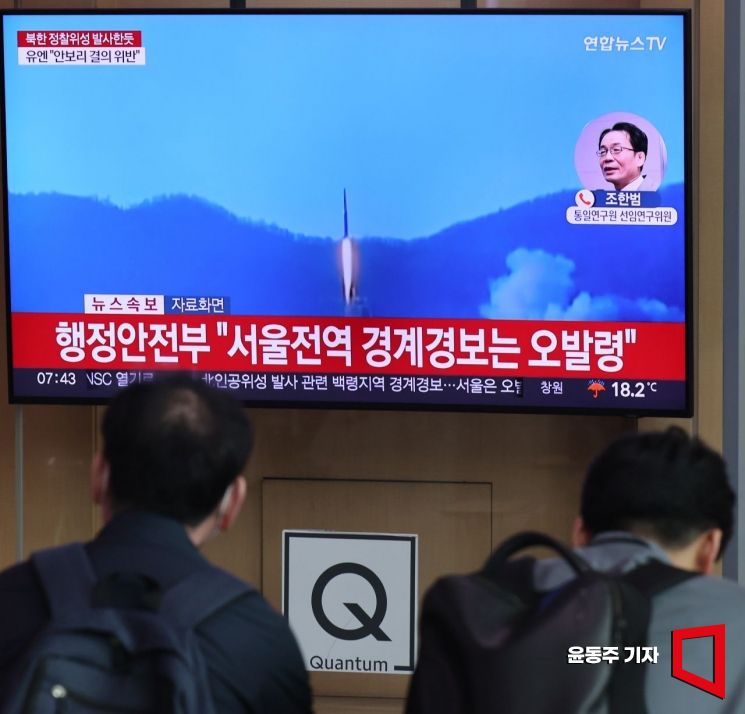 On the 31st, when North Korea launched a space projectile southward, a correction notice from the Ministry of the Interior and Safety stating "The alert issued by Seoul Metropolitan City is a false alarm" was displayed on the news screen in the waiting room of Seoul Station, Jung-gu, Seoul. Photo by Yoon Dong-joo doso7@
Throughout Seoul, an air raid emergency siren issued by Seoul City sounded for about one minute around 6:32 AM. Then, at 6:41 AM, Seoul City sent an emergency disaster alert message. However, at 7:03 AM, the Ministry of the Interior and Safety announced via an emergency disaster message that it was a "false alarm," and later at 7:25 AM, Seoul City sent a notification message canceling the alert.
An official from the Ministry of the Interior and Safety stated regarding Seoul City's alert issuance, "Seoul City's false alarm was not made at the request of the Ministry of the Interior and Safety." However, Seoul City offered a different explanation. Seoul City said, "At 6:30 AM, a command broadcast was received from the Civil Defense Central Control Center of the Ministry of the Interior and Safety," adding, "Before the situation is accurately understood, it is standard procedure in emergencies to first issue an alert and then cancel it after confirming the situation."
The command broadcast from the Civil Defense Central Control Center, as revealed by Seoul City, stated, "At the current time, an actual alert has been issued in Baengnyeong-myeon and Daecheong-myeon. Areas that did not receive the alert should issue their own actual alerts." Depending on interpretation, this could be seen as an instruction to sound the alert.
The Ministry of the Interior and Safety and Seoul City also differ on whether it is appropriate to cancel the alert as an "end of alert" or to treat it as a false alarm. An official from the Ministry of the Interior and Safety said, "An alert implies that there was an actual threat of attack," and argued that since the alert itself was incorrect, it should be treated as a false alarm rather than a cancellation. On the other hand, a Seoul City official explained, "Since the alert was issued first, it was appropriate to take cancellation measures."
Regardless of the controversy between the two sides, criticism that this alert was a "half-measure" seems unavoidable. The alert sent by Seoul City only contained the message: "At 6:32 AM today, an alert has been issued for the Seoul area. Citizens are advised to prepare for evacuation, and please ensure that children and the elderly can evacuate first." It lacked any specific information about what situation had occurred or how to evacuate. Due to this inadequate alert, many Seoul citizens simultaneously attempted internet searches, causing temporary access issues with Naver Mobile on smartphones.
© The Asia Business Daily(www.asiae.co.kr). All rights reserved.
![Clutching a Stolen Dior Bag, Saying "I Hate Being Poor but Real"... The Grotesque Con of a "Human Knockoff" [Slate]](https://cwcontent.asiae.co.kr/asiaresize/183/2026021902243444107_1771435474.jpg)
















