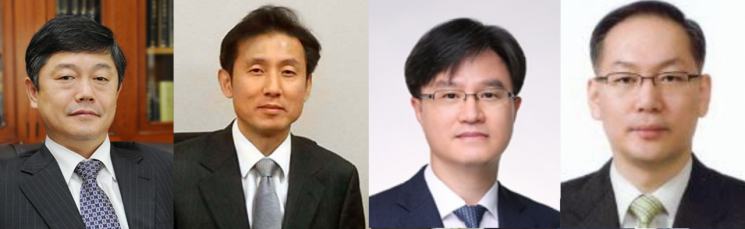
 From the left, Yoon Joon, Chief Judge of the Seoul High Court; Seo Kyung-hwan, Presiding Judge of the Seoul High Court; Son Bong-gi, Presiding Judge of the Daegu District Court; Eom Sang-pil, Presiding Judge of the Seoul High Court (in order of Judicial Research and Training Institute class and Korean alphabetical order).
 [Photo by Supreme Court]
The Supreme Court Justice Nomination Committee has recommended eight candidates as successors to Justices Cho Jae-yeon and Park Jung-hwa, who will retire in July.
On the 30th, starting at 2 p.m., the committee, including Chairperson Choi Young-ae (former Chairperson of the National Human Rights Commission) and all members, conducted a review of the qualifications of nominees recommended from inside and outside the judiciary. After the review, eight candidates were recommended to Chief Justice Kim Myung-soo from a total of 37 Supreme Court justice candidates as nomination candidates.
The candidates recommended on this day are Yoon Joon, Chief Judge of the Seoul High Court (62, Judicial Research and Training Institute Class 16); Seo Kyung-hwan, Presiding Judge of the Seoul High Court (57, Class 21); Son Bong-gi, Presiding Judge of the Daegu District Court (58, Class 22); Eom Sang-pil, Presiding Judge of the Seoul High Court (55, Class 23); Kwon Young-jun, Professor at Seoul National University Law School (53, Class 25); Park Soon-young, Judge of the Seoul High Court (57, Class 25); Shin Sook-hee, Standing Member of the Sentencing Commission (54, Class 25); and Jung Kye-sun, Presiding Judge of the Seoul Southern District Court (54, Class 27).
Yoon Joon, Chief Judge of the Seoul High Court, is from Haenam, Jeollanam-do, and graduated from Daeseong High School and Korea University Law School. He began his judicial career at the Gangneung branch of the Chuncheon District Court and has served as ▲Judge of the Seoul District Court ▲Judge of the Seoul High Court ▲Research Judge at the Supreme Court ▲Professor at the Judicial Research and Training Institute ▲Presiding Judge of the Seoul Central District Court ▲Senior Presiding Judge of the Seoul Southern District Court ▲Presiding Judge of the Daejeon High Court ▲Presiding Judge of the Seoul High Court ▲Senior Bankruptcy Judge of the Seoul Central District Court ▲Chief Judge of the Suwon District Court ▲Chief Judge of the Gwangju High Court, and has been serving as Chief Judge of the Seoul High Court since February this year. He is the son of the late former Supreme Court Justice Yoon Kwan.
Seo Kyung-hwan, Presiding Judge of the Seoul High Court, is from Seoul and graduated from Konkuk University High School and Seoul National University Law School. He began his judicial career at the Western Branch of the Seoul District Court and has served as ▲Judge of the Seoul District Court ▲Judge of the Seoul High Court ▲Litigation Review Officer at the Court Administration Office ▲Presiding Judge of the Jeonju District Court ▲Research Judge at the Supreme Court ▲Presiding Judge of the Incheon District Court ▲Presiding Judge of the Seoul Western District Court ▲Presiding Judge of the Seoul Central District Court ▲Presiding Judge of the Gwangju High Court ▲Presiding Judge of the Seoul High Court ▲Senior Presiding Judge of the Seoul Bankruptcy Court ▲Chief Judge of the Seoul Bankruptcy Court, and is currently serving as Presiding Judge of the Seoul High Court. He handled the second trial of the Sewol ferry incident at the Gwangju High Court, recognizing Captain Lee Jun-seok's guilt for murder and sentencing him to life imprisonment.
Son Bong-gi, Presiding Judge of the Daegu District Court, is from Daegu and graduated from Dalseong High School and Korea University Law School. He began his judicial career at the Daegu District Court and has served as ▲Judge of the Daegu High Court ▲Research Judge at the Supreme Court ▲Chief Judge of the Sangju branch of the Daegu District Court ▲Professor at the Judicial Research and Training Institute ▲Presiding Judge of the Daegu District Court ▲Senior Presiding Judge of the Ulsan District Court ▲Chief Judge of the Daegu District Court, and is currently serving as Presiding Judge of the Daegu District Court.
Eom Sang-pil, Presiding Judge of the Seoul High Court, is from Jinju, Gyeongsangnam-do, and graduated from Dongmyeong High School in Jinju and Seoul National University Law School. He began his judicial career at the Seoul District Court and has served as ▲Judge of the Seoul Family Court ▲Judge of the Seoul High Court ▲Research Judge at the Supreme Court ▲Judge of the Seoul Central District Court ▲Presiding Judge of the Jeonju branch of the Changwon District Court ▲Professor at the Judicial Research and Training Institute ▲Presiding Judge of the Seoul Central District Court ▲Presiding Judge of the Seoul Family Court ▲Presiding Judge of the Suwon High Court, and is currently serving as Presiding Judge of the Seoul High Court. He also presided over the appellate trial concerning allegations of admission fraud and private equity fund related charges involving former Dongyang University professor Jung Kyung-shim's children.
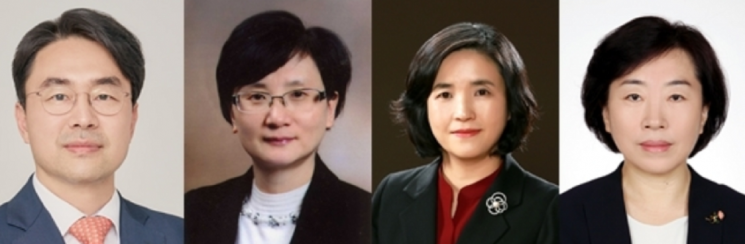 From the left, Kwon Young-jun, Professor at Seoul National University Law School; Park Soon-young, Judge at Seoul High Court; Shin Sook-hee, Standing Commissioner of the Sentencing Commission; Jung Kye-seon, Chief Judge at Seoul Southern District Court (in order of Judicial Research and Training Institute class and Korean alphabetical order)
 [Photo by Supreme Court]
Kwon Young-jun, Professor at Seoul National University Law School, is from Daegu and graduated from Daegun High School and Seoul National University Law School. He began his judicial career at the Seoul District Court and served as ▲Judge of the Eastern Branch of the Seoul District Court ▲Judge of the Daegu District Court ▲Judge at the Planning and Coordination Office of the Court Administration (concurrently serving as Judge of the Suwon District Court) before leaving the judiciary. In 2006, he was appointed as an assistant professor at Seoul National University College of Law. He later became an associate professor and is currently a professor at Seoul National University Law School. He holds various positions including member of the National Intellectual Property Committee, Chairperson of the Legal Advisory Committee of the Ministry of Justice, Vice President of the International Association of Commercial Law, and Vice President of the Korean Civil Law Association.
Park Soon-young, Judge of the Seoul High Court, is from Mokpo, Jeollanam-do, and graduated from Eunkwang Girls' High School and Korea University Law School. She began her judicial career at the Daejeon District Court and has served as ▲Judge of the Incheon District Court ▲Judge of the Seoul District Court ▲Judge of the Seoul Administrative Court ▲Judge of the Seoul High Court ▲Research Judge at the Supreme Court ▲Judge of the Seoul High Court ▲Judge of the Daejeon High Court ▲Judge of the Incheon Trial Division of the Seoul High Court, and is currently serving as a judge of the Seoul High Court. She was appointed as a member of the Central Election Commission in 2021 and currently holds this position concurrently with her role as a judge of the Seoul High Court.
Shin Sook-hee, Standing Member of the Sentencing Commission, is from Yangsan, Gyeongsangnam-do, and graduated from Changmoon Girls' High School and Seoul National University Law School. She began her judicial career at the Seoul District Court and has served as ▲Judge of the Seoul Family Court ▲Judge of the Daejeon District Court ▲Judge of the Eastern Branch of the Seoul District Court ▲Judge of the Seoul Central District Court ▲Judge of the Seoul High Court ▲Professor at the Judicial Research and Training Institute ▲Presiding Judge of the Jeju District Court ▲Judge of the Seoul High Court ▲Judge of the Suwon High Court ▲Judge of the Changwon Trial Division of the Busan High Court, and is currently serving as a standing member of the Sentencing Commission.
Jung Kye-sun, Presiding Judge of the Seoul Southern District Court, is from Yangyang, Gangwon-do, and graduated from Chungbuk Chungju Girls' High School and Seoul National University Department of Public Law. He began his judicial career at the Seoul District Court and has served as ▲Judge of the Seoul Administrative Court ▲Judge of the Goyang branch of the Uijeongbu District Court ▲Judge of the Seoul Southern District Court ▲Judge of the Seoul High Court ▲Presiding Judge of the Ulsan District Court ▲Professor at the Judicial Research and Training Institute ▲Presiding Judge of the Seoul Central District Court ▲Presiding Judge of the Seoul Western District Court, and is currently serving as Presiding Judge of the Seoul Southern District Court. In 2010, he was dispatched to the Constitutional Court while serving as a judge of the Seoul High Court. He served as president of the International Human Rights Law Association and was the first woman to preside over the Seoul Central District Court's Anti-Corruption Division, where she sentenced former President Lee Myung-bak to 15 years in prison on charges including embezzlement and bribery.
The Nomination Committee stated, "Based on recommendation letters, opinion letters, and various review materials concerning the candidates' major rulings, work records, financial status, criminal records, and military service, we thoroughly verified the candidates' qualifications, abilities, and morality as Supreme Court justices. We also deeply discussed diverse opinions gathered from various sectors of society regarding the desirable candidates for Supreme Court justices."
Chairperson Choi Young-ae said, "Our society is increasingly experiencing conflicts and disputes in various fields. Therefore, the responsibility of Supreme Court justices, who make the final legal judgments on diverse social issues and protect the freedoms and fundamental rights of the people at the highest court of the Republic of Korea, is truly significant, and their status is highly symbolic."
Chairperson Choi added, "In this Nomination Committee, we aimed to recommend candidates who possess not only professional and rational judgment as legal experts but also warm social sensitivity toward socially vulnerable and minority groups, human rights insight encompassing diverse values of our society, and a strong sense of mission for judicial independence."
She also stated, "We sought to recommend candidates who can respond to the evolving concepts and categories of international human rights. Furthermore, since the Supreme Court's decisions are not limited to the cases at hand but serve as a framework indicating the values and directions our society should pursue, whether candidates meet this criterion was also a key factor."
She added, "However, the range of candidates this time was not broad in terms of diversity, but within such limitations, we tried to consider diversity in career, background, and gender as much as possible."
Chief Justice Kim plans to disclose the major rulings and work records of the candidates recommended by the Nomination Committee and collect various opinions from inside and outside the judiciary on their suitability as Supreme Court justices until the 2nd of next month. He will then select two new Supreme Court justice candidates and recommend their appointment to President Yoon Seok-youl.
© The Asia Business Daily(www.asiae.co.kr). All rights reserved.
![Clutching a Stolen Dior Bag, Saying "I Hate Being Poor but Real"... The Grotesque Con of a "Human Knockoff" [Slate]](https://cwcontent.asiae.co.kr/asiaresize/183/2026021902243444107_1771435474.jpg)
















