'No.1 Domestic Market Share in Anticancer Drugs' Boryung
Strong Presence in Paclitaxel and Neutropenia Markets
Handles Sales of Original 'Taxol' and 'Neulasta'
Achieves Market Share and Revenue Rebound
Patent expiration is the most critical moment for original pharmaceuticals. As soon as the exclusive sales period ends, the market share tends to shrink due to the influx of generics or biosimilars. However, there are cases in the domestic anticancer drug market where companies overcome this crisis through sales power and even revive their market position.
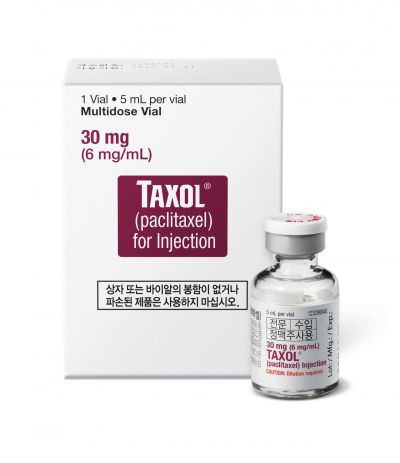
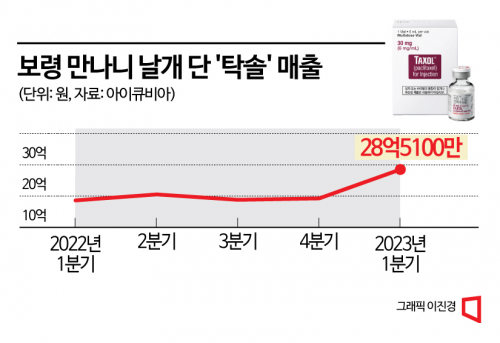
According to IQVIA, a pharmaceutical market research firm, the original anticancer drug 'Taxol,' which contains the active ingredient paclitaxel, recorded sales of 2.851 billion KRW in the first quarter of this year. Considering that the paclitaxel market is worth about 40 billion KRW annually, a market share of 27% is not particularly high.
However, the evaluation changes when compared to previous sales performance. Taxol's sales in the first quarter of last year were 1.861 billion KRW, showing a remarkable growth of 53.2% year-on-year in the first quarter of this year. Quarterly sales last year were around 1.9 to 2 billion KRW, with a market share of about 20%, so this is a sharp increase. This is in stark contrast to the period after the patent expired in 2001, when various generics flooded the market, causing an average annual sales decline of 10%, with last year's annual sales dropping to about 7.7 billion KRW.
The rebound is attributed to a change in the sales company. Boryung Pharmaceutical Co., Ltd. (Boryung), which had previously handled sales of other paclitaxel generics and raised their market share to 65%, started selling Taxol from this year. Paclitaxel is an anticancer drug used to treat ovarian, breast, lung, and stomach cancers, with Taxol developed by Bristol-Myers Squibb (BMS) as the original drug. In March last year, German company Sepla Pharm acquired the global rights to Taxol from BMS, necessitating a reset of domestic rights. Boryung signed an exclusive domestic contract with Sepla Pharm and took over sales. Considering that Boryung began full-scale sales at the end of January, the rapid increase in market share was achieved in just two months.
Boryung is recognized as the leading company in the domestic anticancer drug market. After achieving 160.6 billion KRW in annual anticancer drug sales last year, a 61% increase from the previous year, it recorded 52 billion KRW in sales in the first quarter of this year, a further 47% growth year-on-year. In addition to paclitaxel, Boryung offers a variety of anticancer drugs such as 'Zepzelca' and 'Alimta,' maintaining a diverse portfolio ranging from synthetic drugs to biosimilars and anticancer adjuvants, providing various treatment options to medical professionals and patients.
Notably, in 2020, Boryung established a dedicated anticancer division called 'Onco' to continuously focus on anticancer drug sales. They appointed an executive-level director to lead the division and assigned sales representatives exclusively to anticancer drugs to enhance expertise. Boryung is the only domestic pharmaceutical company operating an oncology-focused organization at the division level.
A Boryung representative explained, "Although it requires double the sales and marketing personnel, this strategy aims for specialized approaches by disease group." They added, "We also operate separate organizations for renal and central nervous system (CNS) diseases."
Another example where Boryung's sales power shines is in the market for neutropenia treatments, a side effect of anticancer therapy. During chemotherapy, neutrophils, which protect against bacterial and fungal infections in white blood cells, often decrease. To prevent this, patients must regularly receive injections of neutropenia treatments in line with their chemotherapy cycles.
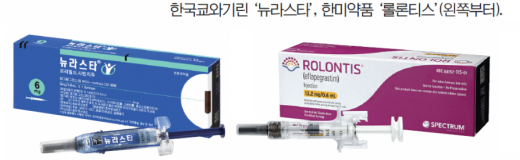
In South Korea alone, this market is worth about 100 billion KRW. Among second-generation treatments with extended dosing intervals, the original drug 'Neulasta' by Korea Kyowa Kirin, containing pegfilgrastim, has maintained the top annual sales position for several years with 31 billion KRW in sales last year. Although a biosimilar briefly overtook Neulasta in sales in the fourth quarter of 2021, Neulasta regained and maintained its lead from the first quarter of last year.
The key player here was also Boryung. From 2018 to 2021, Boryung handled sales of biosimilars, growing them into strong contenders, but from last year, it took over Neulasta's sales. Boryung succeeded in growing annual sales by 27% and increasing the annual market share from 46% in 2021 to 51%, surpassing the majority.
Considering the rapid growth of Hanmi Pharmaceutical's new drug 'Rolontis' (active ingredient eflapegrastim), launched last year, Boryung is evaluated to have successfully defended its market share through strong sales efforts. Rolontis, priced at 490,000 KRW under health insurance, is the only second-generation treatment priced below 500,000 KRW, which has fueled its rapid sales growth. In the first quarter of this year, its domestic sales exceeded 2.3 billion KRW, raising its market share to 14%.
© The Asia Business Daily(www.asiae.co.kr). All rights reserved.
![Clutching a Stolen Dior Bag, Saying "I Hate Being Poor but Real"... The Grotesque Con of a "Human Knockoff" [Slate]](https://cwcontent.asiae.co.kr/asiaresize/183/2026021902243444107_1771435474.jpg)

















