Gaeddal·Chinmyeong "Realizing Equality of Party Member Votes"
Bimyeong "Regional Distribution Counterbalance"
'Supporting Lee Jae-myung?' Internal Party Criticism Also Raised
The Democratic Party of Korea has faced demands to abolish the 'delegate system' following the 'money envelope scandal.' These demands have been raised mainly by pro-Lee Jae-myung faction (pro-Lee Jae-myung group) lawmakers and hardline party members known as 'Gaeddal (Daughters of Reform),' sparking criticism within the party that this is an attempt to create a favorable structure for Lee Jae-myung, the party leader. With the general election 10 months away and the party leadership contemplating reform plans, attention is focused on whether such reforms will be realized.
According to the Democratic Party's petition site, the National Response Center, on the 24th, a petition demanding the 'abolition of the delegate system' garnered 50,000 signatures, making it subject to a mandatory party response. The petitioner argued, "The root cause of the recent money envelope incident lies in the delegate system, which even the People Power Party has abolished," and added, "The Democratic Party, which has operated with vested interests without listening to party members' voices, must be criticized."
Following this petition, voices within the party calling for the abolition of the delegate system have continued. The Democratic Party Innovation Action held a press conference at the National Assembly on the 22nd, stating, "The answer is Democratic Party innovation and strengthening party member democracy," and pointed out, "The delegate system, which violates the principle of vote equivalence and distorts democracy, must be abolished first." On the same day, the Association of Non-incumbent Regional Committee Chairs also delivered reform proposals, including the abolition of the delegate system, to the party leadership.
What is the Democratic Party's Delegate System?
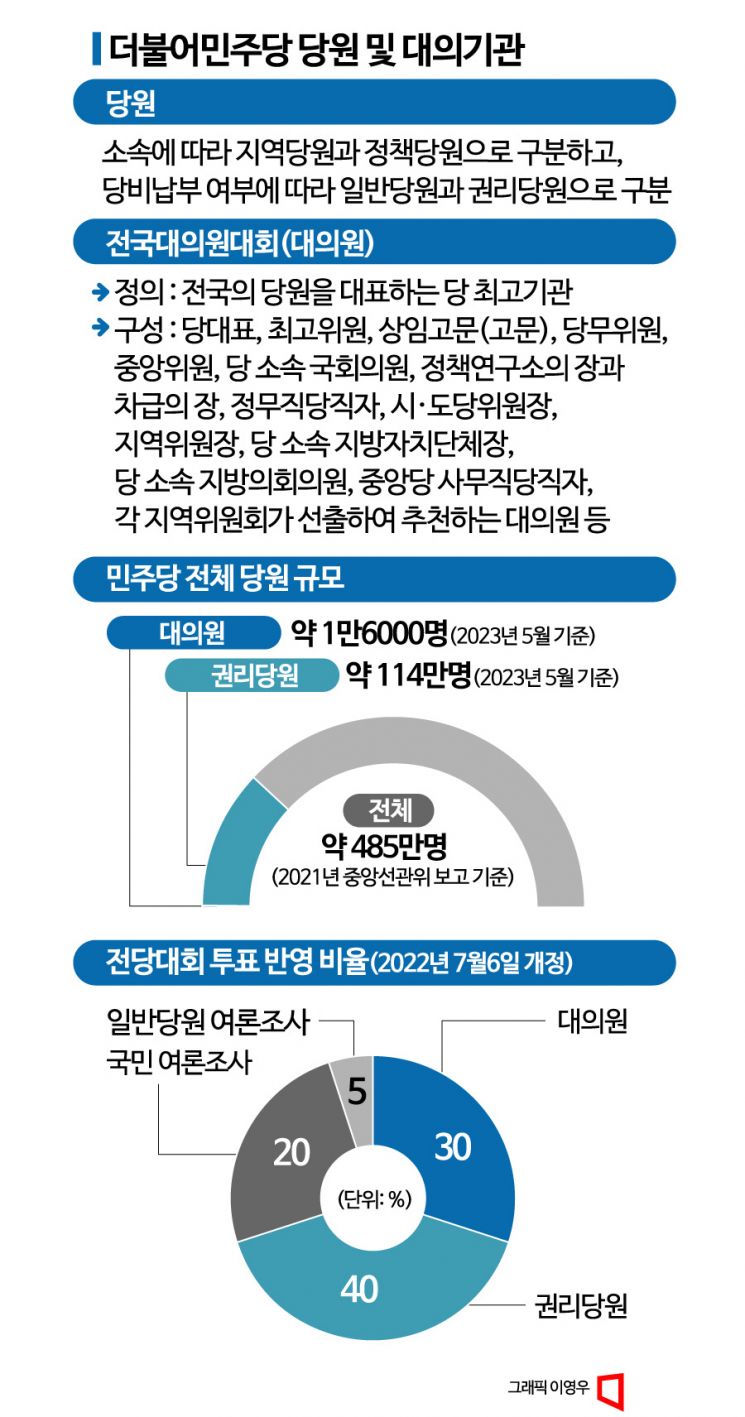
Currently, the Democratic Party has 16,000 delegates, which is about 14% of the 1.14 million registered party members. Delegates consist of members of the National Assembly, regional committee chairs, party officials, and key local party members, and each regional committee regularly elects delegates. Delegates mainly exercise authority in the election of the party leader and supreme council members at the national delegate convention, as well as in the procedures for establishing and amending the party constitution. The voting weight in the party convention for selecting the party leadership is 40% for registered party members, 30% for delegates, 25% for opinion polls, and 5% for general party members. Since one delegate's vote is effectively equivalent to the votes of 50 to 60 registered party members, there have been claims that the value of delegate votes is excessively high.
The Democratic Party introduced the delegate system in the past to balance the number of party members concentrated in the Honam region. It was a mechanism to adjust the value of votes by having delegates from regions with fewer party members, such as Yeongnam. Senior lawmaker Ahn Gyu-baek argued on Facebook last month, "While Honam is indeed the root of our party, the decision-making process as a national party should not be distorted," and emphasized the necessity by saying, "Delegates have the important role of balancing the uneven regional distribution of registered party members' rights."
However, the delegate system has been pointed out as the cause of the recent 'money envelope scandal.' The allegation surfaced that Kang Rae-gu, chairman of the Korea Public Institution Audit Association and the regional committee chair of Dong-gu, Daejeon, at the time of the party convention in May 2021 when former leader Song Young-gil was elected, illegally provided funds to party lawmakers through former Democratic Party deputy secretary-general Lee Jung-geun. The election method, where regional committee chairs manage a small number of delegates, raised concerns about the risk of 'money politics.' At that time, the voting weight in the party convention was 45% for delegates and 40% for party members, with delegates having a higher proportion. The prosecution suspects that those who received money at the party convention were delegates.
Hardline party members known as 'Gaeddal' have pointed out the issue of 'vote equivalence.' They argue that the voting weight of registered party members, who pay a certain membership fee and have increased compared to the past, should be raised. Some have also claimed that "all party members' votes should be recognized as having equal value." In fact, at the Democratic Party convention held last August, reflecting such demands, the proportion of delegate votes was reduced by 15 percentage points from 45% to 30%.
Would Abolishing the Delegate System Favor Lee Jae-myung?
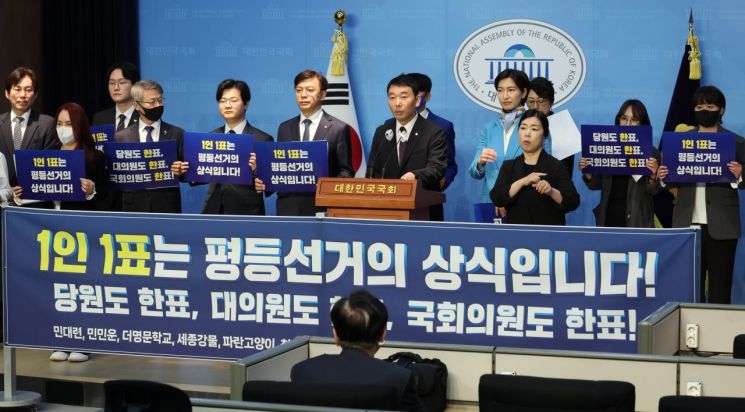
The problem is that opinions on abolishing the delegate system are again divided along factional lines among incumbent lawmakers within the party. Prominent pro-Lee Jae-myung faction lawmakers Kim Yong-min and Min Hyung-bae held a press conference with 11 party organizations at the National Assembly's communication office on the 12th, ahead of a party caucus meeting, advocating for the abolition of the delegate system.
They criticized, "As the number of registered party members increases, the relative value of delegate votes rises, creating a paradoxical situation where one delegate vote, which corresponded to 33 registered party member votes before the presidential election, now equals 54 registered party member votes among today's 1.14 million registered party members," and added, "This is a highly undemocratic practice that directly violates the principle of equal voting rights in democratic elections."
Supreme Council member Jung Cheong-rae also argued at the Supreme Council meeting on the morning of the 22nd, concluding his remarks by saying, "In Democratic Party elections, both the party leader and party members should each have one vote," and insisted, "The delegate system must be abolished." The next day, lawmaker Ahn Min-seok wrote on Facebook, "Leader Lee and the Democratic Party should go all-in on bold Democratic Party innovation, starting with the abolition of the delegate system and the central committee cutoff."
Non-Pro-Lee Faction: "Delegate System Essential for a National Party"
Among the non-pro-Lee faction, there is suspicion about the pro-Lee faction's public advocacy for abolishing the delegate system. They argue that the pro-Lee faction intends to expand the influence of registered party members to strengthen Lee Jae-myung's position. The non-pro-Lee faction has demanded that the pro-Lee leadership, including Lee, 'break ties' with Gaeddal, fearing that abolishing the delegate system could increase the influence of the hardline registered party members. Lawmaker Park Yong-jin pointed out, "If the problem is with those who received money, then the shares of lawmakers or regional committee chairs should be removed, so why abolish the delegate system, which is unrelated? This could actually distance the party from public sentiment."
Park Kwang-on, floor leader belonging to the non-pro-Lee faction, also rebutted on KBS 'News 9' on the 30th of last month, saying, "While the delegate system has some flaws revealed this time, it is an essential system for the Democratic Party's nationalization," and added, "It is premature to say that the delegate system should be abolished based solely on the current revealed flaws."
Earlier, the Democratic Party announced the establishment of an innovation body for political reform with 10 months remaining before the general election. Because of this, there is speculation that abolishing the delegate system could be considered as one of the political reform measures. On the 22nd, Lee Jae-myung hinted at party innovation during a meeting with non-incumbent regional committee chairs, saying, "I think it is time to seriously discuss securing intra-party democracy, political reform, and political innovation in the Democratic Party."
© The Asia Business Daily(www.asiae.co.kr). All rights reserved.
![Clutching a Stolen Dior Bag, Saying "I Hate Being Poor but Real"... The Grotesque Con of a "Human Knockoff" [Slate]](https://cwcontent.asiae.co.kr/asiaresize/183/2026021902243444107_1771435474.jpg)


















