Kim I-bae Jeju Air President VS Jeong Hong-geun T'way Air President
From FSC Competitors to LCC Competitors
LCC No.1 Jeju Air... Breaking Limits T'way Air
Kim I-bae (57), CEO of Jeju Air, and Jung Hong-geun (64), CEO of T'way Air, share many similarities but are completely different types of managers. Their common point is that both come from full-service carriers (FSC) and left to lead independent low-cost carriers (LCCs).
CEO Kim graduated from Seoul National University with a degree in International Business and completed his MBA at Syracuse University in the United States. He joined Asiana Airlines in 1988. In other words, he is an expert in strategy and finance. Since June 2020, he has been leading Jeju Air. Colleagues at Asiana Airlines described him as a "rational person with excellent judgment." An Asiana Airlines official said, "I remember that no matter what kind of report he received, he was excellent at quickly grasping the core and making decisions." They added, "While other executives sometimes made unreasonable decisions, CEO Kim rarely did."
Jung Hong-geun, CEO of T'way Air, graduated from Korea University with a degree in Political Science and Diplomacy and joined Korean Air in 1986. He later worked at Jin Air and has been leading T'way Air since 2015. He is also known as an "LCC industry expert." He was involved when Korean Air established the low-cost carrier Jin Air. Simply put, he is a seasoned manager who has experienced the rise of low-cost carriers in Korea from their inception to the present. An industry insider said, "CEO Jung has experience ranging from Korean Air to Jin Air," adding, "He is the person who knows the airline industry, especially LCCs, most deeply."
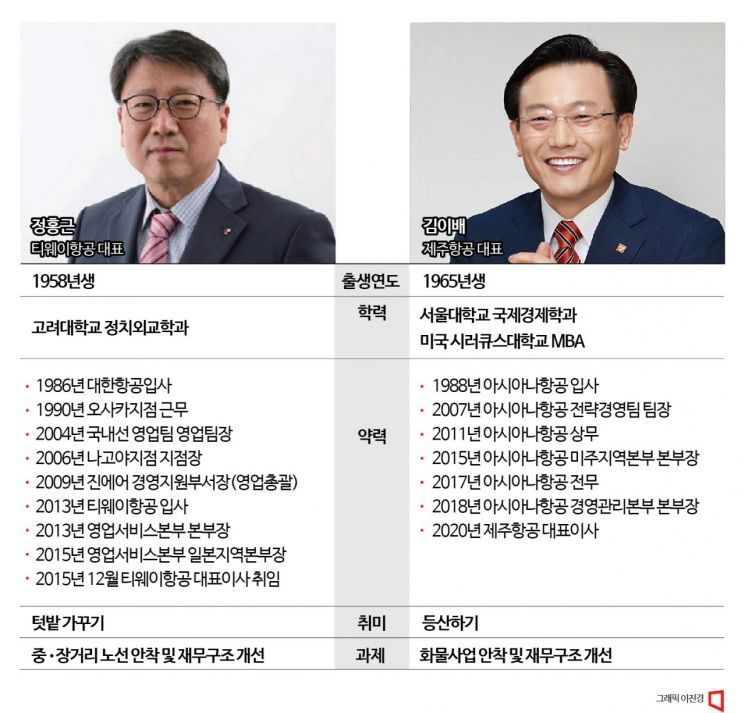
CEO Kim, a finance and strategy expert, is praised for his rationality and excellent judgment. When he took office as CEO of Jeju Air in June 2020, the company was on a downward spiral. Due to the Korea-Japan economic conflict in 2019, the company recorded an operating loss, and the COVID-19 pandemic began in 2020. As a result, Jeju Air posted operating losses of 32.9 billion KRW in 2019 and 335.8 billion KRW in 2020.
In this difficult situation, Jeju Air was the first among LCCs to expand its routes to Japan as soon as Japan allowed visa-free entry last year. As a result, Jeju Air transported 601,127 passengers on Japanese routes last year, ranking first among domestic airlines in terms of passenger numbers. The second and third places were Asiana Airlines (440,953 passengers) and Korean Air (428,367 passengers), respectively.
In the first quarter of this year, Jeju Air carried 840,000 passengers out of a total of 3.86 million passengers traveling to Japan, holding a market share of 22%, ranking first. Thanks to this, Jeju Air recorded an operating profit of 70.7 billion KRW in the first quarter, the highest quarterly operating profit ever. Sales reached 422.3 billion KRW, surpassing 400 billion KRW in quarterly sales for the first time since the company's founding.
He plans to develop the company as a short- and medium-haul specialist airline. At a press conference last year, he said, "In the mid-to-long term, I believe we should preserve the most competitive parts and focus on what we do well." Jeju Air intends to focus on short- and medium-haul routes, which are its strengths as an LCC.
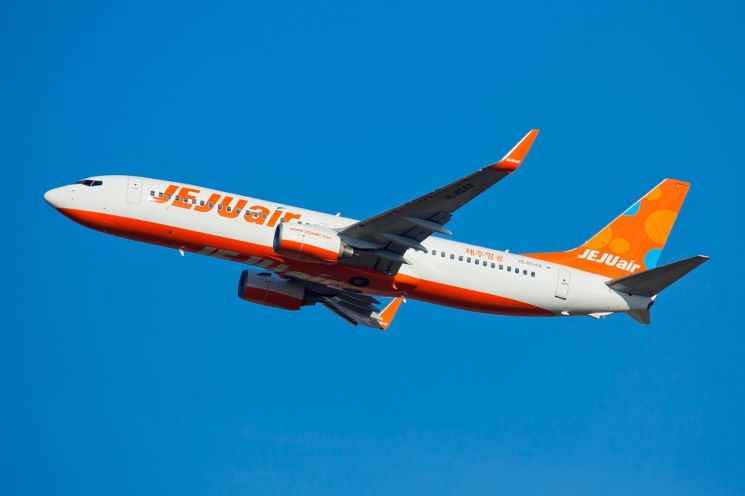
CEO Jung, who is well-versed in the airline industry overall, is implementing a completely different strategy from CEO Kim. Generally, LCCs are considered unsuitable for long-haul routes because most of their aircraft are suitable for short- and medium-haul flights, and they lack experience in long-haul routes. However, T'way Air is regarded as a low-cost carrier strong in both medium- and long-haul routes. It started with short- and medium-haul but is expanding into medium- and long-haul areas.
Despite the difficulties caused by COVID-19 last year, T'way Air introduced three large aircraft, the A330-300. While other airlines reduced their fleet size, T'way Air increased it. Initially, the introduction of large aircraft by T'way Air was met with skepticism but eventually became a success. As Korean Air and Asiana Airlines had to return some slots (takeoff and landing rights) during their merger process, there is a high possibility that opportunities will arise for T'way Air.
At the shareholders' meeting in March, CEO Jung said, "By introducing three medium- and large-sized aircraft, we have laid a solid foundation for a competitive advantage at a time when overseas travel demand is exploding." Industry insiders say his past experience influenced T'way Air's expansion. Since he was mainly responsible for route planning in the past and many former Korean Air personnel are now at T'way Air, he likely has confidence in medium- and long-haul routes. T'way Air recorded sales of 358.8 billion KRW and an operating profit of 82.7 billion KRW in the first quarter. Sales increased by 500% compared to the first quarter of last year. At the same time, the company, which posted losses last year, transformed into a high-performing company with an operating profit margin of 23%.
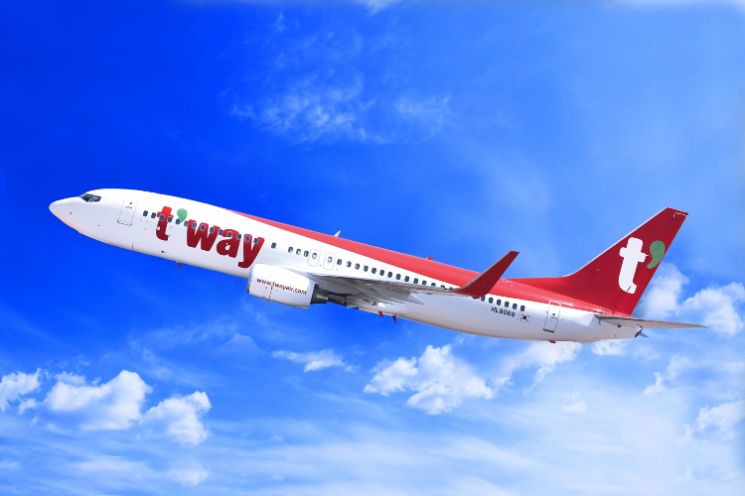
Another commonality between CEO Kim and CEO Jung is that they are known for their down-to-earth personalities. Both prefer soju and Makgeolli over wine or whiskey. CEO Kim reportedly drinks soju with ice. CEO Jung mainly drinks Makgeolli. Their frequently eaten foods include kimchi jjigae and sundae gukbap. Their hobbies are similar as well. CEO Kim enjoys hiking and continued to do so even when he was the head of Asiana Airlines' Americas division. He is known for his exceptional family love, often hiking with his wife. CEO Jung is also described as family-oriented, spending time tending a garden in front of his house or with his pets.
Their attitudes toward employees are also similar. CEO Kim enjoys talking with employees and especially values the opinions of frontline workers. When receiving reports, he does not only listen to department heads but also involves the person responsible for the task, believing that the person most familiar with the issue is the frontline worker. Due to this tendency, he often has lunch with employees. When there is no separate schedule, he frequently uses Lotte Mall Gimpo Airport near Gimpo International Airport for lunch with those who report to him.
CEO Jung is similar. He is known for being informal with employees. He enjoys casual dinners with employees at modest restaurants near the company. To reduce distance and promote communication with employees, he reportedly keeps the CEO office door always open. It is a famous anecdote in the airline industry that he was the first to implement a relaxed hairstyle policy for flight attendants.
However, their work styles differ. CEO Jung clearly sets goals and encourages employees. A T'way Air official said, "He is not vague like 'How about doing this?' but gives clear instructions." Therefore, "work progresses quickly." Conversely, CEO Kim tends to listen to others' opinions before making decisions rather than presenting ideas first. After discussing various proposals together, he chooses the best option. The two are polar opposites.
CEO Kim, who values rational judgment, carefully listens to frontline workers and targets the short- and medium-haul routes, which can be considered the industry standard. In contrast, CEO Jung is venturing beyond short- and medium-haul routes to challenge medium- and long-haul routes, taking paths others do not.
© The Asia Business Daily(www.asiae.co.kr). All rights reserved.
![Clutching a Stolen Dior Bag, Saying "I Hate Being Poor but Real"... The Grotesque Con of a "Human Knockoff" [Slate]](https://cwcontent.asiae.co.kr/asiaresize/183/2026021902243444107_1771435474.jpg)

















