[Serving Robot CEO] 100x Growth in 3 Years
Market Expected to Reach 11,000 Units This Year... Worth 300 Billion KRW
People Driving the Serving Robot Market
The forefront of robot popularization in Korea is in restaurants. The 5,000 serving robots found nationwide have naturally integrated robots into our daily lives. Four years after the introduction of serving robots, the small effort of placing food brought by robots on tables has become familiar. These robots carry more than just food. They also represent the development of the robot industry and the alleviation of labor shortages for small business owners. We listened to the people driving this market.
This year marks the era of 10,000 serving robots in Korea. Starting from about 50 units in 2019 when serving robots were first introduced, the number grew to 5,000 last year. Due to the burden of labor costs and overlapping labor shortages, self-employed business owners struggling with workforce management began to seek serving robots, resulting in a 100-fold increase in three years. VD Company and Birorobotics, which spun off from Woowa Brothers and are leading the market, have set distribution targets of 3,000 and over 1,300 units respectively for this year. Additionally, telecommunications companies are accelerating related businesses based on their nationwide sales networks. KT, which had already entered the market, is now intensifying its business, and LG Uplus also entered this market this year. Based on such industry data, Eugene Investment & Securities expects the domestic serving robot market to reach 11,000 units this year, more than doubling compared to the previous year. The market size is estimated at 300 billion KRW.
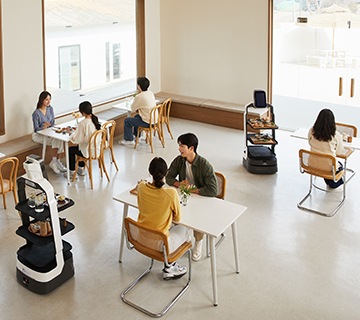
One reason for the rapid spread of serving robots in Korea is the labor shortage in the food service industry. Due to the high labor intensity, employees often quit soon after being hired. As of the first half of last year, the labor shortage rate in domestic restaurants and pubs was 6.6%, nearly double the overall industry average of 3.6%. Serving robots reduce the workload of employees by taking over simple repetitive tasks such as carrying heavy dishes. People can focus more on customer service and other tasks that robots cannot perform.
Major hardware suppliers of serving robots include China's Pudu Robotics and Keenon Robotics. LG Electronics manufactures them domestically, and some startups also produce self-developed robots. In the domestic market, Chinese-made serving robots are known to hold about an 80% market share. However, Korean companies have also started to achieve results in robot manufacturing. A representative example is Bear Robotics, a Silicon Valley-based startup, which entered the Japanese market with its self-developed serving robot 'Servi' and secured the number one market share for serving and delivery robots in Japan. Bear Robotics plans to expand into Europe and Southeast Asia this year. Birorobotics is also promoting the localization of serving robots and market entry into Vietnam and the Middle East this year. Seungyun Yang, a researcher at Eugene Investment & Securities, said, "Serving robots have various advantages such as solving labor shortages and improving store operation efficiency. The core technologies include autonomous driving functions, collision avoidance with people or objects, and integrated control systems managing multiple serving robots. Most of these related technologies can be considered mature."
© The Asia Business Daily(www.asiae.co.kr). All rights reserved.
![Clutching a Stolen Dior Bag, Saying "I Hate Being Poor but Real"... The Grotesque Con of a "Human Knockoff" [Slate]](https://cwcontent.asiae.co.kr/asiaresize/183/2026021902243444107_1771435474.jpg)















