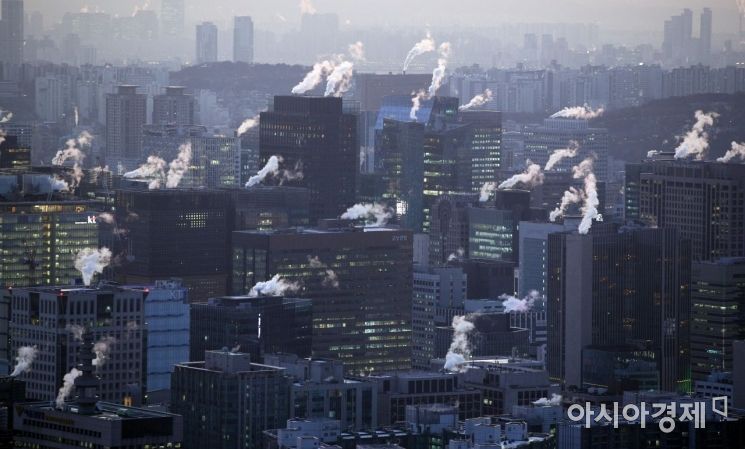
The volume of commercial and office building transactions in Seoul has increased for two consecutive months. It is interpreted that the increase in transaction volume is mainly due to transactions centered on small-sized buildings.
On the 5th, Real Estate Planet, a commercial real estate specialist company based on big data and AI, analyzed data from the Ministry of Land, Infrastructure and Transport and found that as of March, the number of commercial and office building sales transactions in Seoul was 104, a 7.2% increase compared to the previous month.
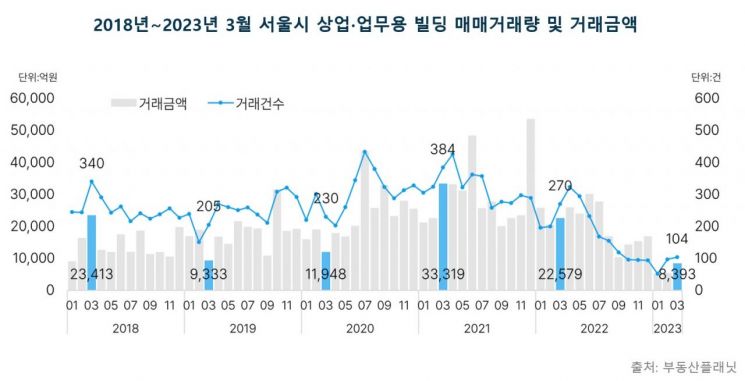
Although the commercial transaction volume fell to the level of the 2008 global financial crisis due to market stagnation, it has been on the rise for two consecutive months since February. Unlike February, when transaction amounts decreased despite the increase in transaction volume, the sales transaction amount of commercial and office buildings in Seoul in March rebounded, increasing by 54% compared to the previous month to 839.3 billion KRW.
Compared to one year ago, the sales transaction volume in March decreased by 61.5%, and the transaction amount also dropped by 62.8%, so it is expected to take time to recover to the usual level.
Looking at the characteristics of commercial and office building sales transactions by major districts in Seoul, GBD (Gangnam-gu, Seocho-gu) recorded 19 transactions and 267.4 billion KRW in transaction amount, ranking first among major districts. Next, in terms of transaction volume, CBD (Jongno-gu, Jung-gu) recorded 16 transactions, and YBD (Yeongdeungpo-gu, Mapo-gu) recorded 14 transactions, with transaction amounts of 65.3 billion KRW for CBD and 59.8 billion KRW for YBD, respectively. Outside the three major districts, a total of 55 transactions and 446.8 billion KRW in transaction amounts occurred.
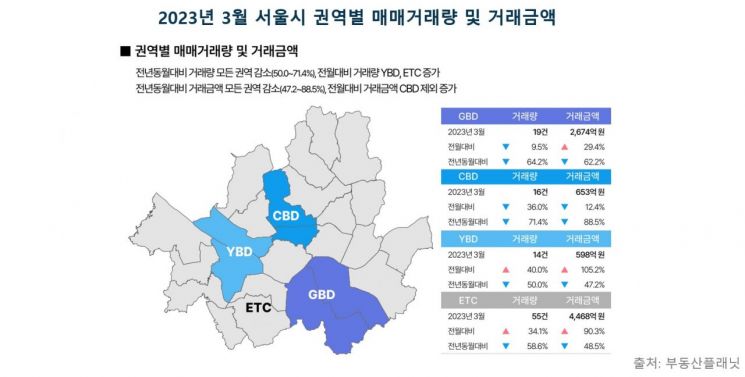
Although YBD had lower transaction volume and amount compared to major districts, its growth rate compared to the previous month was the highest. YBD's transaction volume increased by 40% compared to the previous month, while GBD and CBD decreased by 9.5% and 36%, respectively. In terms of transaction amount, YBD showed an increase of 105.2% compared to the previous month, but GBD only rose by 29.4%, and CBD fell by 12.4%. The three major districts also fell significantly short of the transaction volume and amount of the same month last year. Transaction volume decreased by as little as 50% and as much as 71.4%, and transaction amounts also dropped between 47.2% and 88.5%.
By price range, transactions of buildings under 5 billion KRW accounted for 70 cases, making up 67.3% of total transactions. Transactions of buildings over 30 billion KRW were limited to only four cases: two in Gangnam-gu, one in Yongsan-gu, and one in Gangdong-gu. Due to the ongoing economic downturn and the possibility of changes in the base interest rate, the unstable market situation is interpreted as causing building investments to focus relatively on small-scale buildings.
Jung Soo-min, CEO of Real Estate Planet, said, "With the increase in sales transaction volume continuing through March after February, a favorable atmosphere is finally emerging," but advised, "It is still too early to be overly optimistic about the overall market situation, so it is recommended to approach mainly small-sized properties where fund management and transaction completion are relatively easier."
© The Asia Business Daily(www.asiae.co.kr). All rights reserved.
![Clutching a Stolen Dior Bag, Saying "I Hate Being Poor but Real"... The Grotesque Con of a "Human Knockoff" [Slate]](https://cwcontent.asiae.co.kr/asiaresize/183/2026021902243444107_1771435474.jpg)

















