Bank of Korea and Ministry of Economy and Finance Hold 'Emergency Macroeconomic and Financial Meeting'
Historic High US-Korea Interest Rate Gap of 1.75%p
"Fed's Conditional Rate Hike Pause Signal Is Positive"
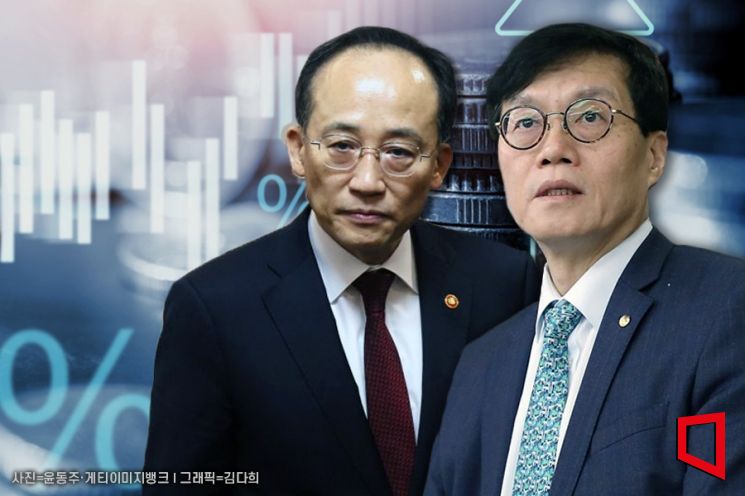
On the 4th, economic authorities including the Bank of Korea and the Ministry of Economy and Finance announced that due to the US interest rate hike causing the Korea-US interest rate gap to widen to a record high of 1.75 percentage points, "there is a possibility that uncertainty in the financial and foreign exchange markets will increase," and they will strengthen monitoring with heightened vigilance.
On the same day, Deputy Prime Minister and Minister of Economy and Finance Choo Kyung-ho, Bank of Korea Governor Lee Chang-yong, Financial Services Commission Chairman Kim Ju-hyun, and Financial Supervisory Service Governor Lee Bok-hyun held an emergency macroeconomic and financial meeting in the morning to assess the impact of the US Federal Reserve's (Fed) interest rate hike on domestic and international financial and foreign exchange markets.
Deputy Prime Minister Choo and Governor Lee, who are attending the Asian Development Bank (ADB) Annual Meeting held in Songdo, Incheon, held an in-person meeting, while Chairman Kim and Governor Lee participated remotely.
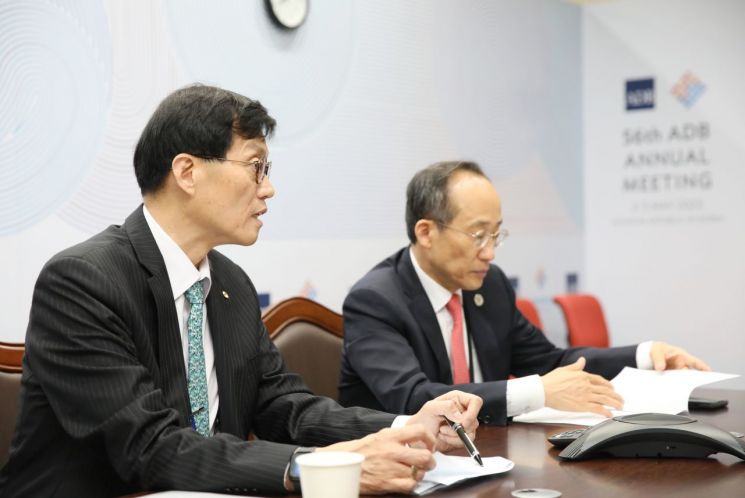 Bank of Korea Governor Lee Chang-yong and Deputy Prime Minister and Minister of Economy and Finance Choo Kyung-ho held an emergency macroeconomic and financial meeting on the morning of the 4th in Songdo, Incheon, discussing response measures related to the overnight US interest rate hike. (Photo by Bank of Korea)
Overnight, the US Fed raised its benchmark interest rate by 0.25 percentage points at the Federal Open Market Committee (FOMC) meeting, following increases in February and March. As a result, the interest rate gap between Korea and the US widened to a record high of 1.75 percentage points.
In its statement, the Fed removed the phrase "additional policy tightening may be appropriate" and stated that future policy tightening decisions will be made considering economic and financial conditions.
Fed Chair Jerome Powell mentioned at a press conference that the June meeting would discuss pausing rate hikes, but emphasized that given the still high inflationary pressures, discussing rate cuts is not appropriate.
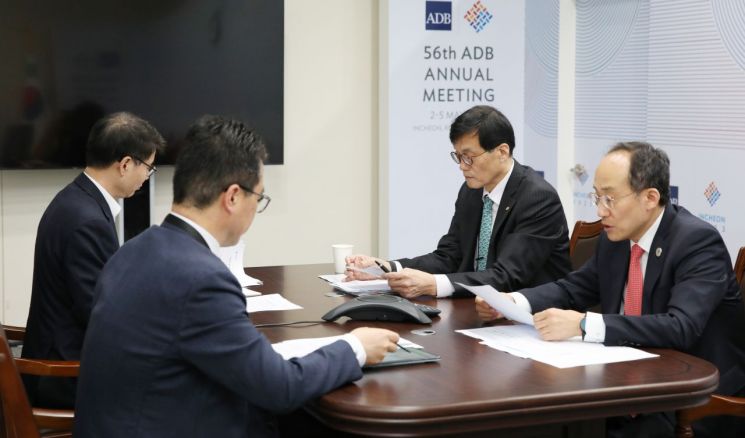 Bank of Korea Governor Lee Chang-yong and Deputy Prime Minister and Minister of Economy and Finance Choo Kyung-ho held an emergency macroeconomic and financial meeting on the morning of the 4th in Songdo, Incheon, discussing response measures related to the overnight US interest rate hike. (Photo by Bank of Korea)
Regarding this, the Bank of Korea and the Ministry of Economy and Finance evaluated that the Fed's indication of a "conditional pause in rate hikes" would act as a positive factor for Korea's financial and foreign exchange markets.
However, they agreed that since concerns about high inflation persist and the possibility of renewed global financial market instability and increased real economy uncertainty due to issues such as the US regional bank crisis cannot be ruled out, it is necessary to maintain high vigilance and thoroughly monitor the situation.
According to the Bank of Korea and the Ministry of Economy and Finance, despite recent global banking sector instability, Korea's financial market has remained relatively stable, supported by net foreign purchases in the stock market, and corporate bonds and short-term money markets have generally shown favorable conditions such as interest rate stability.
The Bank of Korea and the Ministry of Economy and Finance emphasized, "Given the expanded domestic and foreign interest rate gap, there is a possibility of increased uncertainty in the financial and foreign exchange markets, along with concerns about volatility expansion caused by market disruption activities and herd behavior. Therefore, it is necessary to respond to the current situation with heightened vigilance."
They added, "The government, the Bank of Korea, and related agencies will further strengthen monitoring of domestic and international financial markets, thoroughly inspect vulnerable sectors of our financial system, and swiftly implement market stabilization measures according to pre-established contingency plans if necessary."
© The Asia Business Daily(www.asiae.co.kr). All rights reserved.
![Clutching a Stolen Dior Bag, Saying "I Hate Being Poor but Real"... The Grotesque Con of a "Human Knockoff" [Slate]](https://cwcontent.asiae.co.kr/asiaresize/183/2026021902243444107_1771435474.jpg)

















