Small Tenants, Deposit Protection... Benefits at Risk if Jeonse Deposit Increases
The issue of jeonse fraud has emerged as a serious social problem as victims of the "Incheon Construction King" jeonse fraud have consecutively chosen extreme measures.
In February, the government expanded the scope and protection amount for small-scale tenants with priority repayment rights to protect victims of jeonse fraud. However, there are cases where the expanded application does not apply because the date of the building's mortgage registration is used as the criterion for determining small-scale tenants.
According to the Housing Lease Protection Act on the 22nd, small-scale tenants are guaranteed a certain amount of priority repayment even if the house they rented goes to auction. Priority repayment is the right to be repaid a certain amount of the deposit ahead of other secured creditors when the leased house is auctioned or publicly sold.
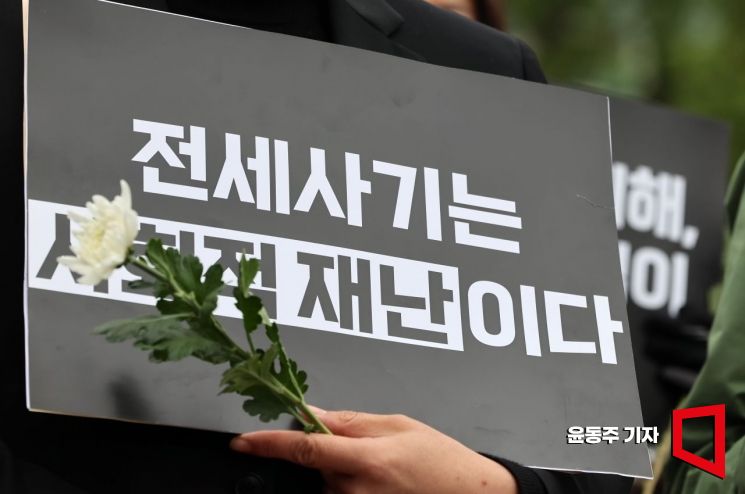 Jeonse fraud victims hold a press conference on the 18th in front of the Presidential Office in Yongsan-gu, Seoul, urging the establishment of measures to address jeonse fraud damage. Photo by Dongju Yoon doso7@
Earlier, as cases where tenants could not recover their full deposits due to jeonse fraud surged, the government expanded the scope of small-scale tenants and increased the protection amount. The Ministry of Justice and the Ministry of Land, Infrastructure and Transport approved partial amendments to the Housing Lease Protection Act and its enforcement decree in February.
The scope of small-scale tenants was uniformly raised by 15 million KRW, and the priority repayment amount was also increased by 5 million KRW. The criteria for small-scale tenants are as follows: in Seoul, the deposit limit is 165 million KRW; in the overpopulated control areas (excluding Ganghwa-gun and Ongjin-gun, including Incheon, Bucheon, Suwon, Gwacheon, etc.), Sejong, Yongin, Hwaseong, and Gimpo, it is 145 million KRW; in metropolitan cities, Ansan, Gwangju, Paju, Icheon, and Pyeongtaek, it is 85 million KRW; and in other regions, it is 75 million KRW.
Even if recognized as a small-scale tenant, the entire deposit is not fully protected. If a portion of the tenant’s deposit exceeds half of the housing value, the priority repayment right applies only up to half of the housing value.
The maximum priority repayment amounts for small-scale tenants are as follows: up to 55 million KRW in Seoul, up to 48 million KRW in overpopulated control areas such as Incheon, up to 28 million KRW in other metropolitan cities, and up to 25 million KRW in other regions. Michuhol-gu in Incheon is an overpopulated control area, so the maximum priority repayment amount is 48 million KRW.
There are cases where the increased priority repayment criteria do not apply. This is because whether one qualifies as a small-scale tenant is determined by the date of the building’s mortgage registration. The third victim, Mr. A, who died in connection with the "Incheon Construction King" jeonse fraud, is such a case. In 2017, the small-scale tenant deposit limit was 80 million KRW, but Mr. A signed a jeonse contract in 2019 with a deposit of 72 million KRW while a senior mortgage existed, and renewed the contract in 2021 with a deposit of 90 million KRW, thus not qualifying as a small-scale tenant.
However, experts have pointed out that retroactively applying the small-scale tenant scope should be approached cautiously. Lawyer Eom Jeong-sook explained, "Priority repayment is a matter directly related to the interests of mortgage holders and tenants," adding, "Tenants who came after banks receive money first." She said, "In fact, small-scale tenant protection is a legal area of benevolence. It is protection given because they are considered socially vulnerable." She added, "It is unfortunate for victims of jeonse fraud, but the law cannot protect everything."
Lawyer Eom also explained that retroactive application of small-scale tenant status could undermine legal stability. She said, "If legislators enact retroactive laws, legal stability deteriorates and there is a risk of abuse, so retroactive legislation must be approached very carefully," adding, "Because of fairness issues, after-the-fact legislation protecting only these individuals is also inappropriate."
© The Asia Business Daily(www.asiae.co.kr). All rights reserved.
![Clutching a Stolen Dior Bag, Saying "I Hate Being Poor but Real"... The Grotesque Con of a "Human Knockoff" [Slate]](https://cwcontent.asiae.co.kr/asiaresize/183/2026021902243444107_1771435474.jpg)















