"Due to Decreased Performance" Company's Logic
Labor: "Worse Than Inflation Rate"
Some Employees "Considering Union Membership"

The wage increase rates of major companies such as Samsung Electronics and LG Electronics have been halved compared to last year. While management claims that it was difficult to raise the increase rate due to reduced performance amid the global recession, labor unions and employees are expressing dissatisfaction that the wage increase rate is lower than the inflation rate.
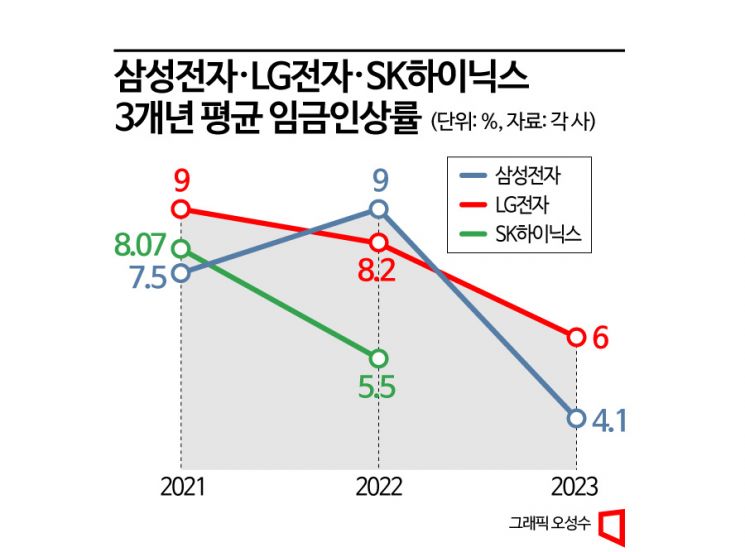
Samsung Electronics announced on its internal bulletin board on the 14th that labor and management agreed on an average wage increase rate of 4.1% this year. The basic increase rate was set at 2%, and the performance-based increase rate at 2.1%. The average wage increase rate refers to the total salary increase rate given to all employees.
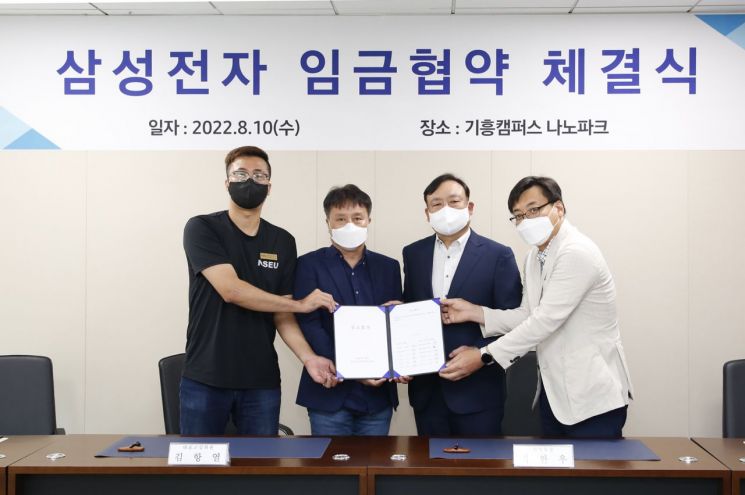 Samsung Electronics signed its first wage agreement in 53 years since its founding last August, following Chairman Lee Jae-yong's declaration to abolish the 'no labor union management' policy. A commemorative photo taken after the 2021-2022 labor-management wage agreement signing ceremony at Samsung Electronics Giheung Campus Nanopark on August 10 last year. From left: Son Woo-mok, Vice Chairman of the Samsung Electronics Labor Union Joint Negotiation Team; Kim Hang-yeol, Chairman of the Samsung Electronics Labor Union Joint Negotiation Team; Choi Wan-woo, Head of HR Team, DS (Semiconductor) Division; Shin In-cheol, Samsung Electronics Negotiation Representative. [Photo by Yonhap News]
Samsung Electronics’ wage increase rate of 4.1% is about half of 7.5% in 2021 and 9% last year. Other companies such as LG Electronics and SK Hynix have also lowered their wage increase rates over the past three years. LG Electronics adjusted from 9% to 8.2% to 6% over three years, and SK Hynix lowered from 8.07% in 2021 and last year to 5.5%. SK Hynix is expected to announce this year’s wage increase rate after May. There is speculation that it will be difficult to raise it compared to last year’s rate due to the semiconductor downturn causing significant losses.
Major companies’ management conveyed to labor unions that it is difficult to raise the wage increase rate due to poor performance last year. Samsung Electronics’ consolidated operating profit last year decreased by 16% compared to 2021. LG Electronics decreased by 12.5%, and SK Hynix by 45.1%.
However, there are complaints that the significantly increased inflation rate was not sufficiently reflected, and that the employee wage increase rate is excessively low compared to the increase rate of executive compensation.
In corporate wage negotiations, labor and management refer to the negotiation principle of the Minimum Wage Commission: 'economic growth rate + consumer price inflation rate - employment growth rate.' In particular, labor unions cite the inflation rate as a major argument. When management presents performance as a basis, labor demands that the inflation rate also be reflected. The consumer price inflation rate announced by the government doubled from 2.5% in 2021 to 5.1% last year. Nevertheless, Samsung Electronics management initially proposed a wage increase rate in the 1% range, but raised it to the 2% range after union opposition.
Employees also express considerable dissatisfaction with management’s attempt to raise the registered executive compensation limit from 41 billion KRW to 48 billion KRW, a 17.1% increase this year. The labor-management council conveyed employees’ reactions to management that raising it by 17% despite poor performance last year was excessive, and management accepted this, deciding to maintain last year’s compensation limit. This effectively put the increase of the registered executive compensation limit on hold.
A Samsung Electronics DX (mobile and consumer electronics) division employee, Mr. A, said, “Wages should be raised at least by the inflation rate and reflect performance-based increases, but that is not happening. Employees are expressing dissatisfaction that management decided to raise executive compensation by 17% while operating under an emergency management system. Especially, the basic increase rate (2%) is too low, and there is a growing atmosphere of colleagues considering joining the union.”
Separate from the fact that major companies lowered wage increase rates based on decreased performance, the voices of labor unions and employees are growing louder. In Samsung Electronics’ case, after Chairman Lee Jae-yong declared the 'end of no-union management,' the number of unions increased to five. In addition to the existing Samsung Electronics Office Workers’ Union, Samsung Electronics Gumi Labor Union, Samsung Electronics Labor Union 'Donghaeng,' and National Samsung Electronics Labor Union, the 'Samsung Electronics DX Labor Union' was launched at the end of January.
The joint bargaining group composed of the four unions excluding the DX union is negotiating separately with management from the labor-management council that conducted this wage negotiation. They have held about ten negotiations with management by the 13th but have not reached an agreement. Although the possibility of a strike is low, if it occurs, it would be the first in 54 years since Samsung Electronics was established in 1969. Last year, the unions opposed the wage negotiations with management at the labor-management council and applied for labor dispute mediation with the Central Labor Relations Commission under the Ministry of Employment and Labor, securing the right to strike.
© The Asia Business Daily(www.asiae.co.kr). All rights reserved.
![Clutching a Stolen Dior Bag, Saying "I Hate Being Poor but Real"... The Grotesque Con of a "Human Knockoff" [Slate]](https://cwcontent.asiae.co.kr/asiaresize/183/2026021902243444107_1771435474.jpg)

















