"Samsung Considering Adopting MS Instead of Google"
MS 'Bing' Combined with ChatGPT Search
Attractive to Smartphone Manufacturers
Samsung Electronics has put Google on alert amid reports that it may switch the default search engine on its Galaxy smartphones from Google to Microsoft (MS) Bing. Samsung produced 259.7 million smartphones last year, holding a 22% share of the global market. This would instantly boost MS's smartphone search market share into the 20% range.
The New York Times (NYT) reported on the 16th (local time) that Google was shocked internally after hearing that key partners, including Samsung, considered switching their search engines to Bing last month. With generative artificial intelligence (AI) search, such as OpenAI's ChatGPT, integrated with Bing search, smart device manufacturers like Samsung and Apple are reportedly considering adopting MS's search engine instead of Google's.
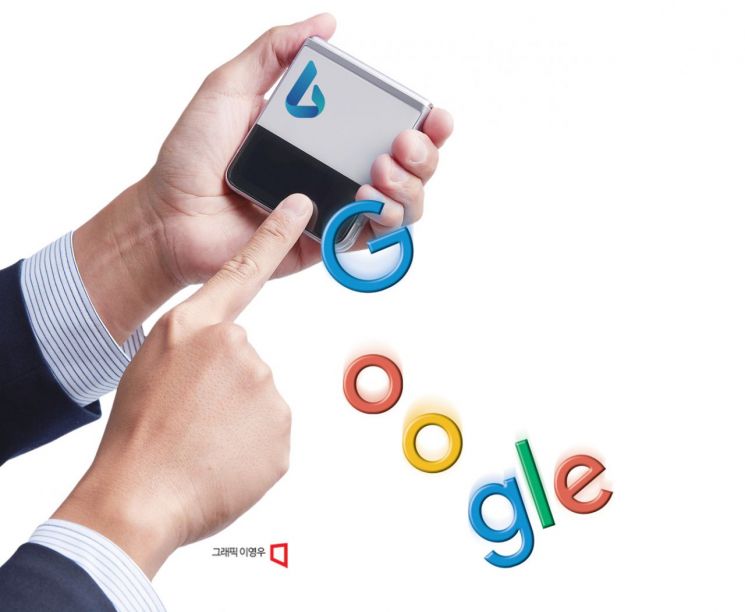
NYT stated that Samsung is currently negotiating with Google on this matter but also noted the possibility that Samsung might retain Google as the default search engine without switching to Bing. It pointed out that since Samsung uses Google's Android operating system (OS) on its smartphones, changing the search engine is not an easy task.
Regarding this, Samsung Electronics has taken the position of "not able to confirm." However, industry insiders say the possibility cannot be ruled out considering the close friendship between MS founder Bill Gates, co-chairman of the Bill & Melinda Gates Foundation, and Samsung Electronics Chairman Lee Jae-yong. Currently, there is a friendly atmosphere between Samsung Electronics and MS. Gates recently expressed his affection for Samsung smartphones multiple times on his social media, stating, "My current phone is the Samsung Galaxy Z Fold4." Previously, he used the Z Fold3. Samsung has been incorporating MS cloud services and Office into its smartphones and releasing them to the market.
The annual revenue from the default search engine contract between Google and Samsung is about $3 billion (approximately 3.9 trillion KRW). Initially, Google paid smartphone manufacturers that used its OS. Simply put, Google gave Samsung money every time it sold a smartphone using the Android OS. However, the situation has completely changed. In 2018, the European Union (EU) Commission fined Google for abusing its smartphone OS and violating competition laws. Since then, Google has charged licensing fees to manufacturers using its search engine. From Samsung's perspective, this situation might feel unfair.
NYT analyzed, "It is unclear whether MS's recent AI-related work is the main reason Samsung is reconsidering its 12-year relationship with Google." However, it evaluated that "Samsung's change in attitude signifies the first potential crack in Google's previously impregnable search business."
Google told NYT that it is continuously improving its search engine to provide more reasons for users and partners to choose Google, and that Android smartphone manufacturers, including Samsung, have the freedom to adopt technologies from other companies to enhance user experience.
Despite this official stance, Google is reportedly experiencing significant internal turmoil. Since Samsung produces hundreds of millions of smartphones annually based on Google's Android OS, an actual switch of the default search engine would inevitably impact Google's market share. According to market research firm StatCounter, Google currently holds a dominant 93.18% share of the global search engine market, while Bing holds 2.87%. However, interest in Bing, equipped with ChatGPT, is heating up. Apple, which produces the iPhone, will see its three-year default search engine contract with Google expire at the end of this year. There is speculation, reported through U.S. investment bank Bernstein in February, that Apple may either renew the contract or sign with a new provider through a bidding process.
Google is accelerating the integration of search engines and AI. NYT reported that Google has assigned about 160 employees to the ‘Magi’ project, developing a search engine that combines traditional search results with AI-generated answers. Like ChatGPT, it will provide users with customized responses based on generative AI, while still displaying ads on search results that lead to transactions such as purchasing goods or booking flights, as before. Currently, internal testing is underway with employees ahead of commercialization, with a goal to launch as early as next month.
Google spokesperson Lara Levin told NYT in a response, "Not all brainstorming materials or product ideas lead to actual launches, but as we have stated before, we are excited about the possibility of introducing AI features into Google Search," adding, "We will share more details soon."
© The Asia Business Daily(www.asiae.co.kr). All rights reserved.
![Clutching a Stolen Dior Bag, Saying "I Hate Being Poor but Real"... The Grotesque Con of a "Human Knockoff" [Slate]](https://cwcontent.asiae.co.kr/asiaresize/183/2026021902243444107_1771435474.jpg)















