Official Meeting at ADB Annual Meeting
Revival Since Suspension in 2016
World Economy in a 'Turbulent Recovery' Process
Fuel Tax Likely to Be Decided This Week
The Korea-Japan Finance Ministers' Meeting, which had been suspended since 2016, will resume next month in Songdo, Incheon, marking its first meeting in seven years. As the government is promoting normalization of relations across various sectors following the Korea-Japan summit, it is expected that this finance ministers' meeting will open the door for expanded cooperation between the two countries in economic areas such as finance and foreign exchange.
On the 13th (local time), Deputy Prime Minister and Minister of Economy and Finance Choo Kyung-ho, after attending the G20 Finance Ministers' Meeting and the International Monetary Fund (IMF) and World Bank (WB) Annual Meetings in Washington D.C., held a press briefing at the IMF headquarters where he stated, "We have agreed to hold a bilateral official meeting with the Japanese Finance Minister at the Asian Development Bank (ADB) Annual Meeting in early May in Songdo, Incheon."
The government announced that officially restoring the dialogue channel between the finance authorities of the two countries is the first time in seven years since the meeting between Yoo Il-ho, then Deputy Prime Minister and Minister of Economy and Finance, and Taro Aso, then Deputy Prime Minister and Finance Minister of Japan, in August 2016. Deputy Prime Minister Choo said, "Following the Korea-Japan summit, there is a shared recognition of the need to expand cooperation in economic and financial fields, and we decided to meet the Japanese Finance Minister at this meeting and hold talks in early May. We expect discussions on whether to expand cooperation between the two countries at that time."
The Korea-Japan Finance Ministers' Meeting, which began in 2006, is an official cooperation channel where the heads and working-level officials of the finance authorities of both countries discuss economic cooperation measures. The meetings cover the economic status of both countries and hold sectoral meetings on macroeconomic policies, taxation, budgets, and related fields. Exchanges had been cut off due to the continuous cooling of relations caused by issues such as the installation of the comfort women statue in front of the Japanese Consulate General in Busan in 2017 and Japan's export restrictions on semiconductor materials in 2019. There is also interest in whether the resumption of the Korea-Japan currency swap, suspended in 2015, will be discussed at this meeting. However, specific topics have not yet been decided. Deputy Prime Minister Choo explained, "There needs to be practical discussions to determine the format and content of the meeting."
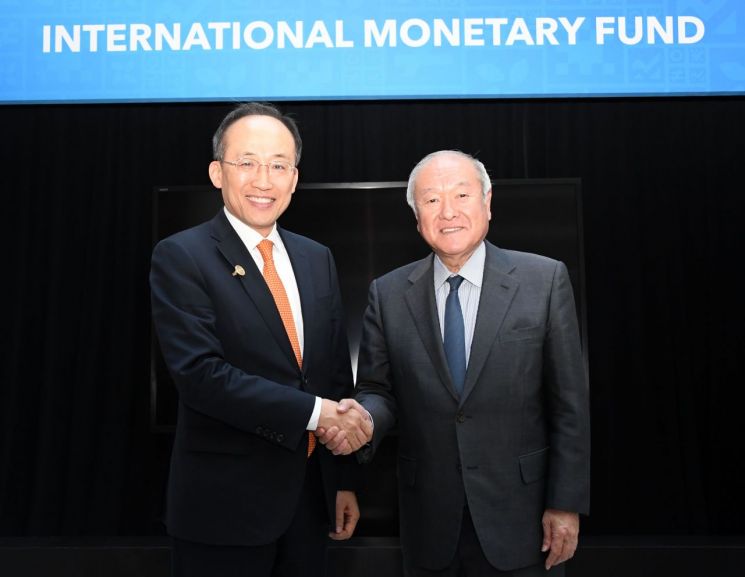 Deputy Prime Minister and Minister of Economy and Finance Choo Kyung-ho, who is visiting the United States to attend the G20 Finance Ministers and Central Bank Governors Meeting, met with Japanese Finance Minister Suzuki Shunichi at the International Monetary Fund (IMF) on the 13th (local time). The two ministers agreed to hold an official bilateral meeting during the ADB Annual Meeting and ASEAN+3 Ministerial Meeting to be held in Songdo, Incheon, in May.
The Global Economy is Undergoing a 'Turbulent Recovery'
Meanwhile, Deputy Prime Minister Choo revealed that through the recent G20 Finance Ministers' Meeting, the IMF assessed the global economic outlook for this year as undergoing a 'turbulent recovery' process. He said, "Amid persistent risk factors since last year such as the Russia-Ukraine war, economic fragmentation, and inflation, recent financial market instability triggered by the collapse of Silicon Valley Bank (SVB) in the U.S. has increased uncertainty in the global economic recovery trend."
In a meeting with U.S. Treasury Secretary Janet Yellen, he explained, "Many of the concerns related to the U.S. Inflation Reduction Act (IRA), including commercial vehicles for eco-friendly cars and previous battery guidance, have been largely resolved, but considering remaining uncertainties and industry concerns, we requested attention and support measures." Additionally, in meetings with global credit rating agencies such as Fitch and Standard & Poor's (S&P), he said, "Their evaluations of the Korean economy's credibility and soundness are quite positive. They frequently used the term 'strong.' However, they also diagnosed that the effects of rapid interest rate hikes will impact various parts of the real economy and financial markets in multiple ways."
When asked about how Korea's economic situation this year compares to other countries, he responded, "The U.S. economy is doing well in the early stages but declines later; Europe is currently not doing well but is expected to improve over time. We do not need to change our stance yet. Variables include semiconductors, China, and advanced economies. We cannot be certain how these intermediate variables will manifest, but this year will still be a year of high uncertainty."
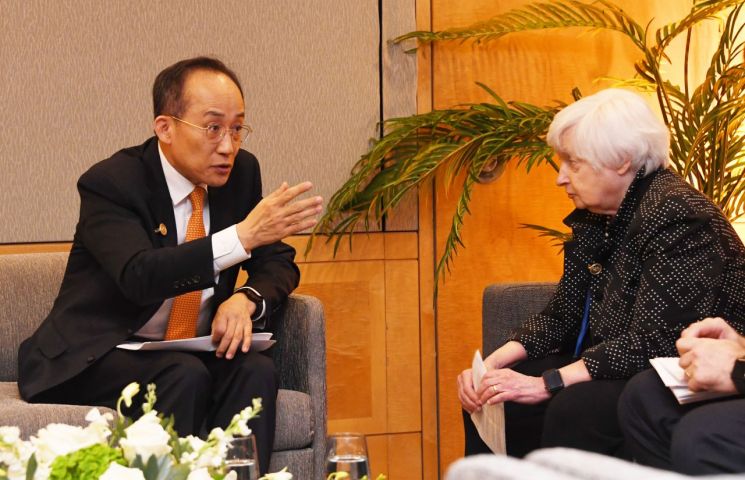 Deputy Prime Minister and Minister of Economy and Finance Choo Kyung-ho, who is visiting Washington D.C., USA to attend the G20 Finance Ministers' Meeting and the IMF and World Bank Spring Meetings, is meeting with U.S. Treasury Secretary Janet Yellen at the International Monetary Fund (IMF) on the 13th (local time).
Fuel Tax Decision Considering Public Burden... To Be Made This Week
Regarding domestic issues, questions continued about the decrease in national tax revenue and whether the fuel tax reduction would be extended. Deputy Prime Minister Choo said, "The tax revenue situation in the first quarter of this year is not easy. We need to observe how the year progresses. The timing for deciding on the fuel tax is currently under consultation between the ruling party and the government, and considering the domestic fiscal situation, uncertainties in international oil prices following OPEC+ production cuts, and the burden on the public, we expect to make a decision around next week (as of the 13th)."
Regarding the possibility of a government revenue adjustment (to cover shortfalls in tax revenue) or supplementary budget due to this year's tax revenue shortfall, he stated, "Conducting tax revenue forecasts when necessary and officially making a revenue adjustment are different matters. Just because we internally conduct new revenue forecasts does not mean we will necessarily make a revenue adjustment or supplementary budget. Supplementary budgets must meet certain conditions. Currently, we are not reviewing a supplementary budget."
According to the recent fiscal trend report released by the Ministry of Economy and Finance, national tax revenue from January to February this year was 54.2 trillion won, down 15.7 trillion won compared to the same period last year. During this period, the managed fiscal balance deficit widened by 10.9 trillion won to 30.9 trillion won compared to the same period last year. Regarding preparations for the 22nd National Assembly general election scheduled for April next year, he answered, "Cabinet members cannot enter or leave at their own will. It is entirely a matter for the President, who holds the personnel authority, to decide."
© The Asia Business Daily(www.asiae.co.kr). All rights reserved.
![Clutching a Stolen Dior Bag, Saying "I Hate Being Poor but Real"... The Grotesque Con of a "Human Knockoff" [Slate]](https://cwcontent.asiae.co.kr/asiaresize/183/2026021902243444107_1771435474.jpg)
















