'World's First DTx Developer' Pair Therapeutics
Recently Filed for Bankruptcy... Unable to Overcome Financial Difficulties
Concerns Over Negative Impact on Korea's Still Early-Stage DTx Industry
"Should Be Seen as Pair's Failure, Not DTx"
"A Lesson to Improve Product Quality and Build Ecosystem"
Pear Therapeutics, once renowned as the 'world's first developer of digital therapeutics (DTx),' has decided to file for bankruptcy. Despite holding as many as three approved DTx products, the company ultimately failed to overcome financial difficulties due to sluggish commercialization in the market. As concerns arise over the negative impact on South Korea's nascent DTx industry, which has just seen its 'first DTx,' industry insiders and experts emphasize the need to learn from this case as a cautionary tale.
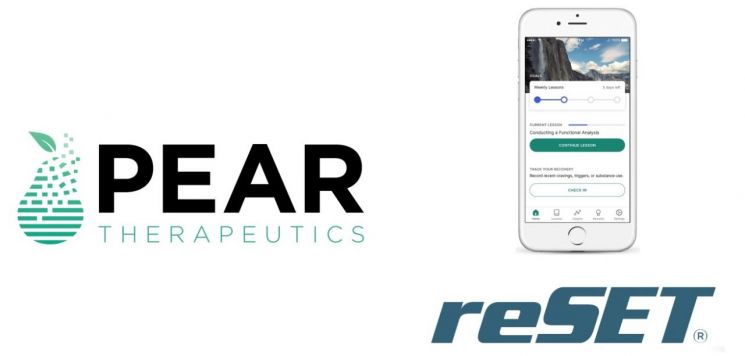 Pair Therapeutics logo (left) and Pair's drug addiction treatment DTx 'Reset'
 [Photo by Pair Therapeutics]
According to related industry sources on the 13th, Pear initiated bankruptcy proceedings under Chapter 11 of the U.S. Bankruptcy Code on the 7th (local time). This measure is taken for companies that are unable to repay their debts and is similar to the court receivership system in South Korea. Although the company announced on the 17th of last month that it was considering raising funds through a sale or merger due to worsening management conditions and that it might have to seek liquidation or restructuring if these efforts failed, it entered bankruptcy proceedings in less than a month. It is known that Pear discussed with about 140 potential buyers and received three non-binding offers but failed to reach an agreement.
Since its establishment in 2013, Pear Therapeutics had positioned itself as an industry leader by securing three FDA-approved DTx products: 'reSET,' the world's first FDA-approved digital therapeutic for substance use disorder in 2017; another substance use disorder DTx, 'reSET-O'; and the insomnia DTx 'Somryst.' In 2021, the company was listed on NASDAQ through a SPAC merger, achieving a valuation of approximately $16 billion (about 21 trillion KRW). However, after struggling with financial difficulties?operating expenses reached $136.4 million, ten times its revenue of $12.69 million last year?and undergoing several rounds of large-scale restructuring, Pear ultimately faced bankruptcy. The stock price, which soared to $14.60 shortly after listing, plummeted to $0.116 as of the previous day's closing, about 0.8% of its peak. Pear's shares are scheduled to be delisted, with trading suspended on the 19th.
Given Pear's rise as the world's first DTx developer, its failure is expected to have a significant impact on the domestic DTx industry. A CEO of a DTx developer in the early stages of development expressed concern, saying, "Fortunately, we succeeded in securing initial investment despite the difficult macroeconomic environment last year. However, if a frontrunner collapses, the ecosystem could be threatened, and it might become even more challenging to attract subsequent investments."

However, domestic industry insiders and experts generally believe that Pear's failure will serve as a cautionary example, as the situation in South Korea differs. They pointed to Pear's lack of effort to improve product quality and the still underdeveloped DTx ecosystem as reasons for its failure.
Professor Shin Jae-yong of Yonsei University College of Medicine's Department of Preventive Medicine (CEO of Evertly) described it as "the curse of the first mover," noting that since the conditions surrounding DTx, such as reimbursement and insurance, differ between the U.S. and South Korea, Pear's bankruptcy will have limited impact domestically. Professor Shin explained, "Using Pear's DTx was not user-friendly, and there was insufficient effort to improve this." He added, "In the U.S., where private corporate insurance predominates, 'intermediate care' for employee health management is well established, so many potential users did not feel the need for DTx. In contrast, in South Korea and Germany, enthusiasm for DTx stems from its ability to do what doctors previously could not, and since these countries have public insurance systems, stable commercialization is possible once reimbursement is secured."
Another DTx developer also commented, "It should be seen as Pear's failure rather than a failure of DTx itself," adding, "I never felt that Pear's DTx UI/UX was good, and Pear made no effort to overcome this." This low usability was cited as a reason why only 51% of patients prescribed Pear's DTx actually downloaded and used the application.
Kang Sung-ji, CEO of Welt, which is currently developing the insomnia DTx 'PillowRx' pending approval from the Ministry of Food and Drug Safety, said the company learned the lesson that while enhancing product capabilities is important, the institutional ecosystem must also develop. Kang said, "Pear should have focused on research and development (R&D) based on feedback rather than just sales. Unlike conventional drugs, DTx requires continuous updates to demonstrate innovation, which seems to have been overlooked." Regarding ecosystem development, he added, "No matter how effective a drug like 'Kymriah' is, it is difficult to get health insurance coverage without social consensus. You need to secure allies and create momentum, but Pear failed to lead as a pioneering company."
CEO Kang also stressed the urgent need for government efforts to build the ecosystem. Since commercialization is difficult without reimbursement under a single public insurance system, he mentioned the necessity of quickly establishing reimbursement policies and referred to the 'Innovation Account' under review as part of the 'Biohealth New Market Creation Strategy' established by President Yoon Suk-yeol's directive. The Innovation Account is a system where the National Health Insurance provides separate compensation during the evidence generation period for safe innovative medical technologies. Kang expressed optimism, saying, "The government seems to have a clear will as it has mentioned several promotion measures. If the state actually introduces systems to promote innovation, the industry can create a virtuous cycle by striving to show corresponding innovation."
© The Asia Business Daily(www.asiae.co.kr). All rights reserved.
![Clutching a Stolen Dior Bag, Saying "I Hate Being Poor but Real"... The Grotesque Con of a "Human Knockoff" [Slate]](https://cwcontent.asiae.co.kr/asiaresize/183/2026021902243444107_1771435474.jpg)
















