Election System Reform Committee Day 3
Heated Debate Among Lawmakers Continues
Active Discussions on Improving Proportional Representation System
With one year remaining until the general election for the National Assembly, the plenary committee for electoral system reform continued heated discussions for the third day. Loud exchanges occurred between ruling party members advocating for a reduction in the number of assembly members and opposition lawmakers criticizing this stance. On this day, the plenary committee was attended by the Secretary-General of the National Election Commission and four experts recommended by each party, but the session was filled mostly with one-sided speeches from lawmakers without substantial debate.
The first speaker, Kim Kyung-hyup of the Democratic Party of Korea, fiercely criticized Kim Ki-hyun, the leader of the People Power Party, for providing guidelines to his party members.
Kim said, "Ahead of the meeting, when the ruling party leader proposed a 10% reduction in the number of National Assembly members, his party members only shouted for a reduction during the precious question and debate time, blaming all current political problems on others and turning it into political strife," adding, "Shouldn't we reform the practice where party members repeat the same words like parrots following that guideline?"
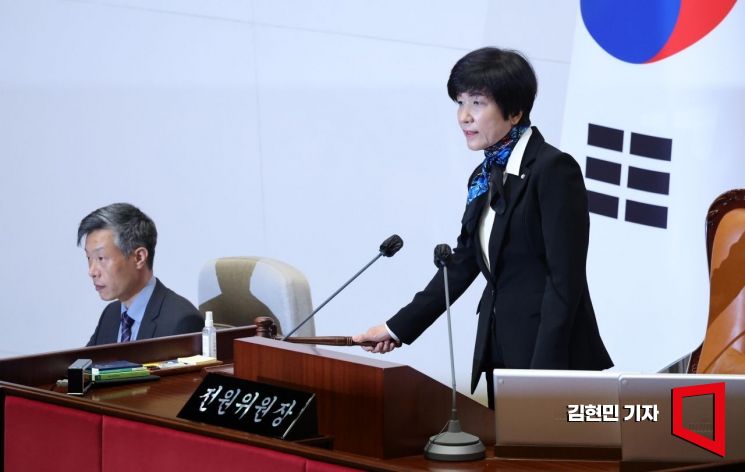 Kim Young-joo, Chairman of the National Assembly's Committee of the Whole, is striking the gavel at the Committee of the Whole meeting held on the 10th at the main plenary hall of the National Assembly in Yeouido, Seoul. Photo by Hyunmin Kim kimhyun81@
Ignoring the noisy atmosphere in the chamber, Kim continued, "For politics to stand upright, we must first fix shameless politics that flip agreements like turning over one's hand and break promises as if eating meals without any shame," and criticized, "We need to change the practice of treating the 300 constitutional bodies and representatives of the people, the National Assembly members, as mere marbles in the pockets of party leaders or floor leaders, controlling them with guidelines." He added, "Are party members elementary school students? The floor leader or party leader controls the conscience and policies of lawmakers, and without consensus among negotiation groups, even the review of bills in standing committees cannot proceed. Is this a normal National Assembly?" Kim questioned. He further criticized, "If this is how the National Assembly is run, why do we need 300 members? If you want to rely on political disgust and only advocate for reducing the number of members without alternatives, why not drastically reduce it to two?"
Min Hyung-bae of the Democratic Party said, "The People Power Party is like a bumper car whose only goal is collision," and criticized, "After deciding on the plenary committee by bipartisan agreement, they suddenly brought up reducing the number of assembly members."
Min cited the review of the 'Complete Removal of Prosecutorial Investigation Rights (Geomsu Wanbak)' bill, saying, "Before the ink on the signature of then floor leader Kwon Seong-dong had dried, they shamelessly destroyed the bipartisan agreement that stipulated the separation of prosecutorial investigation and indictment rights," and criticized, "They deliberately caused conflict and showed the essence of backstabbing politics," adding, "Even now, the People Power Party is destroying politics while acting as collaborators of the Yoon Seok-yeol administration." He continued, "Although the Democratic Party holds an absolute majority, it fails to properly control destructive acts," and said, "The Democratic Party must deeply reflect on its impotence in driving a rational political process." Min proposed, "Let's adjust the number of seats between single-member districts and regional proportional representation to a 1:1 ratio, with 150 seats each, based on a mixed-member proportional representation system."
Yang Kyung-sook of the Democratic Party said that the large electoral district system proposed by President Yoon Seok-yeol is a 'divide-and-conquer tactic' against the opposition, stating, "Since liberation, the large electoral district system was implemented during the military coup regimes, reaching its peak under the brutal dictatorship of Park Chung-hee's Yushin regime, which mobilized the military to massacre civilians, and continued through the Chun Doo-hwan regime that seized power via a new military coup," advocating for the introduction of single-member districts and regional proportional representation.
On the other hand, Park Soo-young of the People Power Party proposed reducing even 10% of the current 300 seats. Park said, "There is a public opinion poll showing that 70% of the people want to reduce the number of National Assembly members," and added, "Let's respond to the people's wishes by showing that the political circles working on electoral reform are listening." He also opposed the mixed-member proportional representation system, saying it must be abolished, and expressed opposition to the open-list large electoral district system. Park said, "The open-list large electoral district system is a system where political consumers, the people, find it difficult to understand candidates or express their opinions properly," adding, "Have you seen a ballot paper so large that a person has to spread their arms wide to see it all? If the National Assembly were a company, this product would be immediately withdrawn from the market." He further argued, "If we introduce a mixed urban-rural large electoral district system and reduce 10% of the total seats, we can cut 5 seats in Seoul, 7 in Gyeonggi Province, 2 in Incheon, and 2 proportional representation seats, reducing 30 seats in total."
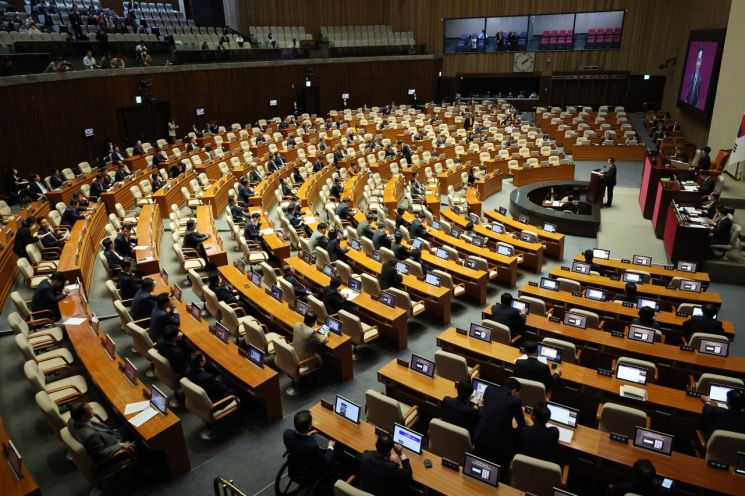
Ahn Byung-gil of the People Power Party cited the 16th National Assembly, saying, "In response to the people's request, the number of seats was reduced by 26," and added, "When structural reform is needed across society, the National Assembly should not cling to the number of seats but boldly reduce them if the people want it."
Wi Sung-gon of the Democratic Party proposed, "While maintaining the basic framework of single-member districts, I suggest introducing regional mixed-member proportional representation that guarantees strengthened regional representation," explaining, "Out of the total 300 seats, reducing 7 district seats to have 246 district seats and 54 proportional representation seats, with the condition that the total number of seats by region and area is maintained, allowing adjustments within regions to change the number of district and proportional seats."
Choi In-ho of the Democratic Party also said, "I have proposed a regional proportional representation system maintaining 300 seats and single-member districts, with a 3:1 ratio of district to proportional seats, 255 to 75 seats," and added, "It is also necessary to seriously consider adopting large electoral districts only in the seven special and metropolitan cities." Choi said, "Even if we give up power, let's move forward with electoral reform together with them," adding, "Only then can a country truly for the people be created."
Park Hyung-soo Proposes Grouping Gyeongbuk-Jeonbuk and Gyeongnam-Honam for Regional Proportional Representation; Park Young-soon Says Proportional Representation Needed to Represent Localities and Regions
Various discussions on electoral reform were also held. On this day, remarks were made emphasizing strengthening the role of proportional representation rather than reducing it.
Park Hyung-soo of the People Power Party proposed adopting a mixed urban-rural electoral district system along with regional proportional representation to overcome regionalism. Park said, "I propose grouping the metropolitan areas of Seoul, Gyeonggi, and Incheon as one region, then Chungcheong and Gangwon as another, Gyeongbuk and Jeonbuk as one, and Gyeongnam, Honam, and Jeju as another," explaining, "If electoral districts are delineated this way, it would be impossible for any party or candidate to disparage the May 18 Gwangju Democratization Movement or criticize people from Yeongnam as reactionary extremists."
Lee Jong-sung of the People Power Party said, "We should not simply abolish proportional representation but look at where the people's criticism stems from," suggesting, "Proportional representation should fully reflect its original purpose by representing political minorities and experts in fields such as national defense, diplomacy, and science and technology, and if fair and transparent candidate selection is institutionalized, public resentment can be sufficiently alleviated."
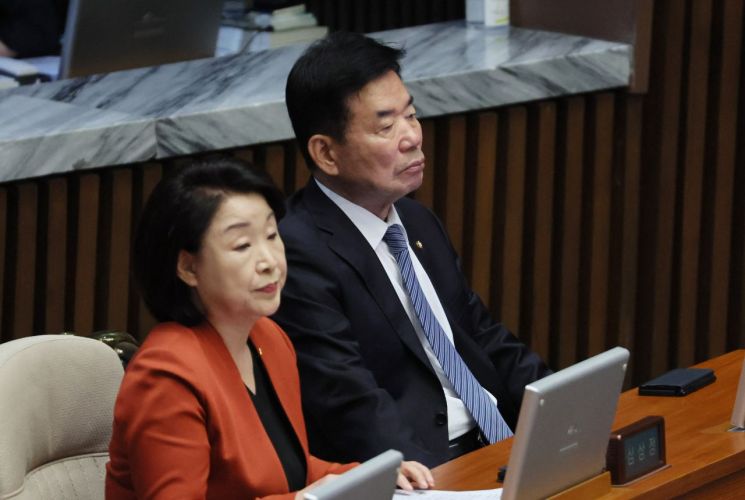
Park Young-soon of the Democratic Party said, "Although the proportional representation system for National Assembly members has sometimes been used as a tool for vested interests and the ruling party to maintain power, since the introduction of the party-list system with two votes per person in 2004, it has played a role in representing social minorities such as women, people with disabilities, and multicultural families," and urged, "Now is the time for proportional representation to represent the most vulnerable in our Republic of Korea, the localities and regions," calling for discussion on a regionally differentiated parallel proportional representation system.
© The Asia Business Daily(www.asiae.co.kr). All rights reserved.
![Clutching a Stolen Dior Bag, Saying "I Hate Being Poor but Real"... The Grotesque Con of a "Human Knockoff" [Slate]](https://cwcontent.asiae.co.kr/asiaresize/183/2026021902243444107_1771435474.jpg)

















