Second Day of the National Assembly's Full Committee
Restoring Compromise Politics on Lawmaker Quotas and Regional Extinction Response
On the second day of the plenary committee meeting for electoral district reform on the 11th, lawmakers from both ruling and opposition parties emphasized the need for a "decision" and presented proposals for electoral district reform. Various claims were made regarding responses to regional extinction, proportional representation seat restructuring, and methods of electing members of the National Assembly. A proposal for a large multi-member district system to overcome political polarization was introduced, while voices calling for a reduction in the number of lawmakers or the abolition of the proportional representation system were also raised.
At the plenary committee held at the National Assembly on the 11th, Lee Yang-su, who served as the former People Power Party floor leader of the National Assembly's Political Reform Special Committee, proposed a mixed system combining urban-rural hybrid electoral districts and regional proportional representation. Lee Yang-su stated, "If proportional representatives are elected by region, it becomes possible to elect lawmakers from various parties in each region, contributing to the alleviation of regionalism," adding, "To resolve regional imbalance, allocating proportional seats to regions at risk of extinction, such as rural farming and fishing areas, can be expected to strengthen the representation of non-capital rural areas."
He argued, "Applying a large multi-member district system in urban areas minimizes wasted votes and integrates National Assembly electoral districts that were previously separated within a single administrative unit, aligning with voters' regional identities," and added, "In rural farming and fishing areas facing steep population decline, maintaining single-member districts is necessary to secure regional representation."
Democratic Party lawmaker Kim Jong-min unveiled a new electoral district reform plan. Kim Jong-min said, "First, I propose trying large electoral districts at least in Seoul and the six major metropolitan cities." He added, "It is frankly embarrassing to have single-member districts in highly urbanized and densely populated areas like Seoul and metropolitan cities," and questioned, "How many residents would know the boundaries if a single district in Seoul is divided into Gap, Eul, and Byeong?" Kim Jong-min explained, "Proportionality, national representation, and diversity all increase," and "(especially) the advantages and disadvantages for political parties do not lean heavily to one side." He further explained, "There are about 46 electoral districts where the Democratic Party is dominant in Seoul and Honam, and about 46 districts where the People Power Party is dominant in Seoul and Yeongnam," calling it a "delicate balance."
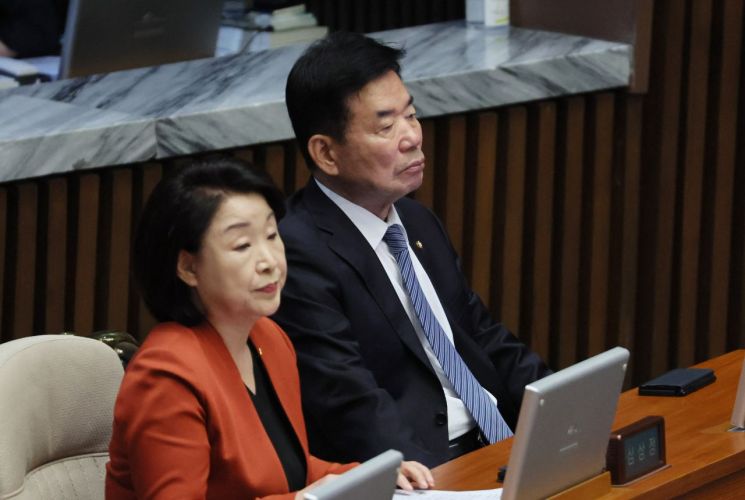
Democratic Party lawmaker Kim Sang-hee advocated for a comprehensive large electoral district system. He said, "We believe we can consider a groundbreaking new system here," proposing, "Changing the current single-member districts to large multi-member districts and introducing a party-list proportional representation system." Kim Sang-hee explained, "With a two-vote system, our voters first vote for their preferred party and then vote for their preferred candidate on an open list, which can secure a certain level of vote equality and proportionality," adding, "By introducing a nationwide proportional representation system, we can guarantee representation for significantly underrepresented groups such as women, youth, and people with disabilities."
On the other hand, skepticism about the large multi-member district system was also expressed. Democratic Party lawmaker Kang Deuk-gu said, "The belief that the large multi-member district system guarantees effectiveness in resolving political structural conflicts is a political superstition," adding, "In a large multi-member district system, a ruling party that struggles to secure a majority in the National Assembly will politically find it difficult to avoid opposition fragmentation." Instead, Kang Deuk-gu proposed maintaining the single-member district framework while suggesting a "dual candidacy system," explaining, "It is an alternative to breaking the regional monopoly of certain parties and a system that allows parties to support candidates running in difficult districts and express interest to local residents."
Democratic Party lawmaker Shin Jeong-hoon argued from the perspective of overcoming regionalism and responding to regional extinction, stating, "The current nationwide proportional representation system should be restructured into a regional proportional representation system to secure seats that respond to regional extinction." He also claimed that regionalism intensifies the confrontation between the two major parties. Shin Jeong-hoon pointed out, "In Honam, people often say, 'If you just get the nomination, there’s no problem,' but this shakes the legitimacy of local politicians and pushes politics into confrontation," adding, "Going further, it produces bullfighters who survive only through hostile confrontations."
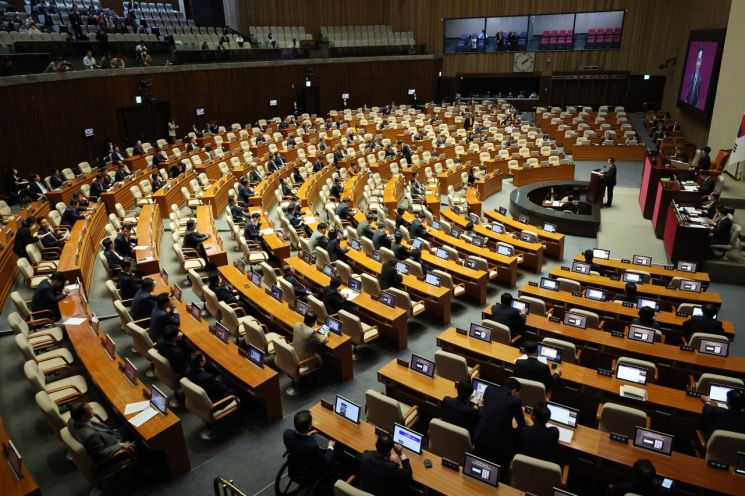
The plenary committee frequently discussed the need to devise measures to respond to regional extinction.
People Power Party lawmaker Jang Dong-hyuk said, "To secure proportionality between regional populations and seats, adjusting the number of seats by region must precede," adding, "Based on March of this year, adjusting the 253 electoral district seats according to population ratios reveals that certain regions are overrepresented compared to others. After adjusting seats according to regional population proportions, a redesign is needed to balance the concentration in the metropolitan area."
People Power Party lawmaker Kim Hyung-dong introduced the trend of decreasing lawmakers in the northern Gyeongbuk region, saying, "It was not originally such a region," and added, "It is a vicious cycle. With reduced representation, regional development stalls and population inflow stops. We need to proceed in a way that considers and strengthens local representation." Democratic Party lawmaker Shin Jeong-hoon argued, "By distributing seats for regional balance, special measures should be provided for regions facing extinction, and solutions should be devised to respond to extinct regions by setting various criteria beyond just population."
Regarding the number of lawmakers, voices mainly from the People Power Party called for reduction, but there were also calls for decisive action by the National Assembly to secure a higher proportion of proportional representatives.
People Power Party lawmaker Cho Kyung-tae said, "I stand here to reduce the number of proportional representatives and the total number of lawmakers," adding, "We will campaign to reduce 47 proportional seats and also reduce district seats to cut about 100 lawmakers, and we will not stop at words but propose this as the party’s official stance for next year’s general election."
People Power Party lawmaker Yoo Sang-beom said, "Some argue that the number of lawmakers should be increased, but such claims ignore the public’s distrust of lawmakers," criticizing the current proportional representation system by saying, "As seen in fake news, embezzlement of comfort women fund donations, and private use of doctor cars, there are many lawmakers abusing their positions for personal gain," and added, "Rather than professionalism, they focus solely on representing their own occupational interests and tend to concentrate only on district activities in places where their chances of winning are easier in the next general election, which is the current reality."
On the other hand, Democratic Party lawmaker Ko Yong-jin said, "In 2015, the National Election Commission submitted an opinion to amend the election law proposing to increase proportional seats from 54 to 100, but now it has rather decreased to 47," adding, "We need to either reduce district seats or increase the total number of lawmakers to secure proportional seats." Ko Yong-jin argued, "Even if a party wins a landslide victory in the general election, what can that party really do?" and urged, "They must relinquish vested interests or take a step forward on the path of change while enduring public criticism."
© The Asia Business Daily(www.asiae.co.kr). All rights reserved.
![Clutching a Stolen Dior Bag, Saying "I Hate Being Poor but Real"... The Grotesque Con of a "Human Knockoff" [Slate]](https://cwcontent.asiae.co.kr/asiaresize/183/2026021902243444107_1771435474.jpg)
















