International Silver Prices Rise 11.78% in March
Demand Surges Due to Intermediate Characteristics Between Gold and Copper
As gold prices continue to rise, silver prices are also increasing accordingly. This is attributed to the growing demand for precious metal investments as an inflation hedge, as well as the strengthened preference for safe-haven assets due to financial market instability triggered by the Silicon Valley Bank (SVB) crisis. Exchange-traded funds (ETFs) and exchange-traded notes (ETNs) investing in domestically listed silver have also recorded double-digit gains over the past month, gaining attention as a refuge amid the increased volatility in the stock market caused by the SVB-related crisis.
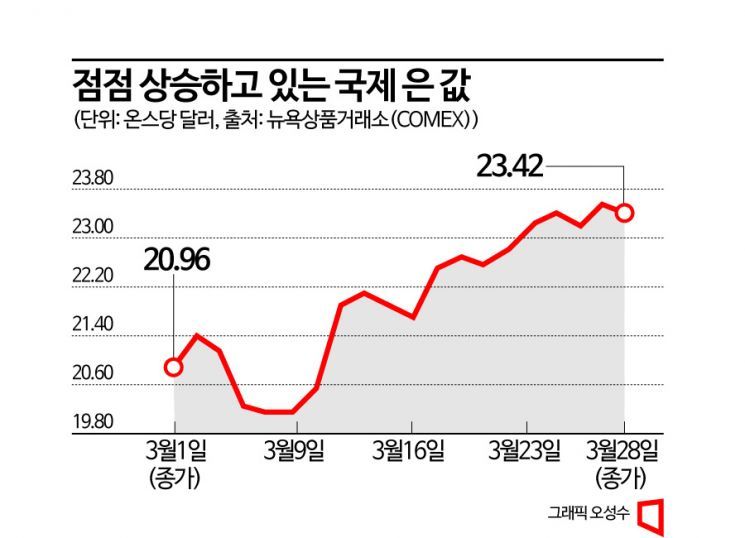
According to the New York Mercantile Exchange, the April international silver futures price closed at $23.42 per troy ounce, up 1.19% from the previous trading day (as of the 28th local time). International silver prices have surged by 11.78% since the beginning of this month (March 1 to March 28), nearly twice the rise of international gold prices (6.94%) during the same period.
ETFs and ETNs investing in domestically listed silver also boast double-digit gains. Currently, methods to invest in gold and silver include trading physical metals at the Korea Gold Exchange or purchasing ETFs and ETNs that track related prices. The 'KODEX Silver Futures (H)' recorded a low of 3,905 KRW during trading on the 10th and has steadily risen to close at 4,560 KRW on the 29th, marking a 16.77% increase. The 'Samsung Silver Futures ETN (H)' rose from 7,950 KRW to 9,300 KRW during the same period, up 16.98%. The 'Meritz Silver Futures ETN (H)' also showed an upward trend after hitting a low of 7,985 KRW on the 9th, closing at 9,295 KRW on the 29th with a 16.40% gain. The 'Shinhan Silver Futures ETN (H)' closed at 12,570 KRW on the 29th, up 16.93% from its low of 10,750 KRW on the 8th.
Silver, which typically moves in tandem with gold prices, tends to rise alongside gold when gold prices increase. However, unlike gold, silver is classified as a precious metal with both safe-haven investment demand and industrial demand alongside copper, making it an intermediate material between gold and copper. The recent rise in silver prices can be attributed to increased demand for safe-haven assets amid global stock market instability and the advantage of low correlation with other assets such as stocks, bonds, and real estate, which enhances diversification effects. The SVB crisis increased stock market volatility, and concerns spreading to commercial real estate and REITs have led to a surge in demand for silver as an alternative investment.
Although the 'bankdemic' (bank + pandemic) has somewhat eased as SVB and Credit Suisse (CS) each found new owners, the preference for safe-haven assets is expected to continue for the time being. Shim Subin, a researcher at Kiwoom Securities, stated, “Last week, gold rose by 0.58% and silver by 3.9%. This appears to be due to the strengthened perception that the U.S. Federal Reserve (Fed) is in the late phase of its rate hike cycle, despite the Fed’s interest rate hikes and Fed Chair Jerome Powell’s dismissal of the possibility of rate cuts within the year.” He added, “Concerns about the soundness of individual banks have not been completely resolved, which is also a factor driving price increases.” Hwang Byungjin, a researcher at NH Investment & Securities, also noted, “With a downward stabilization of real interest rates, the gold-to-silver ratio has declined, resulting in better investment performance for silver compared to gold during the same period.” He predicted, “Investment funds may flow into silver, which possesses characteristics of both gold (safe-haven asset) and copper (industrial metal).”
© The Asia Business Daily(www.asiae.co.kr). All rights reserved.
![Clutching a Stolen Dior Bag, Saying "I Hate Being Poor but Real"... The Grotesque Con of a "Human Knockoff" [Slate]](https://cwcontent.asiae.co.kr/asiaresize/183/2026021902243444107_1771435474.jpg)















