AI's Three Core Strategic Pillars Presented
"Mid-tier Plan Performance Not Disadvantaged... Difficult to Achieve 28GHz Deployment"
SK Telecom is preparing to make a full-fledged leap as an AI company by recruiting artificial intelligence (AI) experts as outside directors at its regular shareholders' meeting.
On the 28th, SK Telecom held the 39th shareholders' meeting at its headquarters T Tower in Euljiro, Seoul, approving agenda items such as the 2022 financial statements, appointment of outside directors, and appointment of audit committee members.
At this shareholders' meeting, the board of directors significantly strengthened its AI capabilities. AI expert Professor Oh Hye-yeon from KAIST was newly appointed as an outside director and audit committee member, and Associate Professor Kim Jun-mo from KAIST was reappointed as an outside director. Newly appointed outside director Oh is an expert in natural language processing-based AI and currently serves as a professor in the Department of Computer Science at KAIST as well as the director of the AI Research Institute. SKT stated that it expects Oh to contribute to the company's growth as an AI company by advising on future AI technology directions and AI ethics issues. The diversity and expertise of the board were also enhanced.
Outside director Kim Jun-mo is an AI expert specializing in deep learning algorithm-based computer vision and signal processing. SKT said it expects Kim to provide expert opinions on AI and digital transformation projects promoted by SKT and AI-based business strategies.
Professor Kim Yong-hak, Emeritus Professor at Yonsei University, was also reappointed as an outside director and audit committee member. During his three-year tenure as chairman of the board, Kim provided advice necessary for enhancing corporate value in areas such as governance modernization, corporate spin-offs, and ESG based on his expertise in sociology. An agenda item granting stock options to management to strengthen responsible management and enhance corporate value from a mid- to long-term perspective was also approved.
At this shareholders' meeting, CEO Yoo explained the achievements of 2022 and the management strategy to accelerate the leap to an AI company to the shareholders. CEO Yoo stated, "2022 was a year in which we settled the five major business groups presented with the launch of SKT 2.0 on a growth trajectory and proactively prepared for the evolution into an AI company," adding, "This year, we will accelerate our leap to an AI company."
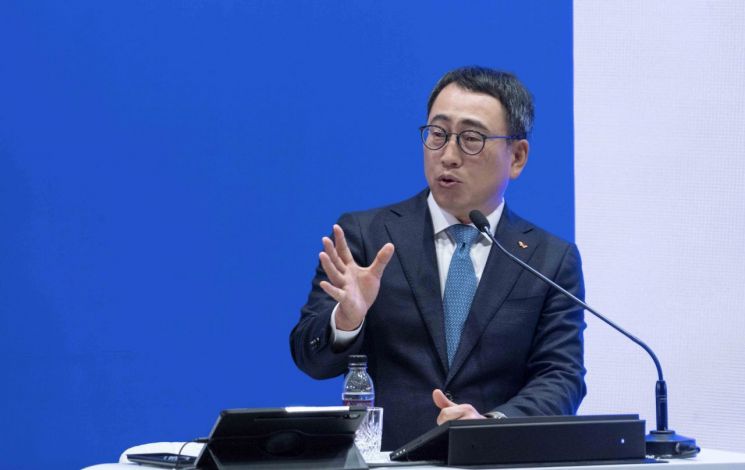
Presentation of Three Core Strategic Pillars for Leap to AI Company
CEO Yoo presented concrete methodologies for a full-fledged leap to an AI company while continuing the solid growth of the five major business groups?wired and wireless communications, media, enterprise, AIVERSE, and connected intelligence?that were introduced with the launch of the SKT 2.0 era and have settled on a growth trajectory. The three core strategic pillars are ▲ AI innovation in core services (Core Biz.), ▲ strengthening customer relationships through AI services, and ▲ AIX, which spreads AI across industries.
Through AI technology, SKT plans to enhance the competitiveness of existing core services such as wired and wireless communications, media, and subscription businesses. It will promote digital transformation that maximizes customer convenience by applying AI throughout the entire process of using mobile communication services. SKT announced that it will innovate customer relationships through AI services led by A., a Korean large language model-based enterprise and consumer (B2C) service. Additionally, AI innovation will be applied across industries. Urban Air Mobility (UAM) will accelerate commercialization with the start of government demonstration projects this year, and the AI semiconductor Sapeon will launch the next-generation product X330. Furthermore, AI will be expanded across industries including robotics, AI advertising platforms, and AI customer centers.
SKT also reported achievements related to 'ESG 2.0,' which was announced at last year's shareholders' meeting, aiming to expand positive influence by linking core business and ESG (environment, social, governance). It became the first domestic telecom company to pass the Science Based Targets initiative (SBTi) verification for greenhouse gas reduction targets and received an A grade from the Carbon Disclosure Project (CDP), which was awarded to only 296 companies out of more than 15,000. AI-driven ESG activities also yielded results. Since July 2021, 'Happy Habit' has reduced the use of 7.45 million disposable plastic cups. AI technology is used to care for 50,000 elderly living alone and has contributed to emergency rescue of more than 450 people. In the past year alone, it blocked over 4 million smishing attempts.
"No Disadvantage to Mid-Tier Plan Performance... Difficult to Achieve 28GHz Deployment Target"
CEO Yoo responded to questions from shareholders and reporters regarding telecommunications issues. In response to shareholders' concerns that diversifying relatively affordable mid-tier plans could worsen profitability, he said, "From experience, when prices go down, demand increases, so I don't think diversifying 5G mid-tier plans will be unilaterally disadvantageous to performance," adding, "We will have to observe various situations going forward." SKT announced on the 23rd that it will launch a '5G customized plan' on May 1, allowing customers to combine four additional data options with the existing 5G mid-tier plan (Basic Plus) according to their preferences.
After the shareholders' meeting, CEO Yoo met with reporters and said regarding the goal to complete the deployment of 15,000 5G 28GHz base stations by May, "We are making some progress, but it will be difficult to meet the target." When asked whether SKT will continue to use the 28GHz frequency, he replied, "We are in consultation with the government," adding, "We will inform you once the consultation is complete."
The 28GHz frequency offers high speed but has a shorter reach and weaker diffraction compared to the 3.5GHz band currently used nationwide, making it difficult to pass obstacles. Because base stations must be densely installed, it incurs enormous investment costs, but a revenue model has not yet been found. When the government allocated the 5G 28GHz frequency in 2018, it set a target for each of the three telecom companies to build 15,000 base stations. Due to insufficient progress, KT and LG Uplus received allocation cancellation orders in December last year, while SK Telecom was given a shortened usage period and an obligation to complete the deployment of 15,000 28GHz base stations by May this year.
Regarding the additional allocation of the adjacent 3.7GHz 5G frequency requested last year, he said, "(Demand) still exists," and "If the government allocates it, we plan to make large-scale investments."
© The Asia Business Daily(www.asiae.co.kr). All rights reserved.
![Clutching a Stolen Dior Bag, Saying "I Hate Being Poor but Real"... The Grotesque Con of a "Human Knockoff" [Slate]](https://cwcontent.asiae.co.kr/asiaresize/183/2026021902243444107_1771435474.jpg)















