Seoul Apartment Jeonse-to-Wolse Conversion Rate at 4.08%
Rises from 3% to 4% Range in 2 Years and 10 Months
High Interest Rates and Increased Demand Push Monthly Rent Up
The practice of ‘Apartment deposit of 100 million KRW = monthly rent of 300,000 KRW (jeonse-to-monthly rent conversion rate of 3.6%)’ in Seoul has been broken. The jeonse-to-monthly rent conversion rate, which is applied when converting a jeonse deposit to monthly rent, has risen from the 3% range to the 4% range for the first time in 2 years and 10 months. As apartments with monthly rents exceeding 1 million KRW are appearing one after another, the housing cost burden for tenants moving from jeonse to monthly rent to avoid high interest rates seems to be increasing.
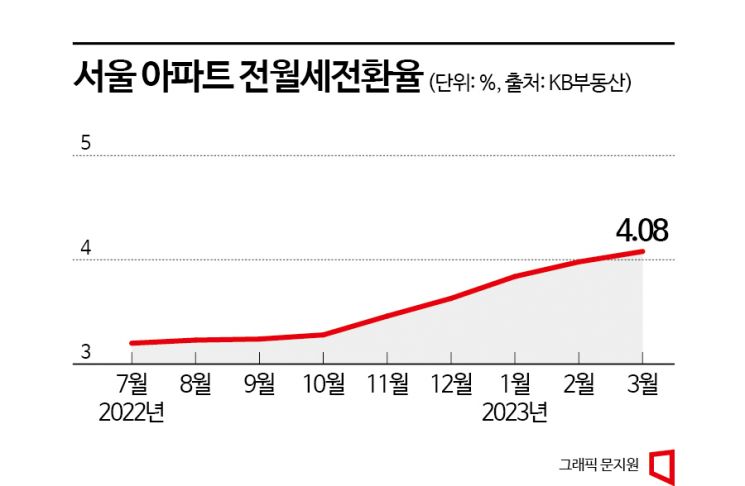
According to KB Real Estate on the 29th, the jeonse-to-monthly rent conversion rate for Seoul apartments in March was 4.08%. This is up 0.1 percentage points (p) from 3.98% a month earlier. It is the first time in 2 years and 10 months since May 2020 that the conversion rate has recorded above 4%.
The jeonse-to-monthly rent conversion rate is the conversion rate applied when converting a jeonse deposit into one year’s worth of monthly rent. For example, if the conversion rate is 3% when converting a jeonse deposit of 100 million KRW into monthly rent, the tenant must pay a total of 3 million KRW in monthly rent over one year. In other words, a higher conversion rate means that the relative burden of monthly rent has increased compared to jeonse.
The jeonse-to-monthly rent conversion rate for Seoul apartments entered the 3% range at 3.97% in June 2020 and dropped to 3.13% by January last year. After the new lease law, jeonse prices soared rapidly, but monthly rents did not keep pace with this rise, causing the conversion rate to fall. However, from February last year, the conversion rate began to rise gradually and sharply increased to ▲3.28% in October ▲3.46% in November ▲3.63% in December ▲3.84% in January this year ▲3.98% in February.
The recent volatile rise in the conversion rate appears to be due to the acceleration of jeonse turning into monthly rent. As tenants shift from jeonse to monthly rent to avoid soaring interest burdens, market principles have caused jeonse prices to fall and monthly rents to rise. In fact, an analysis by Real Estate R114 of the Ministry of Land, Infrastructure and Transport’s actual transaction prices for jeonse and monthly rent in December last year and January this year showed that the average monthly rent for Seoul apartments was 920,000 KRW, up 8.1% from 850,000 KRW during the same period two years ago. Moreover, landlords who calculate monthly rent considering interest rates have also raised rents, pushing the conversion rate higher.
Now, it is common to see apartments of standard size with monthly rents exceeding 2 million KRW in Seoul. On the 22nd, a contract was signed for an 84㎡ apartment in Helio City, Garak-dong, Songpa-gu, Seoul, with a deposit of 300 million KRW and monthly rent of 2 million KRW. On the same day, a contract was signed for an 84㎡ apartment in Mapo Raemian Prugio, Ahyeon-dong, Mapo-gu, Seoul, with a deposit of 100 million KRW and monthly rent of 2.8 million KRW.
As a result, the housing cost burden for tenants moving from jeonse to monthly rent is increasing. Experts say that with the recent rise in monthly rent and the upward trend in the conversion rate, the burden of monthly rent is becoming as significant as the interest on jeonse loans, so tenants need to reasonably compare and choose between jeonse and monthly rent when looking for a home.
Yeo Kyung-hee, senior researcher of the Real Estate R114 Research Team, said, "Due to tenants’ preference for monthly rent and landlords’ desire for returns exceeding market interest rates, monthly rent prices for Seoul apartments have been on the rise recently," adding, "Although interest rates remain high, since jeonse prices are rapidly falling, tenants should carefully compare jeonse loan interest and monthly rent to make a rational choice."
© The Asia Business Daily(www.asiae.co.kr). All rights reserved.
![Clutching a Stolen Dior Bag, Saying "I Hate Being Poor but Real"... The Grotesque Con of a "Human Knockoff" [Slate]](https://cwcontent.asiae.co.kr/asiaresize/183/2026021902243444107_1771435474.jpg)

















