Victims' Cafe, '71.6% Extradited to US, 14.7% to Korea'
"To Quickly Aid Korean Victims, They Must Be Brought Home" Opinions Also Raised
Where should Do Kwon, CEO of Terraform Labs, who was arrested in Montenegro, be extradited to and punished?
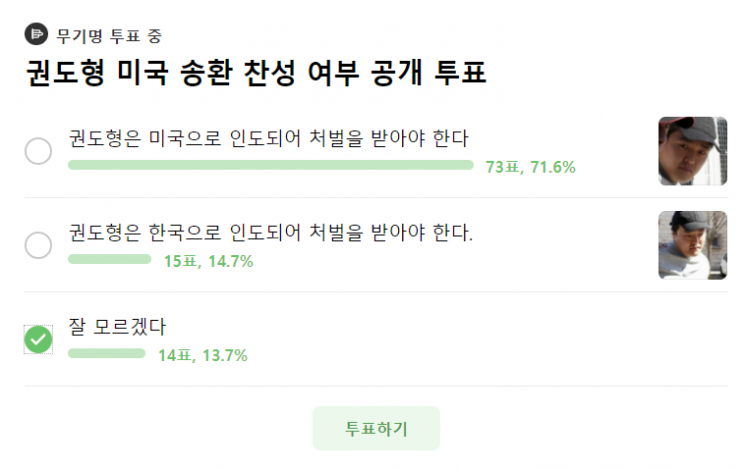
The 'Luna Terra Official Victims Cafe,' with over 2,700 members, conducted a public vote from the morning of the 26th on whether the preferred extradition country for Do Kwon should be the United States or South Korea. As of 4:30 PM on the 27th, 71.6% (73 people) chose the United States, while 14.7% (15 people) chose South Korea.
Although not statistically significant, it can be inferred that Do Kwon’s direct victims favor sending him to the United States, where the punishment is harsher. One netizen said, "Considering that arrest warrants for Shin Hyun-sung (former CEO of Chai Corporation) and others were dismissed, I cannot trust the Korean courts." Another netizen commented, "In Korea, he might receive a light prison sentence, but in the U.S., he could spend his entire life in prison with a life sentence."
The United States tends to impose heavy sentences for economic crimes. In 2009, the U.S. court sentenced Bernard Madoff, former chairman of the NASDAQ Stock Exchange, to 150 years in prison for defrauding about 37,000 investors of $65 billion. Allen Stanford, former chairman of Stanford International Group, who was charged with $7 billion in financial fraud, was sentenced to 110 years in prison in 2012.
In South Korea, the Supreme Court confirmed a 40-year prison sentence last July for Kim Jae-hyun, CEO of Optimus Asset Management, who was charged with a fund fraud amounting to about 1 trillion won. Kim Bong-hyun, former chairman of Star Mobility, who faced charges including embezzlement and fraud under the Act on the Aggravated Punishment of Specific Economic Crimes, was sentenced to 30 years in prison in the first trial. According to the Act on the Aggravated Punishment of Specific Economic Crimes, if the amount of illicit gains from fraud, extortion, embezzlement, or breach of trust exceeds 5 billion won, a life sentence can be imposed, but such cases are rare. Prosecutors sought a life sentence for a former finance team leader of Osstem Implant who embezzled 221.5 billion won, but he was sentenced to 35 years in the first trial. He has appealed the verdict.
On the other hand, there is also a view that extraditing Do Kwon to South Korea would allow for faster relief for domestic victims. Kim Hyun-kwon, a lawyer representing about 20 victims (LKB & Partners), said, "He can be sentenced in both South Korea and the U.S., but since the investigation should proceed in Korea, responsibility can be held not only for Do Kwon but also for those involved in the crime. For the victims’ speedy recovery, domestic extradition is better." He added, "If he is extradited to the U.S. first, domestic victims will find it difficult to understand and access the local judicial process."
Currently, it is difficult to precisely estimate the expected sentence because the charges applicable to Do Kwon in South Korea are not clear. Seung Jae-hyun, senior research fellow at the Korea Institute of Criminal Justice Policy, said, "Although proving the case is not easy, if it is judged as fraud under the Act on the Aggravated Punishment of Specific Economic Crimes, a life sentence is possible, so there is no problem securing a sentence. The problem is that in Korea, sentences often do not follow the statutory penalties." He added, "The U.S. court sentenced Bernard Madoff, who embezzled 70 trillion won in Korean won value, to 150 years, so Do Kwon, who embezzled 50 trillion won, is expected to receive more than 100 years." Yang Tae-jung, lead attorney at Law Firm Gwangya, said, "Although South Korea has fraud charges under the Act on the Aggravated Punishment of Specific Economic Crimes, the sentences are not as severe as in the U.S., so Do Kwon will receive a heavier sentence in the U.S."
Meanwhile, regarding the strong calls for "extradition to the U.S.," Attorney Yang said, "The reason why economic crimes committed domestically receive light punishments despite large-scale damage is because court rulings differ from public sentiment." He argued, "The judiciary needs to strengthen sentencing guidelines for such economic crimes to impose harsher punishments." Senior Research Fellow Seung said, "We must secure sentences that can strictly and objectively punish crimes causing widespread harm to ordinary citizens."
© The Asia Business Daily(www.asiae.co.kr). All rights reserved.
![Clutching a Stolen Dior Bag, Saying "I Hate Being Poor but Real"... The Grotesque Con of a "Human Knockoff" [Slate]](https://cwcontent.asiae.co.kr/asiaresize/183/2026021902243444107_1771435474.jpg)
















