Assemblyman Heo Jong-sik Questions "Private Investment Review for Gyeongin Line Undergrounding"
Minister Won Hee-ryong: "Project Not Feasible with Public Funds Alone, Must Design How to Attract Private Investment"
Regarding the Gyeongin Line underground project, which is facing difficulties due to funding issues, the government has for the first time revealed that it could be pursued through a combination of public finance and private investment.
On the 23rd, at the full meeting of the Land, Infrastructure and Transport Committee, Heo Jong-sik, a member of the Democratic Party of Korea (Incheon Dong-gu Michuhol-gu Gap), urged Land Minister Won Hee-ryong, saying, "Since the office has prepared an alternative linking a deep double-track express line and a shallow private tram and road, we should consider various measures for funding the Gyeongin Line underground project."
Earlier, in 2021, Representative Heo proposed an alternative policy for the Gyeongin Line underground project, suggesting the simultaneous promotion of a "40m deep double-track" along with the construction of a "shallow tram and automobile-only road" as a private investment project.
In response, Minister Won said, "I believe the Gyeongin Line underground project cannot be pursued solely with public funds," adding, "After the enactment of the special underground law, the design will determine how to handle public finance and how to attract private investment."
This is the first time the government has announced its intention to introduce private investment into the Gyeongin Line underground project.
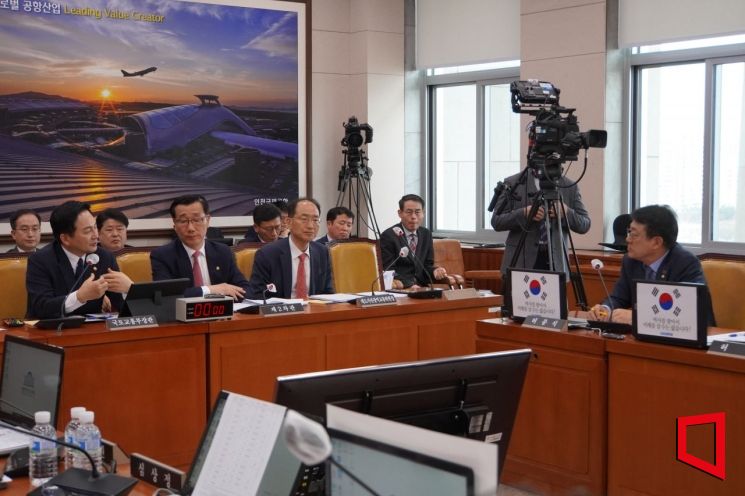 Minister of Land, Infrastructure and Transport Won Hee-ryong is responding to a question from Democratic Party lawmaker Heo Jong-sik at the full meeting of the Land, Infrastructure and Transport Committee held on the 23rd.
 [Photo by Heo Jong-sik]
The option of raising funds through the sale of railway surface land was also discussed.
Representative Heo stated, "In a 2016 research report by the Korea Railroad Research Institute, the sale of surface land was estimated to generate an average of 3.9 trillion won, and in a policy report published by the office in 2022, it was found to generate an average of 5.2 trillion won," adding, "Detailed measures for the sale of surface land and utilization of station areas must also be carefully prepared."
Minister Won responded, "There is a funding issue with railway underground projects," and said, "Since the undergrounding of railways does not increase transport volume, economic differences compared to underground roads are inevitable, but this will be supplemented by the special law."
Representative Heo repeatedly emphasized that the promotion of the Gyeongin Line underground project must be accelerated as the environment surrounding the Gyeongin Line will change significantly around 2030.
With the private station usage permits for Bupyeong Station and Bucheon Station expiring in 2030, the demolition of the private station at Dongincheon confirmed, and the GTX-B line expected to cause demand dispersion due to its similarity to the Gyeongin Line route between Bupyeong Station and Seoul Station, a change in the role of the Gyeongin Line is inevitable.
Meanwhile, since 2021, Representative Heo has been actively working on the prompt promotion and alternative preparation of the Gyeongin Line underground project through policy research projects, policy meetings, full meetings of the Ministry of Land, Infrastructure and Transport, and national audits.
© The Asia Business Daily(www.asiae.co.kr). All rights reserved.
![Clutching a Stolen Dior Bag, Saying "I Hate Being Poor but Real"... The Grotesque Con of a "Human Knockoff" [Slate]](https://cwcontent.asiae.co.kr/asiaresize/183/2026021902243444107_1771435474.jpg)















