Detailed Regulations on Guardrails of the US Semiconductor Support Act Released
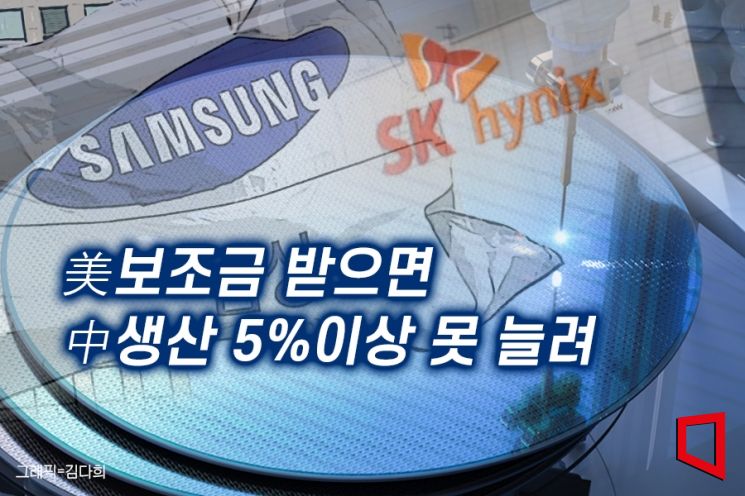
Samsung Electronics and SK Hynix will not be allowed to expand their semiconductor production capacity in China by more than 5% over the next 10 years if they receive investment subsidies under the U.S. CHIPS and Science Act (CSA). However, technical upgrades such as increasing production scale per wafer through technology development are not regulated.
On the 21st (local time), the U.S. Department of Commerce disclosed detailed regulations of the guardrail provisions designed to ensure that CSA subsidies are not used for purposes that undermine national security through the Federal Register and other channels. These regulations will be finalized after a 60-day public comment period.
Companies receiving subsidies under the CSA must return the full amount of the subsidy if they engage in significant transactions that materially expand semiconductor production capacity in China over the next 10 years. The Department of Commerce defined "material expansion" as quantitative increases in production capacity in the regulations released that day. Additionally, transactions exceeding $100,000 were defined as "significant transactions."
If these conditions apply, advanced semiconductors are prohibited from expanding production capacity by more than 5%, and previous-generation legacy semiconductors by more than 10%. The Department of Commerce defined legacy semiconductors as follows: logic semiconductors at 28nm (nanometers, one billionth of a meter), DRAM at 18nm, and NAND flash at 128 layers.
It is reported that most semiconductors currently produced by Samsung Electronics and SK Hynix in China fall under advanced semiconductors. Accordingly, if they receive subsidies from the U.S. government, production facility expansion restrictions are expected to apply in the range of 5-10% depending on the technological level.
However, the Department of Commerce allowed production capacity expansion through internal technological upgrades to maintain the competitiveness of these companies. Increasing the number of semiconductor chips produced per wafer through technology development will not be considered as production capacity expansion under the regulations. Korean companies had previously expressed concerns that the term "material expansion" might include production capacity increases through technical upgrades.
The Department of Commerce stated, "As long as production capacity does not increase beyond the set standards, companies receiving subsidies are permitted to maintain competitiveness and operate through technological upgrades." The specific criteria for semiconductor production capacity were defined as the number of wafers per month for semiconductor manufacturing facilities and the number of packages per month for semiconductor packaging facilities.
Along with this, the Department of Commerce also prohibited companies receiving U.S. government subsidies from conducting joint research or technology licensing (patent use agreements) with Chinese companies of concern on the blacklist, such as Huawei and YMTC. This reconfirms provisions already stated in existing laws. Recently, controversy arose when automaker Ford announced a joint factory with Chinese electric vehicle battery maker CATL, allegedly circumventing related regulations of the Inflation Reduction Act (IRA), prompting this reconfirmation.
A senior official from the Department of Commerce evaluated the guardrail regulations, saying, "They will help prevent malicious actors from acquiring advanced technologies that could be used against the U.S., its allies, and partners." The official also confirmed that coordination with allies such as South Korea was conducted during the formulation of the guardrail regulations. A key official from the Department of Commerce is scheduled to visit South Korea soon for consultations with the Korean government, followed by consultations with Japan and Taiwan.
© The Asia Business Daily(www.asiae.co.kr). All rights reserved.
![Clutching a Stolen Dior Bag, Saying "I Hate Being Poor but Real"... The Grotesque Con of a "Human Knockoff" [Slate]](https://cwcontent.asiae.co.kr/asiaresize/183/2026021902243444107_1771435474.jpg)















