Florida Holds Annual 'Bidanbaem Removal Contest'
18,000 Bidanbaem Removed Since 2000
The state of Florida in the United States is struggling with an increasing number of Burmese pythons, and as a solution, it has been reported that they are even holding a 'Burmese Python Hunting Contest.' Residents have kept Burmese pythons as pets since the 1970s, but as the snakes grew larger, they began releasing them indiscriminately, leading to the current python problem in the state.
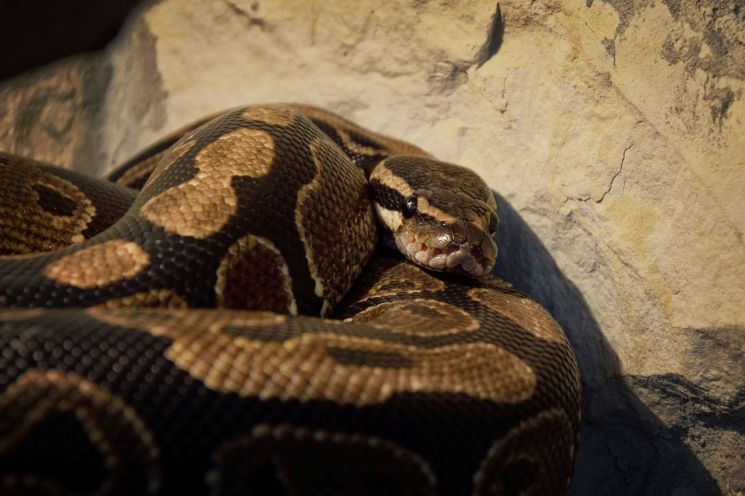
On the 14th (local time), the American daily The New York Times (NYT) highlighted Florida's Burmese python issue. The media stated, "Burmese pythons were popular exotic pets in the U.S. during the 1970s, but some species grew so large that owners eventually released them," adding, "The pythons bred massively, leading to regulations restricting imports and ownership, but it was already too late."
The Burmese pythons found in Florida are typically over 15 feet (4.57 meters) long and weigh more than 200 pounds (90 kg). The most commonly found species is the Burmese python. Known as one of the "world's top five snakes," it is estimated that tens of thousands live in Florida.
The problem is that the invasive Burmese python is destroying Florida's ecosystem. The Burmese python preys on everything from small animals like rodents and rabbits to large animals such as deer and wild boars, causing ecological damage.
In response, the Florida Fish and Wildlife Conservation Commission (FWC) has held an annual "Python Removal Contest" since 2013, where participants hunt Burmese pythons. Awards and prize money are given based on hunting performance. Last year, 977 people participated, and the grand prize winner who caught 28 pythons received $10,000.
Separately from this contest, the state government also offers rewards and allowances to people who catch Burmese pythons. Because of this, some have taken up python hunting as a full-time profession.
The reward amount varies depending on the length of the captured python. For pythons up to 4 feet (122 cm), hunters receive $50 (about 65,300 KRW) per foot, and for lengths exceeding that, $25 (about 32,600 KRW) per foot. In other words, a 4-foot python earns $200 (about 261,300 KRW), a 5-foot python $225 (about 293,900 KRW), and a 10-foot python $350 (about 457,200 KRW).
According to the FWC, more than 18,000 Burmese pythons have been found and removed in Florida since 2000, with 2,500 caught just last year.
© The Asia Business Daily(www.asiae.co.kr). All rights reserved.
![Clutching a Stolen Dior Bag, Saying "I Hate Being Poor but Real"... The Grotesque Con of a "Human Knockoff" [Slate]](https://cwcontent.asiae.co.kr/asiaresize/183/2026021902243444107_1771435474.jpg)















