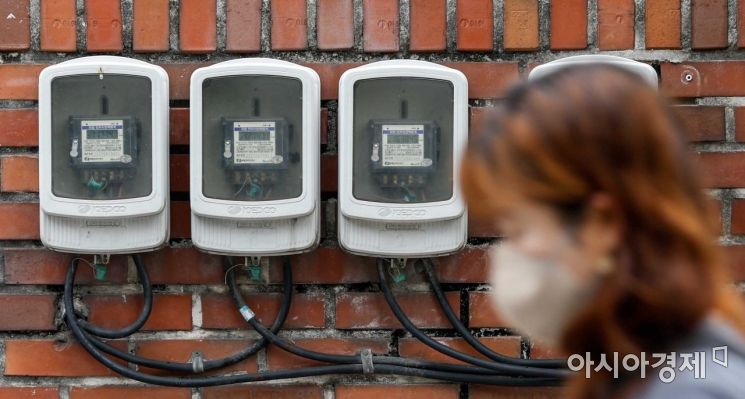
 An electricity meter is installed in a multi-family house in Seoul on the 27th, when the fuel cost adjustment unit price for electricity bills in the third quarter is scheduled to be announced. Photo by Jin-Hyung Kang aymsdream@
The government ministries are deeply deliberating over whether to raise electricity rates for the second quarter of this year, which is scheduled to be announced this month. The Presidential Office and the Ministry of Economy and Finance have hinted at slowing down the pace of the rate hike due to concerns about increasing the burden on low-income households, but the Prime Minister's Office and Korea Electric Power Corporation (KEPCO), which is responsible for power supply, maintain that a phased price adjustment in the second quarter is inevitable. Some voices warn that if the increase is not implemented in the second quarter, normalizing rates in the second half of the year will also be difficult, as public utility charges could become a political variable ahead of next year’s general elections.
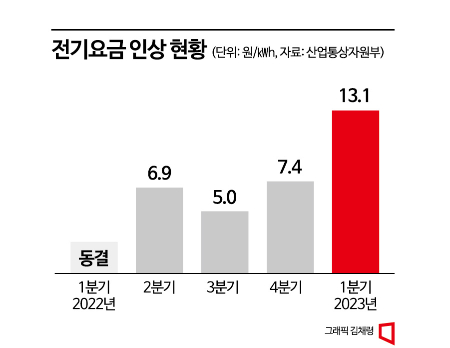
According to related ministries and the energy industry on the 15th, KEPCO will submit the "Fuel Cost Adjustment Unit Price Calculation Details" to the Ministry of Trade, Industry and Energy on the 16th. The calculation details are a kind of opinion letter in which KEPCO requests the Ministry of Trade, Industry and Energy to approve the amount of rate increase determined by referring to the average trade statistical prices of bituminous coal, liquefied natural gas (LNG), and bunker C oil over the past three months. KEPCO is expected to propose in this calculation that a rate increase of about 25 won per kilowatt-hour (kWh) is unavoidable. Previously, KEPCO requested a 25.0 won increase in the first quarter of this year, but the government ultimately raised the rate by 13.1 won per kWh.
The reason KEPCO hinted at a rate increase despite concerns about the burden on low-income households is that it judged it is difficult to continue bearing losses exceeding 30 trillion won last year. According to the Monthly Electricity Statistics Report, in January this year, KEPCO purchased electricity at 164.2 won per kWh and sold it at 147.0 won, incurring a deficit of 17.2 won per kWh. To secure operating funds, KEPCO has already issued corporate bonds totaling 6.98 trillion won by the 10th of this month, surpassing the issuance amount of 6.87 trillion won at the end of March last year. This means that without a rate increase, the deficit structure will inevitably continue this year as well. The Ministry of Trade, Industry and Energy has also stated that electricity rates need to be raised by 51.6 won per kWh this year to eliminate KEPCO’s record losses by 2026. Prime Minister Han Duck-soo is also supporting the Ministry’s rate increase plan. In a recent interview with the media, Prime Minister Han said, "We have not made a policy to freeze energy rates in the first half of the year," and added, "Energy rates will be adjusted to minimize the burden on the people, considering their difficulties."
After Heating Bill Shock, Cooling Bill Shock Expected This Summer
The problem is that an increase in public utility rates inevitably increases the burden on low-income households. This was confirmed by the heating bill shock caused by the gas rate hike this past winter. According to Statistics Korea, electricity, gas, and water charges in January surged 28.3% compared to the same month last year, the highest since related statistics began in 2010. KEPCO actually raised rates by 32.4 won per kWh four times from the second quarter of last year through the first quarter of this year. If electricity rates are further increased in the second quarter, there are concerns that the burden on low-income households could be repeated this summer in the form of a cooling bill shock.
President Yoon Suk-yeol also announced that public utility rates managed by the central government, such as roads, railways, and postal services, will be frozen in the first half of the year, and that the magnitude and pace of increases in energy rates such as electricity and gas will be controlled. This is to minimize factors directly linked to the burden on low-income households and to prevent these from becoming variables in national governance. Deputy Prime Minister Choo Kyung-ho also hinted earlier at the possibility of freezing energy rates in the first half of the year. On the 9th, Choo said to reporters, "Since there were significant concerns about heating bills recently, we need to deeply consider the burden on the people when deciding rates." This implies the need to keep open the possibility of slowing the pace of energy rate hikes in the first half, as such increases could lead to consumer price inflation.
Political dynamics are also a major variable. With the 22nd National Assembly elections next year, if the country enters election mode in the second half of this year, it is judged that raising public utility rates will become even more difficult. In fact, during the previous administration, LNG prices soared in the second half of 2021, but electricity rates were frozen until the 20th presidential election in March last year. The biggest concern is that the current government might repeat the "passing the buck" with populist policies of freezing public utility rates ahead of the elections. Professor Sung Tae-yoon of Yonsei University’s Department of Economics said, "Looking at the current situation of energy companies, a rate increase in the first half is unavoidable due to the difficulties they face," and added, "It is necessary to have self-help efforts commensurate with the rate increase to persuade the public."
© The Asia Business Daily(www.asiae.co.kr). All rights reserved.
![Clutching a Stolen Dior Bag, Saying "I Hate Being Poor but Real"... The Grotesque Con of a "Human Knockoff" [Slate]](https://cwcontent.asiae.co.kr/asiaresize/183/2026021902243444107_1771435474.jpg)
















