CSIS Discussion on Solutions for Forced Labor Issues
American experts have evaluated that the Yoon Suk-yeol administration's solution to the forced labor issue announced on the 6th has created an important turning point to actively discuss South Korea's participation in the Quad and to expand trilateral cooperation among South Korea, the United States, and Japan.
Yuki Tatsumi, co-director of the East Asia Program at the U.S. Stimson Center, said on the 9th (local time) during a discussion at the Center for Strategic and International Studies (CSIS) that the compensation solution for forced labor victims is "a truly important milestone from the U.S. perspective," adding, "The U.S. has never wanted to be caught in the middle between two equally important allies."
He continued, "The fact that South Korea and Japan have taken steps to resolve the forced labor issue is a great help from the U.S. standpoint in advancing the agenda of a free and open Indo-Pacific," and evaluated, "With the new South Korea-Japan relationship functioning, discussions can finally begin on ways for South Korea to become more involved in the Quad and to expand it further."
Tatsumi said, "Both the South Korean and Japanese governments need to jointly respond to the increasingly aggressive North Korea and China," adding, "Unless the South Korea-Japan relationship strengthens, the effectiveness of the U.S. response will inevitably decrease. From this perspective, Japan also wants to strengthen the relationship."
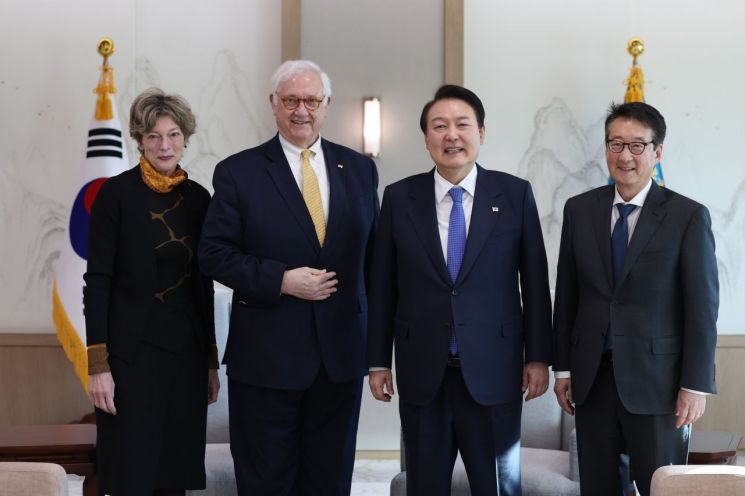 President Yoon Suk-yeol is meeting with John Hamre, Chairman of the Center for Strategic and International Studies (CSIS), at the Yongsan Presidential Office Building in Seoul on the morning of the 2nd. From left to right: Catherine Stevens, former U.S. Ambassador to Korea; John Hamre, Chairman; President Yoon Suk-yeol; Victor Cha, CSIS Korea Chair. [Photo by the Presidential Office]
Victor Cha, CSIS Korea Chair, also noted, "From a geopolitical perspective, it is interesting that U.S. President Joe Biden and Secretary of State Antony Blinken immediately expressed their welcoming stance right after the agreement was announced," emphasizing, "Although this is a domestic issue, the world surrounding South Korea and Japan is a battlefield including North Korea, China, and Russia. In this context, the negotiation is not an issue that ends in itself."
He asked, "Has Chinese President Xi Jinping ever made any remarks regarding the solution? Have Kim Jong-un or Vladimir Putin supported this negotiation?" and added, "This shows the geopolitical significance of the compensation solution."
He also mentioned, "Historically, China has wanted to isolate Japan by using colonial issues as leverage," and "They have regarded this issue as something to be given for free."
At the event, experts praised President Yoon Suk-yeol and the South Korean government for making a courageous decision and emphasized the need for a low-key approach to avoid political backlash for the concrete implementation of the solution in the future.
Victor Cha said, "No negotiation ever receives full public support," adding, "There is no perfect negotiation unless it happens in a vacuum, but it is important to move forward."
He evaluated, "President Yoon will visit Japan this month for the first time in years and will visit the U.S. next month on a state invitation. This is the second state invitation from the Biden administration, which is a very big deal," and added, "Moreover, many issues, including export controls, are making progress."
He referred to the 2015 comfort women agreement, saying, "At that time, Japan bore a heavy burden, but neither South Korea nor Japan was satisfied."
Sumi Terry, Asia Director at the Wilson Center, also said, "I applaud President Yoon for making a courageous decision despite domestic opposition," adding, "Although there is much criticism within South Korea, President Yoon is known to be quite stubborn, so I believe he will not back down."
She emphasized, "This is just the beginning, and both South Korea and Japan face threats from North Korea and the issue of China," adding, "We need to see the bigger picture, and in that sense, this is a positive development."
Tatsumi said, "This negotiation is very sophisticated and a typical Asian-style solution that requires reading between the lines," interpreting, "Japanese Prime Minister Fumio Kishida welcomed the agreement and referred to the 1998 'Kim Dae-jung-Obuchi Joint Declaration.' Through this, he signaled his intention to advance South Korea-Japan relations with President Yoon despite opposition."
He forecasted, "To resolve the previously strained issues and avoid media and public attention, a step-by-step solution by issue is necessary," adding, "In Japan, companies are expected to participate voluntarily by donating to a Korean foundation. Companies participating in the Japan Business Federation will be selected to ensure implementation."
© The Asia Business Daily(www.asiae.co.kr). All rights reserved.
![Clutching a Stolen Dior Bag, Saying "I Hate Being Poor but Real"... The Grotesque Con of a "Human Knockoff" [Slate]](https://cwcontent.asiae.co.kr/asiaresize/183/2026021902243444107_1771435474.jpg)















