Insufficient Guidance on Kiosk Usage in Restaurants, Cafes, and Animal Hospitals
Expert: "Operations Should Consider Consumer Convenience... Accessibility Must Be Improved"
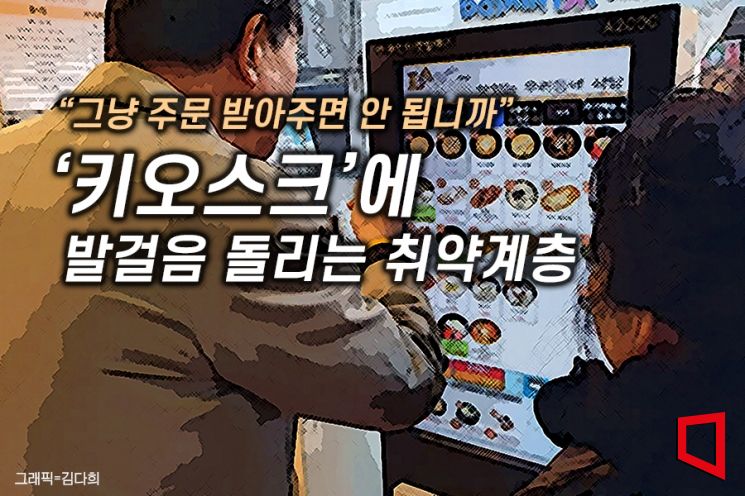
[Asia Economy Reporter Jang Sehee] "I don't know how to use the device, so can't you just take my order? There's no instruction on how to use it, so how exactly am I supposed to use it?"
On the 9th, Mr. Lee (67), who visited a gimbap restaurant in Songpa-gu, Seoul, said, "Kiosk ordering is difficult," and requested the staff to take his order face-to-face, but was told, "We are busy preparing food and cannot assist you." Mr. Lee left the store in frustration, and the waiting customers frowned.
As kiosks are gradually expanding in restaurants, cafes, convenience stores, and even animal hospitals after COVID-19, there is a growing call for social consideration for digitally vulnerable groups such as the elderly and people with disabilities.
An animal hospital in Seongbuk-gu, Seoul, decided to accept registrations through kiosks starting this month. Ms. Park Inja (70), who owns a Maltese dog, said, "I was instructed to register using the kiosk, but I couldn't see the letters well and didn't know how to use it at all, so I ended up not using it," adding, "I barely managed to ask for face-to-face registration."
Ms. Lee Insun (64), who lives in Chungnam and visited Seoul, also experienced inconvenience due to unfamiliarity with kiosk use. She said, "Even though the cafe staff were not busy, I was told to use the kiosk," and added, "Since many people crowded around the kiosk, I wished they would have taken some orders face-to-face."
46.6% Experienced Kiosk Inconvenience: "Difficult Operation and Device Errors"
According to Consumer 24, the government’s comprehensive consumer support system, 46.6% of users experienced inconvenience while using kiosks. Specific cases include order delays (52.8%), difficulty in operation (46.6%), and device errors (39.1%). Over 90% reported inconvenience in the food service industry, and others found kiosk use difficult in retail stores (30.4%) and parking lots (28.6%).
However, the 20s and 30s age groups showed positive responses toward kiosk use. Mr. Lee Jungwon (33), who works at a financial company in Seoul, said, "It's nice to see the menu items with pictures," and added, "It's comfortable because I don't have to talk to people more than necessary." Ms. Lee Bora (26) explained, "When several people go to a restaurant together, ordering via kiosk makes you less self-conscious," and "Using gifticons was convenient because the barcode was read immediately."
Experts pointed out that while kiosks are convenient, accessibility must also be improved. Currently, Consumer 24 recommends that kiosks provide usage instructions on the surface, use font sizes of at least 12mm, and offer alternative content, but these are not legally mandatory.
Professor Lee Eunhee of Inha University’s Department of Consumer Studies emphasized, "Digitally vulnerable groups such as the elderly who cannot adapt to digitalization may face significant inconvenience in daily life going forward," and added, "Businesses should operate kiosks considering consumer convenience, and it is necessary to consider making display guidelines mandatory."
© The Asia Business Daily(www.asiae.co.kr). All rights reserved.