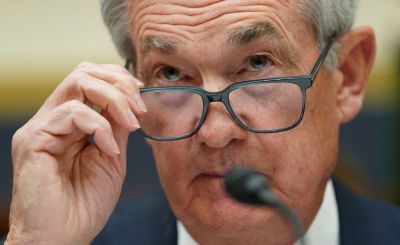
Will the era of a 6% benchmark interest rate finally become a reality? As Jerome Powell, Chairman of the U.S. Federal Reserve (Fed), delivered 'hawkish' (favoring monetary tightening) remarks for two consecutive days, strong employment data once again confirmed, raising concerns about tightening. On Wall Street, interest rate forecasts ranging from 6% to 7% are emerging, surpassing the 5.1% projected by the Fed's dot plot in December last year. It is expected that the February employment report and Consumer Price Index (CPI), released before the March Federal Open Market Committee (FOMC) meeting, will determine the future interest rate path.
◆ "It Could Go Higher" Powell’s Hawkish Remarks Again
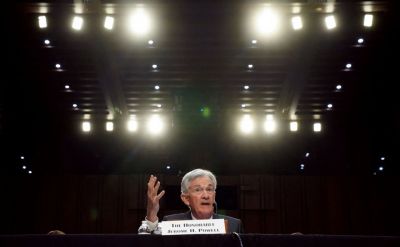
Chairman Powell attended a House Financial Services Committee hearing and stated that the rate hike size at the March FOMC has not yet been decided, but he repeated hawkish comments such as "the terminal rate could be higher" and "we are prepared to raise the pace of rate hikes." Appearing before Congress for the second consecutive day, he reaffirmed the Fed's commitment to tightening to reduce inflation, saying, "If the overall data direction indicates a need for faster tightening, we are prepared to raise the pace of rate hikes."
However, he also emphasized that the key to the pace of tightening depends on upcoming data. He explained, "There are important indicators such as the CPI before the March FOMC. There is no predetermined path, and it will depend on the data and forecasts we receive." When asked whether the terminal rate could exceed 5.5%, he replied, "Based on current data, it could go higher," but added, "We need to see the remaining indicators." Furthermore, when asked if rate hikes would stop if a recession occurs, he said, "There is no need to experience a recession for economic recovery," and described it as a serious question that cannot be answered with a simple 'yes' or 'no.'
Since March last year, the Fed has raised U.S. interest rates to the highest level since 2007, between 4.5% and 4.75%, through a tightening cycle and has signaled further hikes. Powell’s remarks were interpreted as opening the possibility of a big step (a 0.5 percentage point increase in the benchmark rate) at the March FOMC. The interest rate projections in the Fed’s dot plot are also expected to rise compared to previous forecasts. The Fed will release a new dot plot reflecting these tightening expectations on the 22nd, after the March FOMC regular meeting. The median year-end rate forecast in the previous December dot plot was 5.1%.
The employment data released that day also added weight to tightening expectations. This is the background behind Powell’s repeated concerns about inflation and labor market overheating during the House hearing. According to the ADP National Employment Report, U.S. private sector employment increased by 242,000 in February, exceeding the Dow Jones expert forecast of 205,000. Although the February wage growth rate slowed slightly to 7.2% year-over-year from 7.3% in January, it remains at a high level. On the same day, the U.S. Department of Labor released the January Job Openings and Labor Turnover Survey (JOLTS), showing 1,082 job openings in January, surpassing the market forecast of 1,058. The ratio of job openings per unemployed person remained steady at 1.9, compared to a pre-pandemic average of 1.2.
◆ Strengthened Big Step Outlook... Next Is the February Employment Report
With hawkish remarks continuing for two days and strong employment data added, the market’s expectation for a big step has intensified. According to the Chicago Mercantile Exchange (CME) FedWatch tool, the federal funds (FF) futures market currently reflects about a 78% chance that the Fed will raise rates by 0.5 percentage points at the March FOMC. This is a sharp increase from around 9% a month ago and 29% a week ago. It is even stronger than the 69% level seen the previous day when Powell’s Senate testimony heightened tightening concerns.
The year-end terminal rate forecast is also converging around 5.5% to 5.75%. Following Goldman Sachs’ upgrade the day before, Citigroup also raised its rate outlook. Projections for terminal rates in the 6% to 7% range are also emerging. Rick Rieder, Chief Investment Officer (CIO) at BlackRock, recently noted the resilience of the U.S. economy and predicted, "There is a possibility that the Fed will raise rates to 6% and maintain them for an extended period." William Lee, Chief Economist at the Milken Institute, pointed out, "Achieving 2% inflation requires economic slowdown, and for that, rates may need to rise to the 6.5% to 7% range." If the U.S. economy remains stronger than expected despite continued tightening, rates in the 6% to 7% range will become inevitable. Edward Moya, Senior Market Analyst at OANDA, also said, "The Fed will rely on data," and assessed, "At this point, one could argue that the Fed needs to raise rates to the 6% range."
The key now is the employment report to be released on the 10th. Wall Street currently expects nonfarm payrolls to increase by 225,000 in February, with the unemployment rate at 3.4%. If the employment report again significantly exceeds expectations as it did a month ago, the Fed will face increased pressure to accelerate tightening. Wall Street currently estimates February wage growth at 0.3%. Derek Tang, an economist at LH Meyer, predicted, "If wages rise by 0.4% to 0.5%, it will raise significant alarm." Next week, the February Consumer Price Index (CPI), Producer Price Index (PPI), and retail sales data will also be released. These will be major variables influencing the Fed’s rate decisions. Michael Gapen, U.S. Chief Economist at Bank of America (BoA), warned, "The stronger the data, the greater the risk acceleration."
Some critics argue that the Fed’s recent decision to slow the pace of hikes just a month ago was premature. Mohamed El-Erian, Chief Economic Advisor at Allianz, pointed out that the Fed should have raised rates by 0.50 percentage points instead of lowering the increase to a baby step (0.25 percentage points) at the last meeting. Ken Griffin, CEO of hedge fund Citadel, also criticized in an interview with Bloomberg the previous day, saying, "The messaging inconsistencies over the past few weeks have caused unbelievable counterproductive effects." Despite ongoing tightening concerns, the New York stock market closed mixed and flat, awaiting upcoming data releases.
© The Asia Business Daily(www.asiae.co.kr). All rights reserved.
![Clutching a Stolen Dior Bag, Saying "I Hate Being Poor but Real"... The Grotesque Con of a "Human Knockoff" [Slate]](https://cwcontent.asiae.co.kr/asiaresize/183/2026021902243444107_1771435474.jpg)
















