Party Leadership Misjudgment... Rebellious Lawmakers Concealing True Intentions
Concerns and Desires Surrounding Nominations... Sparks of Conflict in the Opposition
Early Confirmation of Nomination Rules Four Years Ago Calmed the Conflict
The notable point in the result of the arrest motion against Lee Jae-myung, leader of the Democratic Party of Korea, is not the 138 votes against the motion, but the fact that the party leadership failed to read the internal party sentiment until a day before the vote. It was expected that the number of votes against the motion would be around 170, more than the 161 votes against the arrest motion for Democratic Party lawmaker Roh Woong-rae, but the reality was completely different.
It is analyzed that there was a defection of at least 30 votes within the Democratic Party. Although there was the variable of a secret ballot, there were more Democratic Party lawmakers hiding their true intentions than expected. The so-called anti-Lee Jae-myung faction is being pointed out as the target of the rebellious votes, but looking deeper, the situation could be more complex.
The vote on the arrest motion against the Democratic Party leader was not just a decision on the arrest of a single lawmaker. For the first time in history, the prosecution took steps toward detaining the opposition party leader, and the National Assembly responded accordingly. However, a large number of opposition lawmakers cast dissenting votes against the leadership’s wishes. Although the plenary session vote narrowly resulted in rejection, it means that a significant number of opposition lawmakers agreed with the prosecution’s claim that Lee should be detained.
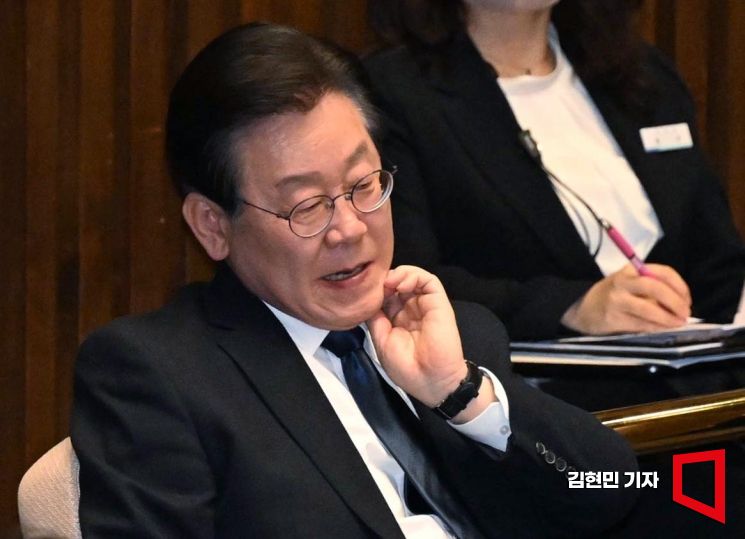 Lee Jae-myung, leader of the Democratic Party of Korea, is observing the vote counting process of the arrest consent bill concerning himself at the 8th plenary session of the 403rd National Assembly (extraordinary session) held at the National Assembly in Yeouido, Seoul on the 27th. Photo by Kim Hyun-min kimhyun81@
The politicians who joined the rebellious votes made decisions that risked their political careers. This is an issue that could lead to tremendous political aftershocks. It is rare in Korean political history to see so many lawmakers supporting the claim that the party leader should be detained.
So why did this happen?
Goh Min-jung, a Supreme Council member of the Democratic Party, appeared on MBC Radio’s ‘Shin Jang-sik’s News High Kick’ on February 27 and said, "We tried to persuade many people about the direction the leadership wanted to take, but it seems it was insufficient," and analyzed, "Statements like ‘It will obviously be rejected’ might have triggered a psychology of ‘Isn’t that overconfidence?’"
This suggests that the misjudgment of Lee and the leadership was the background. Before the vote, Lee separately contacted anti-Lee lawmakers. Perhaps thanks to those efforts, the Democratic Party effectively reached a consensus to reject the motion at the lawmakers’ general meeting. Although the party did not choose a party-line vote, the dominant opinion was that the arrest motion would be rejected. This is why it was predicted that about 170 lawmakers would participate in the rejection.
However, a different situation unfolded behind the scenes. Some lawmakers who reassured Lee made the exact opposite decision. Since it was a secret ballot, it is difficult to say who did so, but the fact that more than 30 lawmakers made that choice suggests it cannot be seen solely as individual decisions. It is said that there was an organized movement to send a warning to the Lee Jae-myung leadership for political reasons.
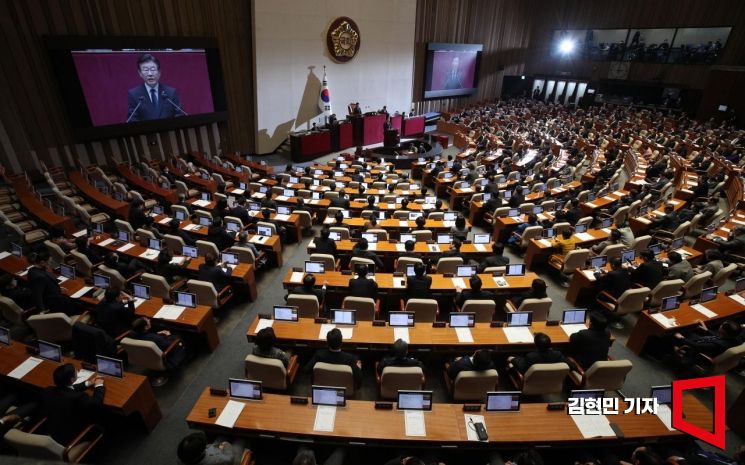 Lee Jae-myung, leader of the Democratic Party of Korea, is making a personal statement regarding the submission of a motion for his arrest at the plenary session held at the National Assembly in Yeouido, Seoul on the 27th. Photo by Hyunmin Kim kimhyun81@
Democratic Party’s Rebellious Votes Not a Coincidence? "Small Groups Coordinated"
Lee Sang-min, a Democratic Party lawmaker, said in an interview with CBS Radio’s ‘Kim Hyun-jung’s News Show’ on February 28, "It’s not just a coincidence that the numbers added up; some degree of coordination in small groups of three to five people must have taken place," and added, "I don’t think it was just individual thoughts that coincidentally summed up."
The anti-Lee faction may have made such choices for factional interests. It is also noteworthy that the ruling party described this vote as a "political death sentence," delivering a direct blow to Lee. Lee’s leadership has suffered a deep wound.
It can also be interpreted that Lee conveyed his intention not to lead the party into next year’s general election. This implies that the general election could be contested under a new leader or an emergency committee system. Lee met with Democratic Party lawmakers one by one and had various conversations, but this means that there are quite a few lawmakers harboring doubts about next year’s general election.
Ultimately, the essence of the rebellious votes boils down to fear surrounding next year’s general election. Looking at the Democratic Party’s past preparations for general elections, except for the 2020 election, there has never been a general election without nomination conflicts.
Even in the 21st general election in 2020, there were controversies over nominations, but compared to previous elections, it was almost negligible.
In other elections, conflicts over so-called nomination purges intensified to the point of practically causing party splits. Eventually, conflicts were eased by dividing nominations among factions, but the embers of controversy remained as the election was held.
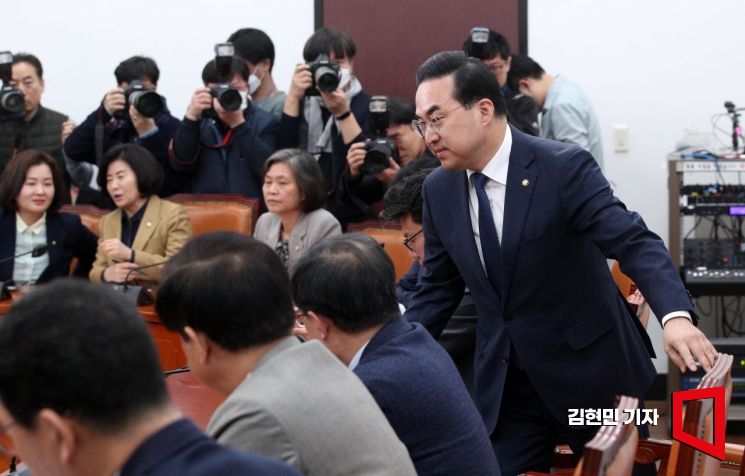 Park Hong-geun, floor leader of the Democratic Party of Korea, is attending the floor strategy meeting held at the National Assembly in Yeouido, Seoul on the 28th. Photo by Hyunmin Kim kimhyun81@
Four Years Ago, Democratic Party Finalized Nomination Rules One Year Before General Election
Four years ago, ahead of the 21st general election, the Democratic Party chose a clever strategy. In May 2019, one year before the general election, they unveiled the blueprint for the ‘general election nomination rules.’ This was a move to settle the election rules early to ease the anxiety of incumbent lawmakers and minimize unnecessary conflicts.
At that time, the nomination rules included provisions not to exclude incumbent lawmakers from nominations and to give them a chance to compete in primaries. This was to prevent the leadership from removing opposition factions during the nomination process according to their preferences. However, through party audits, if an incumbent lawmaker was ranked in the bottom 20%, their penalty points could be increased up to 20%.
Political newcomers were given bonus points ranging from 10% to 20%. Women, youth, and disabled candidates could receive up to 25% additional points. Furthermore, the standards for moral verification were strengthened.
The rule for primaries that lawmakers were most interested in was to decide based on 50% party members’ votes and 50% safe number public opinion polls.
With the basic framework of nominations established early, nomination conflicts were significantly reduced. The Democratic Party’s securing of 180 seats, including favorable proportional seats, in the 21st general election was partly due to minimizing nomination risks. Controversies over nomination rules remain a matter of interest this year as well. The general election is now less than one year and two months away.
The Democratic Party has exposed a level of conflict that cannot be easily covered up. What solution will the Democratic Party leadership present? It is a point of attention whether, like four years ago, they will choose to finalize the general election nomination rules early again to change the political landscape.
© The Asia Business Daily(www.asiae.co.kr). All rights reserved.
![Clutching a Stolen Dior Bag, Saying "I Hate Being Poor but Real"... The Grotesque Con of a "Human Knockoff" [Slate]](https://cwcontent.asiae.co.kr/asiaresize/183/2026021902243444107_1771435474.jpg)

















