IIF "Debt of 30 Developing Countries Reached $9.8 Trillion at End of Last Year"
Direct Hit from Strong Dollar
[Asia Economy Reporter Kwon Haeyoung] Debt in developing countries has reached a record high of nearly $100 trillion (approximately 12,970 trillion KRW). Government spending has increased since the COVID-19 pandemic, and with the "King Dollar" (strong dollar) causing currency values to fall, repayment costs have ballooned like a snowball. Inflation triggered by the Ukraine war, interest rate hikes, and the strong dollar have raised concerns that many emerging countries could face sovereign default risks. Meanwhile, debt in advanced countries has decreased, deepening the "rich get richer, poor get poorer" gap between nations.
According to the Institute of International Finance (IIF) on the 22nd (local time), the combined debt of government, household, corporate, and financial sectors in 30 middle- and low-income countries reached $98 trillion (approximately 12,710 trillion KRW) at the end of 2022. This is an increase from $96 trillion (approximately 12,450 trillion KRW) at the end of 2021 and a significant expansion compared to $75 trillion (approximately 9,720 trillion KRW) at the end of 2019, just before the COVID-19 outbreak.
The share of government debt in developing countries reached a record high of 65% of global gross domestic product (GDP). This is due to governments significantly increasing COVID-19-related spending, rising by 10 percentage points compared to before the pandemic.
In particular, last year, the U.S. Federal Reserve's (Fed) aggressive tightening caused the dollar's value to surge, increasing the debt burden on developing countries. Since a large portion of developing countries' debt is denominated in dollars, repayment costs have sharply increased. Interest rate hikes have also contributed to the rising repayment burden.
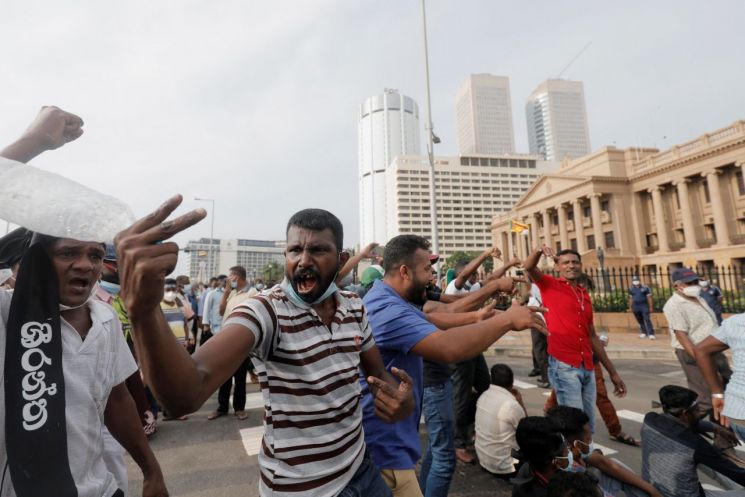
As a result, a domino effect of sovereign default crises is becoming a reality. Sri Lanka and Ghana have already declared defaults on their external debts. This is due to debt repayment ratios relative to government revenues soaring to exceptionally high levels. In fact, Pakistan and Egypt, two developing countries included in the IIF's debt survey, are also facing default risks. These countries have altered their exchange rate regimes to receive bailout funds from the International Monetary Fund (IMF) and have rapidly depreciated their currencies against the dollar since the beginning of this year.
According to the IMF, 60% of the poorest countries are already in debt crises, double the 30% level in 2015. Emre Tiftik, an economist at the IIF, explained, "Many developing countries relied mainly on dollar-denominated bonds to attract global investors," adding, "These countries now face additional borrowing costs as the dollar strengthens."
What is more concerning is that the King Dollar phenomenon may intensify this year. If the Fed delays the pause in raising its benchmark interest rate beyond initial expectations, the dollar value, which had declined since last fall, could rebound. This would further increase borrowing costs and debt levels for developing countries, potentially leading to a chain of sovereign defaults. Ed Parker, Head of Research at global credit rating agency Fitch, predicted, "With the dollar maintaining strength by historical standards, 2023 could be another challenging year," and "Debt and deficit levels in developing countries are expected to remain much higher than before COVID-19."
Accordingly, debt restructuring for developing countries is expected to be a key topic at the upcoming G20 Finance Ministers and Central Bank Governors meeting scheduled to be held in India on the 24th.
On the other hand, the total debt of advanced countries was about $201 trillion (approximately 26,700 trillion KRW), down $6 trillion (approximately 7,700 trillion KRW) from the previous year, according to the IIF survey. This contrasts with the $2 trillion increase in developing countries' debt. As a result, the global total debt decreased from $303 trillion (approximately 39,300 trillion KRW) at the end of 2021 to below $300 trillion (approximately 38,910 trillion KRW) at the end of last year.
© The Asia Business Daily(www.asiae.co.kr). All rights reserved.
![Clutching a Stolen Dior Bag, Saying "I Hate Being Poor but Real"... The Grotesque Con of a "Human Knockoff" [Slate]](https://cwcontent.asiae.co.kr/asiaresize/183/2026021902243444107_1771435474.jpg)















