[Asia Economy New York=Special Correspondent Joselgina] The U.S. New York stock market started trading lower on the 21st (local time), amid concerns over the prolonged tightening by the Federal Reserve (Fed) and corporate earnings.
As of 10:11 a.m. at the New York Stock Exchange (NYSE), the Dow Jones Industrial Average was down 467.64 points (1.38%) from the previous close, trading at 33,359.05. The S&P 500, centered on large-cap stocks, was down 51.01 points (1.25%) at 4,028.08, and the tech-heavy Nasdaq was down 181.54 points (1.54%) at 11,605.74. The market was closed on the 20th for Presidents' Day.
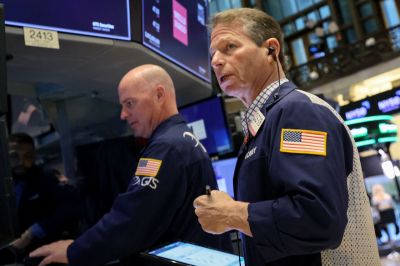
Investors are closely watching the Fed's tightening concerns ahead of the release of the February Federal Open Market Committee (FOMC) minutes the next day. Concerns that the Fed will maintain high interest rates for a longer period intensified, putting pressure on both the stock market and bond prices. In the New York bond market, the 10-year U.S. Treasury yield rose to around 3.9%. The 2-year yield, sensitive to monetary policy, also jumped to the 4.7% range. Bond prices and yields move inversely.
According to the CME FedWatch tool, the federal funds (FF) rate futures market is currently betting on the possibility that the Fed will raise rates by more than 0.75 percentage points by July. Just last month, it was expected that the tightening cycle would end after two baby steps (0.25 percentage point rate hikes), but the possibility of additional tightening has gained traction.
This week, the January Personal Consumption Expenditures (PCE), the Fed's preferred inflation gauge, will also be released. Additionally, speeches by Fed officials including John Williams, President of the New York Fed and the Fed's third-ranking official; Raphael Bostic, President of the Atlanta Fed; Philip Jefferson, Fed Governor; and James Bullard, President of the St. Louis Fed, are scheduled, making their inflation and economic outlooks worth monitoring. Manufacturing and services Purchasing Managers' Indexes (PMI), housing indicators, and the revised GDP growth rate for Q4 of last year, which provide insight into economic conditions, will also be disclosed.
Mike Wilson, U.S. equity strategist at Morgan Stanley, appeared on CNBC's Squawk Box and said, "There will be at least two or three more rate hikes by June," adding that the combination of strong inflation and the labor market is negative for the stock market. John Stoltzfus, Chief Investment Strategist at Oppenheimer, said, "Investors have a lot to consider this week," noting that economic indicators will provide hints about the health of the U.S. economy.
Guidance from retail companies also contributed to the day's decline. Walmart and Home Depot, which released earnings before the market opened, attracted investor attention as indicators of U.S. consumer outlook.
Walmart's adjusted earnings per share (EPS) for Q4 last year was $1.71, exceeding the market consensus of $1.51. Revenue also surpassed Wall Street consensus at $164.05 billion versus $159.72 billion. However, Walmart showed caution regarding its outlook for this year. Considering that grocery prices and others continue to rise, it anticipates a potential decline in consumer discretionary spending. John David Rainey, Walmart's Chief Financial Officer (CFO), said, "Consumers are still under pressure," adding, "Balance sheets are shrinking and savings rates are falling according to economic data. This is why we are taking a very cautious outlook this year."
Home Depot also forecasted almost no revenue growth for fiscal year 2023. Due to soaring inflation and a housing market downturn, Home Depot missed Wall Street's quarterly revenue estimates for the first time since November 2019. Home Depot's Q4 revenue was $35.83 billion, below the Wall Street consensus of $35.97 billion. Earnings reports from eBay, Nvidia, Papa John's, Beyond Meat, and Warner Bros. Discovery are also scheduled this week.
Currently, within the S&P 500, all 10 sectors except energy are showing declines. Consumer discretionary, technology, financials, and real estate sectors are experiencing notable drops. Among individual stocks, Home Depot's shares are down more than 5% from the previous close. HSBC Holdings rose more than 5% on earnings that beat market expectations. AutoNation fell nearly 5% after JPMorgan downgraded its investment rating due to reduced weighting. Major tech stocks such as Tesla, Amazon, Apple, and Microsoft are also down around 1-2%.
Geopolitical concerns have also intensified as U.S. President Joe Biden made an unannounced visit to Ukraine, and before the market opened, Russian President Vladimir Putin declared the suspension of the U.S.-Russia nuclear arms control agreement 'New START.' Ahead of the one-year anniversary of the war, President Biden, who visited Kyiv and Poland, reaffirmed NATO's support for Ukraine, stating, "The North Atlantic Treaty Organization (NATO) is stronger than ever." Meanwhile, President Putin, in a two-hour state address, blamed the West and Ukraine for the war. During the address, shelling in southern Ukraine's Kherson caused casualties.
European stock markets are also showing slight declines. The European DAX index fell 0.24%, the UK FTSE index dropped 0.29%, and the French CAC index declined 0.19%.
© The Asia Business Daily(www.asiae.co.kr). All rights reserved.
![Clutching a Stolen Dior Bag, Saying "I Hate Being Poor but Real"... The Grotesque Con of a "Human Knockoff" [Slate]](https://cwcontent.asiae.co.kr/asiaresize/183/2026021902243444107_1771435474.jpg)















